
How to Measure for Bike Frame Size
Picking the wrong How to measure for bike size frame can turn your ride into a nightmare. Imagine pedaling uphill with numb hands, knee pain shooting through your legs, or feeling like you’re perched on a too-small stool—uncomfortable, inefficient, and risky. On BikesLover.com, we’ve helped thousands of riders worldwide—from bustling streets in Islamabad to winding European trails—find their perfect fit.
This 2026 guide breaks it all down: why frame size matters, how to measure your body and the bike itself, bike-type charts, test-ride red flags, and pro tips for special cases like tall riders or kids. Whether you’re eyeing a mountain bike (MTB) in Pakistan, a road racer in the UK, or an e-bike in Australia, we’ll cover global differences, tools you need at home, and exact symptoms of a bad fit. No fluff—just actionable steps to confidently choose a frame that boosts comfort, speed, and safety. By the end, you’ll master “how to measure bike frame size” like a pro. Let’s pedal in.
Why Bike Frame Size Matters More Than You Think
Your bike’s frame is its skeleton—everything from handling to endurance hinges on it. A mismatched size doesn’t just feel off; it leads to real problems.
Comfort and Daily Riding Bliss
The right frame aligns your body naturally. Too big? You stretch like a giraffe, straining shoulders and back. Too small? Knees cram up, causing fatigue on commutes. Riders in Europe, where long tours are common, swear by proper sizing for pain-free 100km days.
Injury Prevention: The Hidden Risk
Vague guides mention “discomfort,” but specifics matter. Wrong size triggers:
- Numb hands/wrists from poor reach.
- Knee pain from incorrect saddle height.
- Lower back aches from bad posture.
Studies from cycling bodies like the British Cycling Federation show 40% of injuries stem from fit issues. In Asia’s humid climates (think Pakistan summers), sweat amplifies these pains.
Performance and Handling Boost
Efficient frames optimize power transfer. Road bikes need aero reach; MTBs demand standover clearance for drops. Get it right, and you’ll corner sharper, climb faster—key for dirt bikes in Australia’s outback or urban scooters in India.
Resale and Long-Term Value
A well-fitted bike lasts. Poor fits lead to quick sales at a loss. Global brands like Trek or Giant adjust sizes by region (e.g., shorter reaches for Japanese riders).
Bottom line: Frame size affects 80% of your ride. Skip it, and no fancy gears save you.
Measure Your Body First – The Foundation of Bike Sizing
Before eyeing bikes, know your metrics. This separates rider fit from frame geometry— a top gap in most guides.
Tools You’ll Need (All At-Home Friendly)
- Flexible tape measure (or string + ruler).
- Thick book or yardstick.
- Wall and hard floor.
- Mirror or friend for accuracy.
No gym required—perfect for “how to measure bike frame size at home.”
How to Measure Inseam (The Magic Number)
Inseam rules How to measure for bike size, frame sizing, especially for standover.
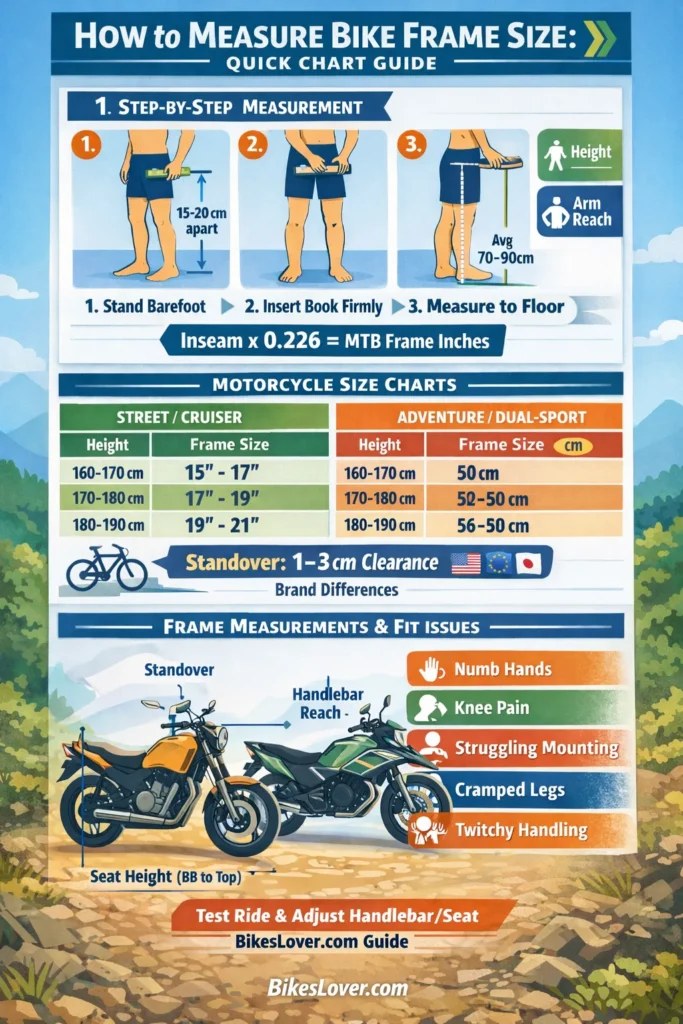
- Stand barefoot on flat floor, feet 15-20cm apart (like shoulder-width).
- Wedge book firmly between legs against crotch (mimics saddle pressure).
- Hold book level; measure floor to top edge.
- Repeat 3x, average for precision.
Pro Tip: Women or shorter riders add 1-2cm for pelvic differences. Expect 70-90cm for adults.
Height and Arm Measurements
- Height: Wall against back, no shoes—head level.
- Arm length: Shoulder to wrist, arm straight.
Use both with inseam for charts.
Global Note: Inseam varies culturally—South Asians average shorter (75-82cm) vs. Europeans (80-90cm).
| Body Measurement | Why It Matters | Average Adult Range (Men/Women) |
| Inseam | Standover, saddle height | 76-89cm / 70-84cm |
| Height | Overall frame scale | 165-185cm / 155-175cm |
| Arm Reach | Handlebar fit | 70-80cm / 65-75cm |
Decode How Bike Frames Are Actually Measured
Manufacturers measure differently—don’t get fooled.
Traditional Method: Seat Tube (MTB, Hybrids, Cruisers)
- From bottom bracket center to seat tube top.
- Inches common (e.g., 17″ for medium).
Popular in Pakistan/India for affordable MTBs like Hero or Bajaj.
Modern Method: Stack & Reach
- Stack: Bottom bracket to head tube top (height feel).
- Reach: Head tube center to seat tube center (forward stretch).
Enduro bikes from Europe (e.g., Santa Cruz) prioritize this for aggressive geometry.
Virtual Measurements for Sloping Tubes
Many frames slope—use “effective” top tube (horizontal head tube to seat junction).
Example: A 54cm road frame might have 52cm stack / 38cm reach.
| Measurement Type | Bike Types | Pros | Cons |
| Seat Tube | MTB, Hybrid | Simple for beginners | Ignores modern slopes |
| Stack/Reach | Road, E-Bike | Precise posture fit | Needs geometry charts |
| Top Tube | All | Quick home check | Varies by brand |
Regional Twist: Chinese e-bikes (e.g., Super73) list stack/reach; Japanese roadies (Shimano) stick to cm.
Master Bike Frame Size Charts by Type
Charts aren’t one-size-fits-all—adapt for bike type.
MTB/Hybrid Size Chart (Height + Inseam)
Mountain bikes need standover clearance for trails.
| Height (cm) | Height (ft’in”) | Inseam (cm) | Frame Size (inches) | Example Brands |
| 150-160 | 4’11”-5’3″ | 68-74 | 13-15″ | Giant, Trek (XS/S) |
| 160-170 | 5’3″-5’7″ | 74-80 | 15-17″ | Specialized (S/M) |
| 170-180 | 5’7″-5’11” | 80-86 | 17-19″ | Canyon (M/L) |
| 180-190 | 5’11”-6’3″ | 86-92 | 19-21″ | Scott (L/XL) |
| 190+ | 6’3″+ | 92+ | 21-23″+ | Custom (XXL) |
Road/Gravel Size Chart
Longer reach for speed—e.g., UK tours.
| Height (cm) | Frame Size (cm) | Stack/Reach Example |
| 155-165 | 48-50 | 50/36 cm |
| 165-175 | 50-52 | 52/37 cm |
| 175-185 | 52-54 | 54/38 cm |
| 185+ | 56+ | 56/39+ cm |
Brand Variations: Trek runs small; Specialized large. Always cross-check.
Bigger vs Smaller Frame – Make the Smart Choice
Between sizes? Here’s the debate.
Go Smaller: Agile and Forgiving
- Best For: Beginners, city riders, comfort seekers.
- Upright posture reduces strain.
- Easier standover—safer for Pakistan’s potholes.
- Example: Choose 17″ over 18″ if inseam borderline.
Go Larger: Stable and Aero
- Best For: Racers, tall riders, touring.
- Stretch position boosts efficiency on European flats.
- But risks overreach—test first.
Rule: Prioritize standover (1-3cm crotch clearance). Comfort > speed for 90% of riders.
| Factor | Smaller Frame Pros/Cons | Larger Frame Pros/Cons |
| Handling | Agile, quick turns | Stable at speed |
| Comfort | Upright, less strain | Stretched, aero |
| Adjustability | Stem/saddle tweaks easy | Risk of pain if off |
| Resale | Appeals to more buyers | Niche for tall riders |
Test-Ride Like a Pro – Spot Fit Issues Early
Charts lie—rides reveal truth.
10 Red Flags of Wrong Size
- Too Big: Toes barely touch ground over top tube.
- Numb hands after 10 mins (reach issue).
- Knee pain at full pedal extension.
- Back hunch or shoulder rock.
- Twitchy steering in corners.
- Too Small: Cramped legs, “on top” of bars feel.
- Heel drag on frame.
- Unstable at 30km/h+.
- Saddle sores from rocking.
- Wrist buzz on rough roads.
Quick Adjustments Before Blaming Frame
- Raise/lower saddle (inseam + 0.88 x crank length).
- Swap stem (shorter for cramped reach).
- Angle bars for neutral wrists.
Test Protocol: 20-min ride—hills, sprints, stops. Global hack: UAE riders test in heat for sweat fit.
Special Cases – Tailor Sizing for Everyone
Kids and Teens: Inseam Over Age
- Frames from 12″ up.
- Brands like Woom (Europe) or Firefox (India) scale precisely.
Chart starts at 130cm height = 13″.
Women and Petite Riders
Shorter torsos need compact geometry—e.g., Liv (Giant’s women’s line) with 2cm shorter reach.
Tall Riders (Over 190cm)
XL+ or custom. Australian brands like Avanti offer 23″+. Check reach >39cm.
E-Bikes and Heavy Riders
Battery weight shifts balance—add 1cm reach. Chinese models like Xiaomi prioritize stack.
| Rider Type | Key Adjustment | Recommended Brands (Global) |
| Kids | Inseam primary | Woom (EU), Decathlon (Asia) |
| Women | Shorter reach | Liv, Rose (Germany) |
| Tall | Long top tube | Specialized, Cervelo |
| E-Bike | Higher stack | Specialized Turbo, Haibike |
How to Measure Bike Frame Size at Home
Own a bike? Verify it.
- Flip bike upside down or use stand.
- Seat Tube: Tape from bottom bracket center to seat top (vertical).
- Top Tube: Horizontal head tube center to seat tube center.
- Stack/Reach: Use online tools or app (e.g., BikeInsights)—measure BB to HT top, HT center to ST center.
- Convert: 1″ = 2.54cm.
Tools Table:
| Tool | Use Case | Cost (Global Avg) |
| Tape Measure | All measurements | $5-10 |
| Plumb Bob | Vertical accuracy | $3 |
| App (GeoSetter) | Digital stack/reach | Free |
Pros and Cons of Getting Frame Sizing Right
Pros
- Zero pain on long rides—enjoy Pakistan hills or UK lanes.
- Better power: 10-20% efficiency gain.
- Injury-proof: Saves doctor visits.
- Resale boost: Fitted bikes sell 30% faster.
- Confidence: Ride any terrain fearlessly.
Cons
- Chronic aches sideline you.
- Wasted money on returns.
- Poor handling risks crashes.
- Generic advice fails diverse bodies.
FAQs
A: Measure inseam/height, match charts, test-ride. Use 0.226 x inseam for MTB inches.
A: smaller for beginners (agile); larger for speed freaks. Limit: 2cm max.
A: No standover clearance, stretched arms, numb hands, tippy handling.
A: Online tools like Competitive Cyclist; formula: Frame (cm) = Inseam (cm) x 0.665.
A: Road emphasizes reach/stack; MTB inseam/standover.
Final Expert
Mastering how to measure bike frame size can completely transform your riding experience. It starts with accurately measuring your inseam and matching it to a proper bike sizing chart. This simple step helps you avoid common issues like knee strain, back pain, and poor control on the bike. Many riders rely on vague estimates, but using precise measurements ensures a fit that supports comfort and performance from the very first ride.
Once you have your basic numbers, compare them with frame geometry charts and test different setups if possible. Small adjustments in saddle height and reach can make a huge difference in comfort. Whether you’re riding dirt trails in Australia or commuting through busy European streets, the right frame size gives you stability, efficiency, and confidence. Take the time to measure correctly now, and your body will reward you with smoother, pain-free rides for years.
