
How to Measure a Bike
Ever hopped on How do you measure a bike that felt like a torture device? Too small, and you’re hunched like a pretzel; too big, and you’re stretching for the handlebars, risking a wipeout. Proper bike measurement isn’t just nerdy geometry—it’s the difference between joyful rides and nagging injuries. Whether you’re sizing up a sleek road racer from Italy, a rugged MTB from the USA, or an electric commuter from China, getting the fit right boosts comfort, efficiency, and safety.
In this comprehensive 2026 guide on how to measure a bike, we’ll dive deeper than surface-level advice. You’ll get precise steps for frame size, saddle height, handlebar reach, wheel sizing, and bike geometry, like stack and reach. Expect printable charts, bike-type breakdowns (road vs. MTB vs. e-bikes), global variations, pro tips, and pitfalls to dodge. Tailored for riders worldwide—from Pakistan’s bustling streets to Australia’s outback trails—we’ll help beginners and pros alike. By the end, you’ll confidently match your height and style to the ideal bike. Let’s pedal into the details.
Why Accurate Bike Measurement Matters More Than Ever
Bike fit has evolved. Modern rigs from brands like Trek (USA), Giant (Taiwan), and Hero (India) pack advanced geometry for performance. A mismatched bike slashes power transfer by 20%, spikes injury risk, and kills fun. Per cycling studies from the UK’s BikeRadar and EU safety reports, poor sizing causes 30% of novice crashes.
Global riders face unique tweaks: taller Scandinavians favor long-reach tourers, while compact Asian frames suit urban scooters. Electric bikes add battery weight and shifting balance. Measuring yourself ensures standover clearance, knee alignment, and ergonomic bliss—extending rides from 10km to marathons.
Essential Tools for Measuring Your Bike
Before diving in, grab these budget-friendly essentials. No fancy lab needed.
- Flexible tailor’s tape measure (or string + ruler): Curves around tubes perfectly; rigid rulers flop on frames.
- Plumb line or level app: Ensures vertical accuracy for saddle and reach.
- Helper: Spotting from afar prevents wobbles.
- Bike stand (optional): Lifts for easy access; $20 on Amazon.
- Digital caliper: Precision for tires/wheels on high-end models.
- Notepad or app (like BikeInsights): Logs metrics.
Pro tip: Measure in riding gear—jersey, shorts, shoes—for realism. Works for all bikes: dirt rockets from Japan to cruisers from the USA.
Step-by-Step Guide: How to Measure Bike Frame Size
Frame size sets the foundation. It’s the seat tube length, dictating standover and fit. Misjudge it, and you’re cramping or dangling.
1. Position the Bike Upright
Lean against a wall or use a stand. Ensure wheels touch flat ground, no sag.
2. Locate Key Points
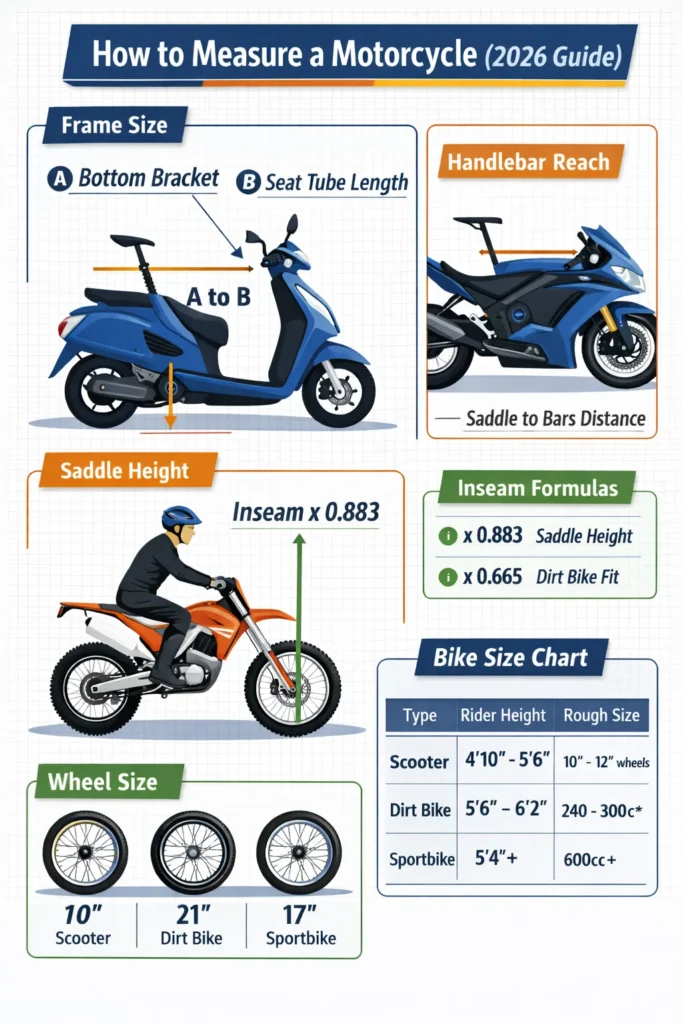
Find the bottom bracket (BB)—where crank arms meet. The center of the axle is point A. The top of the seat tube (where the saddle clamps) is point B. Ignore the seat post extension.
3. Measure Center-to-Top (C-T) for Road/Hybrid
From BB center to seat tube top: typical adult range 48-62cm. Road bikes use C-T; multiply inseam (crotch-to-floor) by 0.665 for a ballpark.
4. Measure Center-to-Center (C-C) for MTB
BB center to where the top tube intersects the seat tube. Accounts for sloping tops; expect 15-22 inches.
5. Check Standover Height
Straddle frame; aim 1-3cm clearance (less for aggressive MTBs). Women/kids: prioritize this over frame size.
Test it: Ride 5km post-adjust. Hurts? Resize.
| Bike Type | Rider Height | Frame Size (cm, C-T) | Frame Size (inches, C-C) | Inseam Multiplier |
| Road | 5’4″-5’7″ | 50-52 | 19-20″ | x0.665 |
| MTB | 5’8″-6’0″ | – | 17-19″ | x0.226 |
| Hybrid | 6’1″+ | 56-58 | 21-23″ | x0.665 |
| Kids | 4’0″-4’6″ | 26-30 | 10-12″ | x0.19 |
This bike size chart covers global standards—adjust for brands like Bajaj (India) or Yamaha (Japan).
Mastering Saddle Height and Fore-Aft Position
Saddle woes cause 40% of knee pain, per REI data. Get it right for power and health.
Step-by-Step Saddle Height Measurement
- Sit on the bike, heels on the pedals at 6 o’clock.
- Measure from pedal spindle center to saddle top surface (along tube).
- Target: 0.883 x inseam (LeMond method). Or 88-105% for versatility.
Fore-aft: Dangle plumb line from kneecap over pedal axle (at 3 o’clock). The ball of the foot should align; tweak 1-2cm.
Regional note: Hot climates (UAE/Pakistan) favor higher saddles for airflow.
| Method | Formula | Best For | Example (Inseam 80cm) |
| LeMond | Inseam x 0.883 | Road racing | 70.6cm |
| Heel-to-Pedal | Heels touch at bottom | Beginners | 75-78cm |
| 109% Inseam | Inseam x 1.09 | MTB comfort | 87.2cm |
Adjust in 2cm increments, spin 10km, refine.
Handlebar Reach, Drop, and Width: Precision Setup
Reach dictates posture—too long strains neck; too short hunches shoulders.
Measuring Reach on Drop Bars (Road/Gravel)
- From saddle nose to handlebar center (hoods).
- Ideal: 36-42cm for adults. Match your ape index (arm span minus height).
Width: Shoulder distance +2cm (38-44cm). Flat bars: stem 90-120mm.
Use level for parallel bars. Example: A 5’10” rider on a Trek Madone with 39cm reach.
Drop: Bar bottom to saddle, 8-12cm for aero.
Wheel and Tire Sizing Demystified
Wheels define roll and handling—don’t guess.
- Diameter: Valve stem to opposite rim (27.5″, 29″ MTB; 700c road).
- Width: Tread edge-to-edge (25-50mm).
- ISO: ETRTO like 622x19E for compatibility.
E-bikes (e.g., ENGWE from China): Beefier tires for torque.
| Standard | Diameter | Use Case | Global Brands Example |
| 700c | 622mm | Road, hybrid | Specialized (USA) |
| 29″ | 622mm | XC MTB | Giant (Taiwan) |
| 26″ | 559mm | Dirt, older MTBs | Hero (India) |
Bike Geometry Explained: Stack, Reach, and Beyond
Ditch old frame sizes—geometry rules. Stack (BB to head tube top) vs. reach (BB to head tube horizontal).
- Low stack/long reach: Aggressive road (e.g., Pinarello Dogma, Italy).
- High stack/short reach: Upright hybrid/touring.
Target reach/stack ratio 1.5:1. Use free tools like geometrygeeks. bike.
| Geometry Metric | Road Bike | MTB | Hybrid | Why It Matters |
| Stack | 520-560mm | 580-620mm | 600+mm | Torso uprightness |
| Reach | 370-400mm | 420-450mm | 380-410mm | Forward lean |
| Chainstay | 405-415mm | 430-450mm | 425mm | Stability/accel |
Bike-Type Variations: Tailor Measurements by Category
No one-size-fits-all. Adjust per style.
Road Bike Sizing
Long top tube (54-58cm effective). Low stack for drops. Example: Canyon Ultimate (Germany)—prioritize cleat fore-aft.
Mountain Bike Measurements
Standover king (2-5cm clearance). Fork adds 10-20cm height. Slack head angle (65-68°) for descents. Brands: Santa Cruz (USA).
Hybrid and Commuter Bikes
Upright, 56-60cm frames. Flat bars, wide tires.
Electric Bikes
Battery lowers the center of gravity—measure loaded. E.g., VanMoof (Netherlands) needs 2cm extra setback.
Kids, Women, and Specialty Bikes
Women: Shorter reach (step-through frames). Kids: Inseam x0.19, 152mm cranks. Scooters (e.g., Honda Activa, India): Deck height key.
Global twist: Australian fat-tire MTBs measure wider for sand.
Common Mistakes to Avoid When Measuring a Bike
Rookies fumble—don’t join them.
- Shoe-ins: Skews inseam 5cm; barefoot it.
- Ignoring flex: Loaded vs. unloaded differs by 1-2cm.
- Wall leans: Tilts frame 3° off.
- No test rides: Metrics lie without road feel.
- Brand bias: Trek XS ≠ Specialized XS.
Standover neglect causes 15% falls, per the US CPSC.
Pros and Cons of DIY Bike Measuring
Pros
- Free and fast—done in 30 minutes.
- Custom to your body, beats generic charts.
- Builds knowledge for upgrades.
- Works globally, no shop needed.
Cons
- Human error (use helper).
- Lacks motion capture (pro fit adds $200 value).
- Geometry is blind without tools.
- E-bikes tricky solo.
Printable Bike Size Charts and Tools
Download our free PDF at BikesLover.com/resources (link in bio). Covers 15 brands, heights 4’0″-6’6″, inseam-based recs.
Quick chart for 5’10” rider (178cm, inseam 81cm):
| Height | Road (cm) | MTB (“) | Hybrid (cm) |
| 5’10” | 54-56 | 18-19 | 57-59 |
Apps: Retul, BikeFit—input metrics for 3D sims.
Pro Tips for the Perfect Bike Fit Worldwide
- In-store: Test 2 sizes, 20min spin.
- Country diffs: EU mandates lower seats for safety; Asia favors nimble.
- Post-buy: $100 pro fit (3D pressure mapping).
- Annual check: Flexibility shifts 1cm/year.
- Women: Q-angle tweaks (narrower stance).
- E-bikes: Torque sensors demand centered weight.
Example: Pakistani rider on United DB007—measure for city potholes.
Advanced Bike Fit for Performance Riders
Racers geek out: KOPS (Knee Over Pedal Spindle), but modern says 2cm behind. Cleats: 5° float reduces torque.
Off-road: Shorter stems for flickability.
Global Bike Sizing Standards and Brand Nuances
USA (Trek): Virtual sizing. Japan (Honda): Compact. India (Royal Enfield): Tall cruisers. China (ENGWE): E-focused.
Compare: Specialized S-Works vs. Cube Agree—tables above adapt.
FAQs
A: Stand the bike upright against a wall. Measure from the bottom bracket (BB) center—where pedals attach—to the seat tube top (center-to-top, C-T for road bikes) or top tube intersection (center-to-center, C-C for MTBs). Adults typically range 48-62cm (19-24″). Cross-check with inseam x 0.665 for road or x 0.226 for MTB.
A: Sit with heels on pedals at bottom (6 o’clock). Measure from pedal axle center to saddle top. Formula: Inseam x 0.883 (LeMond) or x 1.09 (Hamley, pedal surface). Adjust 2cm at a time, test-ride. Aim for 88-105% inseam to avoid knee pain.
A:Road: C-T longer (low stack/reach for aero), focus on the effective top tube (54-58cm). MTB: C-C shorter, high standover (2-5cm), slack angles for trails. Geometry trumps frame size—road reach 370-400mm; MTB 420-450mm.
A: Stack: Vertical BB-to-head tube (upright = high stack). Reach: Horizontal BB-to-head (long = aggressive). Ratio ~1.5:1. Low stack suits road speed; high for MTB comfort. Check manufacturer charts.
Final Thoughts
Mastering bike measurements is the key to unlocking comfort, efficiency, and control on every ride. Whether you’re dialing in a road bike, mountain bike, or e-bike, understanding frame size, geometry, and fit adjustments helps you ride longer with less fatigue and better performance. With the right tools and a reliable size chart, you can confidently fine-tune your setup like a pro.
From smooth pavement to rugged trails, the perfect fit transforms your entire riding experience. Take a few minutes to measure, adjust, and test your position—it’s a small effort that delivers big results. Get it right, and every ride will feel more natural, powerful, and enjoyable.
