
How to Measure Bike Frame Size
Introduction
Choosing the right bike starts with one crucial step: understanding How to measure bike frame size correctly. Whether you’re buying a new road bike, upgrading your mountain bike, or simply checking your current ride, accurate frame measurement directly impacts comfort, performance, and safety.
Many riders rely only on height charts or guesswork, which often leads to poor riding posture, knee pain, or inefficient pedaling. The truth is, measuring a bike frame isn’t complicated—but it must be done correctly.
In this complete guide, you’ll learn everything from basic seat tube measurement to advanced geometry concepts, including inseam-based calculations, C-T vs C-C differences, and bike type variations. This guide is designed for both beginners and experienced cyclists, with clear steps, real-world examples, and expert insights.
By the end, you’ll not only know how to measure your bike frame—but also how to choose the perfect size for your riding style.
How Do You Measure a Bike Frame Size? (Quick Answer)
To measure a bike frame size:
- Measure the seat tube length from the center of the bottom bracket to the top of the seat tube
- Use a tape measure and record the value in centimeters (cm) or inches
- For modern bikes, also measure:
- Top tube length
- Standover height
This measurement determines the official frame size of your bike.
What Is Bike Frame Size?
Bike frame size refers to the length of the seat tube, which is the vertical tube running from the crank (bottom bracket) to the saddle.
Units Used Globally
| Bike Type | Measurement Unit |
| Road Bikes | Centimeters (cm) |
| Mountain Bikes | Inches (“) |
| Hybrid Bikes | cm or inches |
Why It Matters
The frame size determines:
- Riding posture
- Leg extension
- Handlebar reach
- Overall comfort
A properly sized bike feels natural—almost like an extension of your body.
Why Measuring Frame Size Correctly Matters
An incorrect frame size can lead to serious issues:
Problems with Wrong Frame Size
- Back and neck pain
- Knee injuries
- Poor control and balance
- Reduced pedaling efficiency
Benefits of Correct Size
- Better power transfer
- Improved handling
- Comfortable long rides
- Reduced fatigue
In professional cycling, even a 1–2 cm difference can affect performance significantly.
Tools You Need to Measure a Bike Frame
You don’t need expensive equipment—just a few basic tools:
Essential Tools
- Tape measure
- Flat wall or surface
- Marker or chalk
Optional Tools
- Spirit level (for accuracy)
- Smartphone leveling app
- Helper (recommended for beginners)
Step-by-Step: How to Measure Bike Frame Size
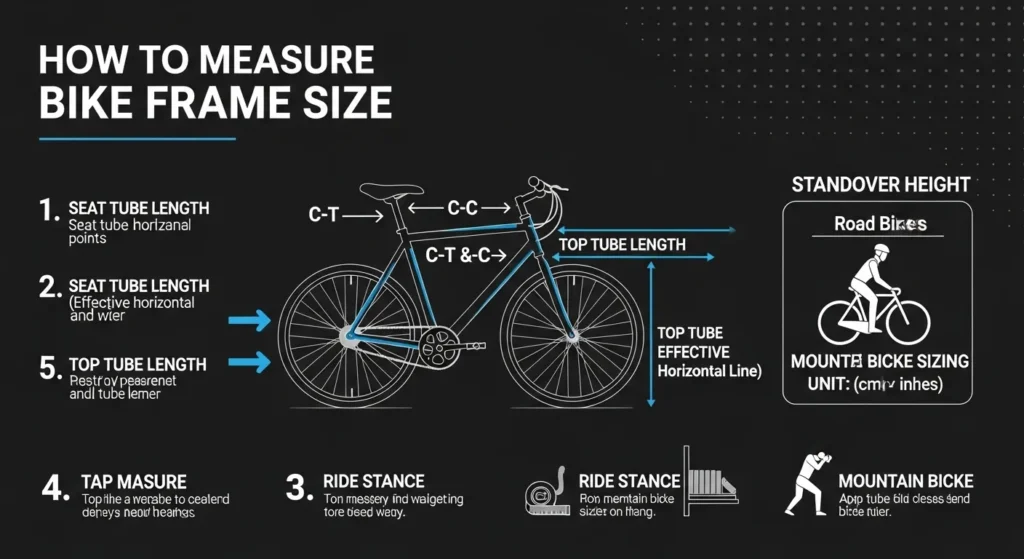
1. Measure Seat Tube Length (Primary Method)
This is the official and most important measurement.
Steps:
- Locate the bottom bracket (center of pedal crank)
- Measure vertically up to:
- Top of seat tube (C-T method) OR
- Top tube intersection (C-C method)
This value = your frame size
2. Measure Top Tube Length (Modern Bikes)
Modern bikes often have sloping frames, so the seat tube alone isn’t enough.
Steps:
- Measure the horizontal distance between:
- Center of head tube
- Center of the seat tube
This is called the effective top tube length
3. Measure Standover Height
This ensures safe clearance when standing over the bike.
Steps:
- Measure from the ground to the top tube
- Stand over the bike with both feet flat
Ideal clearance:
- Road bikes: 1–2 inches
- MTB: 2–4 inches
C-T vs C-C Measurement Explained (Most Confusing Part)
This is where most cyclists get confused.
Key Differences
| Method | Full Form | Measurement |
| C-T | Center to Top | Bottom bracket → top of seat tube |
| C-C | Center to Center | Bottom bracket → top tube intersection |
Why It Matters
- Different brands use different standards
- The same bike can appear in different sizes depending on the method
Always check manufacturer specs before buying.
How to Calculate Frame Size Using Inseam
This is the most accurate method for choosing the right size.
Step 1: Measure Your Inseam
- Stand against a wall
- Place a book between your legs
- Measure from the floor to the book
Step 2: Apply Formula
| Bike Type | Formula |
| Road Bike | Inseam × 0.665 |
| Mountain Bike | Inseam × 0.225 |
Example
- Inseam = 84 cm
- Road bike size = 84 × 0.665 = 55.8 cm
Choose the closest size (e.g., 56 cm)
Road Bike vs Mountain Bike Measurement Differences
Different bikes require different sizing approaches.
Comparison Table
| Feature | Road Bike | Mountain Bike |
| Units | cm | Inches |
| Riding Position | Aggressive | Upright |
| Geometry | Longer reach | Compact |
| Top Tube | Longer | Shorter |
| Usage | Speed & distance | Trails & off-road |
Always measure according to bike type.
Bike Frame Size Chart (Height vs Size)
Use this as a general guideline:
| Rider Height | Road Bike Size | MTB Size |
| 5’4″–5’7″ | 52–54 cm | 16–17″ |
| 5’7″–5’10” | 54–56 cm | 17–18″ |
| 5’10″–6’1″ | 56–58 cm | 18–19″ |
| 6’1″–6’4″ | 58–60 cm | 19–21″ |
This is not exact—use inseam for precision.
Common Mistakes to Avoid
Avoid These Errors
- Measuring the seat post instead of the seat tube
- Using only height charts
- Ignoring the top tube length
- Assuming all brands use the same sizing
- Not considering riding style
These mistakes can lead to buying the wrong bike.
Pro Tips from Bike Fit Experts
Expert Advice
- Always compare geometry charts
- Focus on reach and comfort, not just the size label
- Smaller frame = better control
- Larger frame = more stability
- Test ride whenever possible
Professional bike fitting can improve performance by up to 20%.
Pros & Cons of Measuring Bike Frame Yourself
Pros
- Free and easy
- No special tools required
- Helps understand bike geometry
- Useful for buying used bikes
Cons
- Can be inaccurate without experience
- Confusing terminology (C-T vs C-C)
- Doesn’t replace professional fitting
FAQs
A: Measure the seat tube length or check the manufacturer’s geometry chart.
A: You can measure it using a tape measure, a wall, and basic tools.
A: Use effective top tube length instead of actual tube length.
A: Each brand uses slightly different geometry and sizing standards.
A: Inseam-based calculation gives a more precise frame size.
Final Expert
Understanding how to measure bike frame size is essential for every cyclist—from beginners to professionals. While the seat tube measurement is the official standard, modern bikes require a deeper understanding of geometry, including top tube length and standover height.
The biggest Mistake riders make is relying only on height charts. Instead, use inseam-based formulas, compare geometry charts, and consider your riding style.
If you’re serious about cycling—whether for commuting, fitness, or adventure—investing time in proper measurement will save you money, improve comfort, and enhance performance.
