
How to Measure a Bike Frame: The Definitive 2026 Professional Guide
Finding the perfect ride starts with understanding how to measure a bike frame correctly, yet thousands of cyclists settle for “close enough” every year. Whether you are hunting for a vintage steel frame on a local marketplace or investing in the latest carbon fiber How do you measure a bike frame m” means nothing without the real numbers behind it.
In the modern era of cycling, geometry has evolved. A medium from Trek feels nothing like a medium from Specialized, and the old-school “standover” test is no longer enough to prevent back pain or inefficient power transfer.
In this comprehensive 2026 guide, we go beyond basic height charts to show you exactly how to measure a bike frame like a professional mechanic. You’ll learn the science behind Effective Top Tube (ETT), the role of Reach and Stack, and how your body’s Ape Index influences your ideal geometry.
At BikesLover.com, we believe a bike should feel like an extension of your body—so let’s grab a tape measure and dial in your perfect fit.
The Pro’s Tool Kit: What You Actually Need
Forget the flimsy sewing tape your grandmother uses. Professional frame measurement requires rigidity and precision. If you want an “extraordinary” fit that prevents joint strain, assemble this kit:
- Steel Tape Measure: Must feature both Metric (cm) and Imperial (inches), as road and MTB standards differ.
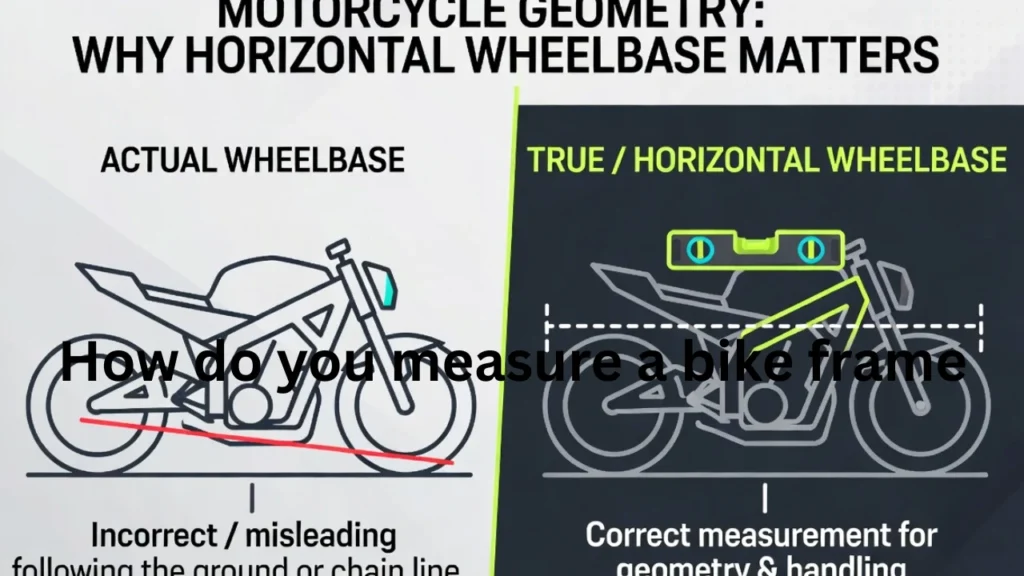
- Spirit Level: Essential for measuring “Effective” lengths by ensuring a perfectly horizontal line.
- Plumb Line: A simple string with a weight (a nut or bolt works) to find the Bottom Bracket (BB) alignment relative to the saddle.
- Smartphone Clinometer App: Use your phone’s built-in gyro to measure seat tube and head tube angles accurately.
- A Second Pair of Hands: Measuring a bike while keeping it upright is significantly easier with a friend.
The Geometry Secret: Effective Top Tube (ETT)
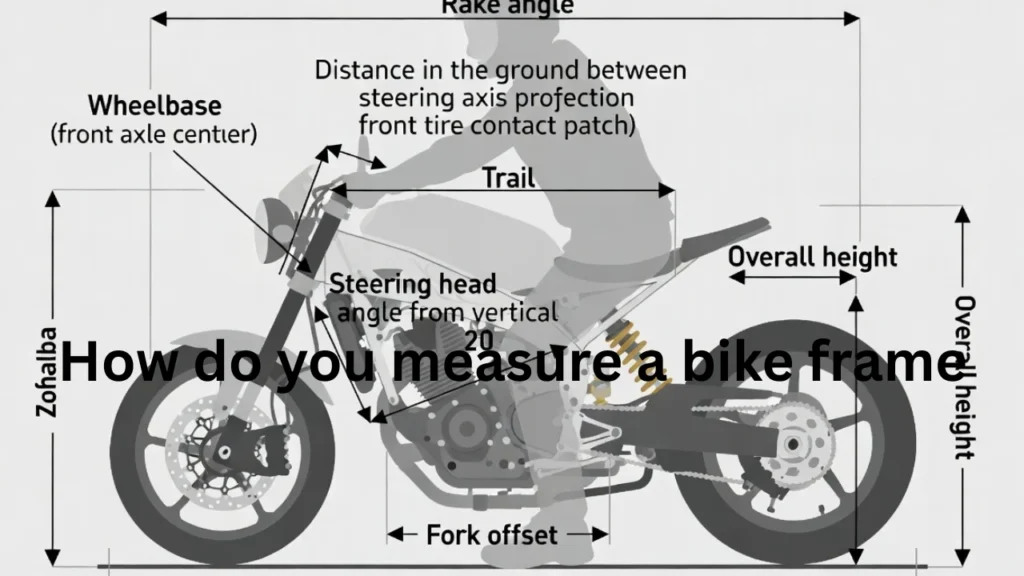
Most beginners make the mistake of measuring the actual physical tube. On modern bikes—especially those with “sloping” geometry—this measurement is useless. You must focus on the Effective Top Tube (ETT).
Actual vs. Effective
- Actual Top Tube: The physical length of the tube from the head tube to the seat tube.
- Effective Top Tube: A horizontal line drawn from the center of the head tube to the center of the seatpost.
How to measure ETT:
- Place your bike in a work stand or hold it perfectly vertical.
- Hold your spirit level at the junction where the head tube meets the top tube.
- Extend the tape measure horizontally until it intersects with the center of the seatpost.
- Why it matters: This represents the true “stretch” of the bike. If your ETT is too long, you’ll overreach, leading to lower back pain.
How to Measure Road Bike Frames (Centimeters)
Road cycling is a game of millimeters. Traditionally, road frames are categorized in centimeters (e.g., 54cm, 56cm). However, the industry uses two different measuring standards.
Center-to-Top (C-T) vs. Center-to-Center (C-C)
- Center-to-Top (C-T): Measure from the center of the crank bolt (Bottom Bracket) to the very top of the seat tube where the clamp sits. This is the most common modern standard.
- Center-to-Center (C-C): Measure from the center of the BB to the exact point where the top tube and seat tube intersect.
Expert Tip: Most European and modern carbon manufacturers use C-T. Always verify which standard a manufacturer’s geometry chart uses, or you may accidentally buy a frame that is 2cm too small or too large.
How to Measure Mountain Bike Frames (Inches)
MTB sizing is rugged and generally measured in inches (17″, 19″, etc.). Because MTB frames often have radical “dropper” seat posts and low-slung top tubes, the seat tube length is less about fit and more about clearance.
The Key MTB Metrics
- Seat Tube Length: Center of the BB to the top of the seat tube.
- Standover Clearance: Stand flat-footed over the mid-point of the bike. For trail safety, you need a minimum of 2–3 inches of “air” between your body and the frame to account for sudden stops on uneven terrain.
- Reach: This is the horizontal distance from the BB to the head tube. In modern “Long, Slack, and Low” MTB geometry, Reach is more important than seat tube length.
Measuring the Rider: The “Ape Index” and Inseam
A bike frame is only half the equation. To find the right match, you need to measure yourself with the same precision.
The Inseam Formula
Do not use your pant size! Stand against a wall with a book between your legs (mimicking a saddle) and measure from the floor to the top of the book.
- Road Fit: Inseam (cm) × 0.665 = Ideal Frame Size.
- MTB Fit: Inseam (cm) × 0.225 = Ideal Frame Size (in inches).
The Ape Index
Your “Ape Index” determines if you should size up or down when you fall between two frame sizes.
- The Calculation: Arm Span minus Height.
- Positive Ape Index (Arms longer than height): You have a longer reach. You should choose the larger frame size for better stability.
- Negative Ape Index (Height longer than arms): You have a shorter reach. Size down to avoid overstretching your shoulders.
Hybrid and E-Bike Frame Specifics
Hybrid and Electric bikes are the fastest-growing segments in 2026. Because these bikes focus on comfort and utility, the measurements differ slightly.
- The “Upright” Factor: Look for a higher Stack (the vertical distance from the BB to the head tube). This ensures you aren’t hunched over, which is vital for heavy E-bikes that require more effort to maneuver.
- Step-Through Frames: On “low-step” or step-through frames, ignore the top tube entirely. Focus on the Reach and the Distance to Pedals to ensure your knees are at the correct angle.
2026 Master Bike Size Comparison Table
Note: Use this as a starting point. Always cross-reference with the specific manufacturer’s geometry chart.
| Rider Height | Road Frame (cm) | MTB Frame (in) | Hybrid/E-Bike Size |
| 4’11” – 5’3” | 47 – 50 | 13 – 15 | XS / S |
| 5’3” – 5’7” | 51 – 53 | 15 – 17 | S / M |
| 5’7” – 5’11” | 54 – 56 | 17 – 19 | M / L |
| 5’11” – 6’3” | 57 – 60 | 19 – 21 | L / XL |
| 6’3”+ | 60+ | 21+ | XXL |
Pros & Cons of Different Measurement Methods
Effective Top Tube (ETT)
- Pros: Most accurate reflection of how the bike feels; accounts for modern sloping frames.
- Cons: Harder to measure without a spirit level and a second person.
Seat Tube Length (C-T)
- Pros: Easy to measure; universal standard for road bikes.
- Cons: Doesn’t account for how “long” the bike feels or the rider’s arm length.
The “Standover” Test
- Pros: Quick and easy; no tools required.
- Cons: Highly inaccurate for modern MTBs and gravel bikes with compact geometry.
Common Mistakes to Avoid
- Measuring with Shoes Off: Always measure your inseam and standover height wearing the cycling shoes you intend to use. Cleats add 1–2cm of height!
- Ignoring the “Stack”: If you have a stiff back, a bike with a low stack height will be miserable, regardless of the frame size.
- Trusting the Label: A “54cm” bike is not a universal unit of measurement. It is a marketing label. Always trust your tape measure over the sticker on the seat tube.
- Overlooking Crank Length: If you have short legs but a large frame, long 175mm cranks can cause hip “rocking.”
Summary Table: Step-by-Step Measurement Process
| Step | Action | Tool Needed | Goal |
| 1 | Measure Rider Inseam | Book & Tape Measure | Calculate baseline frame size |
| 2 | Check Ape Index | Tape Measure | Decide between two sizes |
| 3 | Measure Seat Tube | Steel Tape Measure | Determine frame height (C-T) |
| 4 | Measure Effective Top Tube | Spirit Level & Tape | Determine “Reach” and comfort |
| 5 | Check Standover | Your own body | Ensure safety clearance |
FAQs
A: To a degree. You can move the saddle forward or backward (fore-aft) or swap for a shorter/longer stem, but these are “band-aid” fixes for a frame that is fundamentally the wrong size.
A: Use centimeters for Road, Gravel, and Cyclocross. Use inches for Mountain Bikes. For Hybrids and E-bikes, manufacturers often use Alpha sizing (S, M, L), but they will provide the cm/inch breakdown in their charts.
A: Reach is the horizontal distance from the center of the Bottom Bracket to the center of the head tube. It is a more “pure” measurement of how the bike feels when you are standing on the pedals.
A: Refer to your Ape Index. If your arms are long, go for the larger size. If you prefer a more “flickable” and aggressive bike for racing, go for the smaller size.
A: Not the measurement method itself, but the geometry often differs (shorter ETT and narrower handlebars). The process of measuring the frame remains identical.
Final Expert Verdict
Measuring a bike frame is no longer just about the length of a piece of aluminum or carbon. It is about understanding dynamic geometry. In 2026, the Effective Top Tube (ETT) is your most important metric, followed closely by your Ape Index.
If you take the time to use a spirit level and a plumb line, you remove the guesswork from buying online. A well-measured bike isn’t just faster; it’s the difference between a ride that ends in a chiropractor’s office and one that ends with a smile.For more deep dives into bike geometry and professional reviews, keep it locked to BikesLover.com—your global hub for everything on two wheels.
