
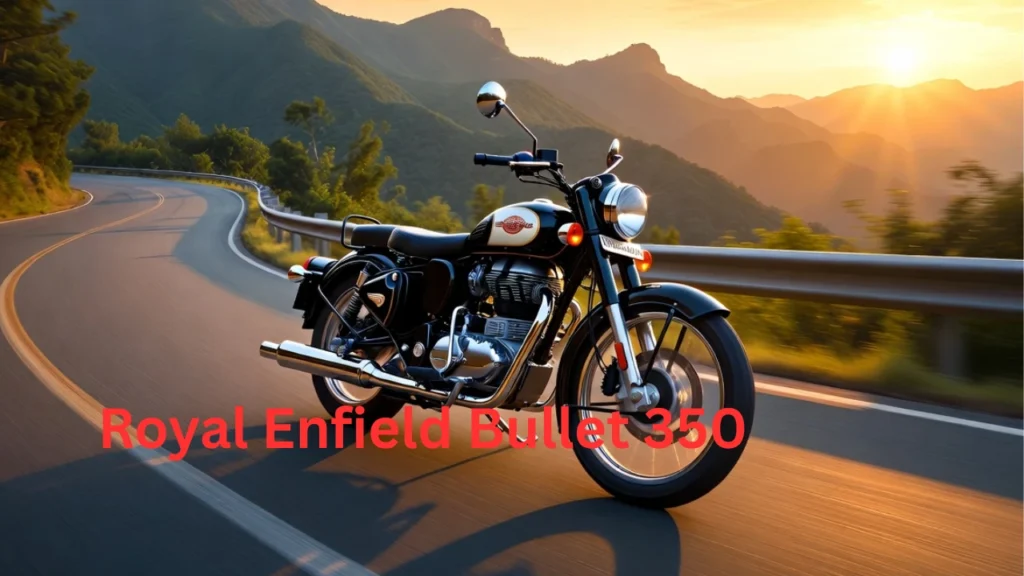
Royal Enfield Bullet 350: The Complete 2026 Guide – History, Specs, Ride Impressions, Ownership, Comparisons & Buying Advice
The Royal Enfield Bullet 350 stands as more than just a motorcycle—it’s a rolling piece of history that continues to capture hearts in 2026. As the world’s longest-running motorcycle model in continuous production since the 1930s, the Bullet embodies timeless design, mechanical simplicity, and that unmistakable “thump” that defines the Royal Enfield experience.
Whether you’re a heritage enthusiast drawn to its British-Indian roots, a daily commuter seeking relaxed cruising, or a weekend tourer exploring mixed roads, the latest J-series Bullet 350 delivers modern refinements without sacrificing its soul. This comprehensive guide from BikesLover.com covers everything: detailed specifications, real-world performance, ownership realities, comparisons, and practical buying advice tailored for riders across Europe, India, the US, and beyond.
In this article, we’ll dive deep into what makes the Bullet 350 special in 2026, helping you decide if it’s the right classic for your garage.
A Brief History: From British Roots to Global Icon
The Bullet story traces back to 1932 when Royal Enfield introduced early singles in the UK, named for their swift, bullet-like performance. Post-WWII, the model evolved with innovations like swinging-arm suspension. Production shifted significantly when the Indian Army placed large orders in the 1950s, leading to local manufacturing in Madras (now Chennai) by Enfield India.
By the 1960s, the Bullet became a cultural staple in India—used by military, police, and civilians—for its bulletproof reliability on rough roads. Even as the UK parent company faced challenges, production continued uninterrupted in India, cementing its status as the longest-running motorcycle nameplate.
The 2023+ J-series (or next-gen) update marked the biggest overhaul in decades: a new engine, frame, suspension, and features while preserving the iconic styling, spoked wheels, and thump. In 2026, it remains a favorite for those seeking authenticity in an era of high-tech machines.
Brand Background and Country of Origin
Royal Enfield, originally a British brand founded in 1901 in Redditch, England, is now headquartered in Chennai, India, under Eicher Motors. It blends British heritage with Indian engineering prowess, producing bikes celebrated for character over outright speed. The Bullet 350 is proudly Indian-made but retains global appeal, with availability and minor spec tweaks for markets like the US, Europe, and Asia.
Key Specifications (2026 Model)
Engine & Performance
- Type: 349cc single-cylinder, air-oil cooled, SOHC, 2-valve, fuel-injected (J-series)
- Power: 20.2 bhp @ 6,100 rpm
- Torque: 27 Nm @ 4,000 rpm
- Transmission: 5-speed constant mesh, chain drive
- Performance: Relaxed acceleration; 0-100 km/h takes time, but strong low-to-mid torque. Top speed around 110-120 km/h (indicated). Excellent for 50-90 km/h cruising.
Dimensions & Capacity
- Kerb Weight: 195 kg
- Fuel Tank: 13 liters
- Seat Height: 805 mm
- Ground Clearance: ~170 mm
- Wheelbase: 1,390 mm
Chassis, Suspension & Brakes
- Frame: Twin downtube spine/cradle frame
- Suspension: 41mm telescopic forks (front, 130mm travel); twin emulsion shocks with preload adjustment (rear)
- Brakes: Front 300mm disc; rear drum (base) or disc (higher trims); single or dual-channel ABS
- Wheels & Tyres: Spoked; 19-inch front (100/90), 18-inch rear (120/80), tube-type
Efficiency: Claimed ~35-37 kmpl; real-world 30-40+ kmpl (highway bias). Strong on relaxed rides.
Design, Styling & Build Quality
The Bullet 350 retains its signature round headlight, long fuel tank with gold pinstripes (many variants), single-piece bench seat, and minimalist retro aesthetics. It feels more “pure” and traditional than the Classic 350, with subtler cues like a squared rear fender in some trims. Build quality is solid—modern J-series bikes show fewer leaks and better fit-finish than older UCE models. Halogen lighting is functional; higher trims add premium touches.
Electronics & Features: Semi-digital instrument cluster (analog speedo + digital LCD), USB port, hazard lights, and optional Tripper navigation. No advanced rider aids, keeping it simple and true to roots.
Ride Impressions: Comfort, Handling & Performance
Riders praise the upright ergonomics and compliant suspension for soaking up poor roads. The big wheels and travel make it stable and comfortable for daily commutes or weekend getaways. Low-end torque shines in traffic and highways at 60-90 km/h, with the deep “dug-dug” exhaust note. Vibrations are controlled up to ~100 km/h.
Handling is predictable, but the 195 kg weight requires effort in tight maneuvers. Brakes are adequate (stronger with dual ABS); cornering is composed. It’s built for relaxed, soulful riding—not sporty sprints. Pillion comfort on the bench seat is good for touring.
Real-World Notes: Excellent for mixed Indian/European roads or US backroads. Fuel economy holds well on highways (35+ kmpl); city riding drops with stops.
Variants, Trims & Color Options
Variants differ mainly in brakes, ABS, and styling:
- Base/Battalion Black/Military (single-channel ABS, rear drum) – more affordable, rugged look.
- Higher trims (dual-channel ABS, rear disc) – premium colors like Black Gold.
Colors include Military Black/Red, Standard Black/Maroon, and Black Gold. Prices vary: India ~₹1.64–2.08 lakh ex-showroom; US ~$4,499–$4,799 MSRP.
Pricing Table (Approximate, 2026)
| Variant/Region | India (Ex-Showroom) | US (MSRP) | Notes |
| Base/Battalion | ₹1.64–1.66 lakh | ~$4,499 | Entry-level |
| Mid/Standard | ₹1.85–1.90 lakh | – | Balanced |
| Top/Black Gold | ₹2.02–2.08 lakh | ~$4,799 | Premium ABS & styling |
On-road prices add taxes, insurance; check locally. Europe/UK varies with VAT.
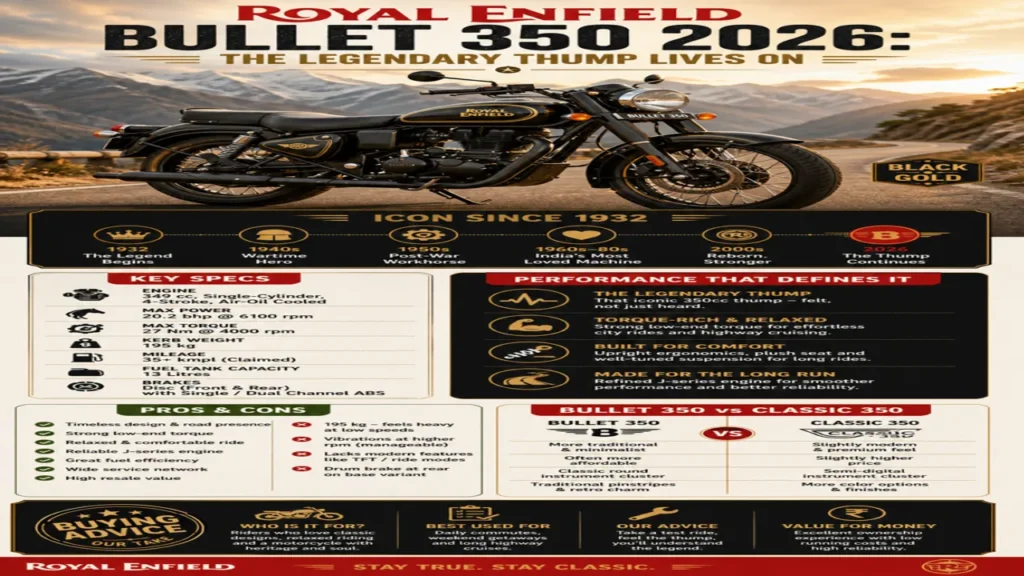
Bullet 350 vs. Classic 350: Head-to-Head Comparison
Both share the J-series engine, frame, and core specs. Differences are primarily stylistic and positioning.
Comparison Table
| Aspect | Bullet 350 | Classic 350 | Winner |
| Styling | More traditional, squared fender, single bench seat, pinstripes | Premium, rounded fenders, split seat options | Bullet (purity) |
| Price (Entry) | Lower (~₹1.64L) | Higher (~₹1.85L) | Bullet |
| Features/Lights | Mostly halogen | Some LED options | Classic |
| Feel | Raw, authentic heritage | Polished, modern-retro | Depends on preference |
| Seat/Comfort | Single bench, good for touring | Often split, plush | Tie |
Pros of Bullet: Better value, simpler heritage focus.
Pros of Classic: More color/options, slightly premium vibe.
Vs. Rivals (e.g., Honda H’ness CB350, Jawa): Bullet wins on character, vast service network (especially India), and resale. Rivals may edge in refinement or features.
Maintenance, Servicing & Reliability
J-series models are far more refined and leak-free than older units. Service every 6 months/5,000+ km at authorized centers—costs are reasonable. Owners report high reliability with proper care; many exceed 50,000+ km.
Common Points: Minor oil seepage is rare now; heavier clutch; monitor chain/suspension on rough roads. Spare parts widely available globally. Tubeless upgrade popular. Excellent community support.
Ownership Experience: Low running costs, strong resale, huge accessory ecosystem (screens, crash guards, seats). Long-term: Comfortable, low-fatigue cruiser with presence. Service intervals can feel frequent for some.
Pros & Cons
Pros:
- Timeless styling and cultural icon status
- Refined J-series engine with strong low-end torque and characterful thump
- Comfortable ergonomics and a compliant ride on bad roads
- Reliable with a good service network
- Strong value, especially base variants
- Excellent resale and community
Cons:
- Weighty feels in tight spaces
- Relaxed performance (not for speed enthusiasts)
- Heavier clutch in traffic
- Basic electronics/halogen lights
- No kick-start; tube tyres standard
Who Should Buy the Royal Enfield Bullet 350?
Ideal for riders seeking relaxed cruising, heritage vibes, and road presence on city, highway, or light touring duties. Great for beginners comfortable with weight (after test ride) and veterans wanting simplicity. Perfect in Europe/Asia for scenic roads or India for daily use.
Skip if you prioritize quick acceleration, lightweight handling, or advanced tech.
Best Use Cases: Daily commuting, weekend getaways, relaxed highway plonking, pillion-friendly touring on mixed roads. Not for aggressive sport riding or heavy off-road.
FAQs
A: You can expect around 30–40 km/l depending on riding style, with 35+ km/l achievable on highways.
A: It’s beginner-friendly if you’re comfortable handling its weight. A test ride is recommended to get a feel for balance and control.
A: The bike can reach around 110–120 km/h (indicated), but it performs best when cruising between 80–100 km/h.
A: It’s highly reliable with regular maintenance. The newer J-series engine has improved refinement and durability.
A: It comes with ABS—single-channel or dual-channel, depending on the variant.
Final Expert
In 2026, the Royal Enfield Bullet 350 perfectly balances nostalgia with usability. It’s not the fastest or most tech-laden bike, but it delivers unmatched character, comfort, and connection at its price. For those who value the journey, heritage, and soul over speed, few motorcycles match it. Test ride one—its thump might just win you over.
Ready to own a legend? Visit a Royal Enfield showroom, factor in local on-road costs and accessories, and embrace the Bullet life. Ride safe, wear proper gear, and enjoy the timeless experience.
This guide draws from official specs, expert tests, owner forums, and real-world data as of 2026. Specs/prices vary by market—verify locally. BikesLover.com – Your trusted global motorcycle knowledge hub.
