

How to Measure a Bike Frame Size: The Ultimate 2026 Guide (Comprehensive & Accurate)
Choosing the right How do you measure a frame size on a bike transforms your riding experience. A well-fitted bike delivers comfort on long rides, better power transfer, improved control, and reduced injury risk. An ill-fitting one causes discomfort, numbness, back pain, or inefficient pedaling that saps your enjoyment and performance.
Whether buying new, comparing second-hand options, or verifying your current bike, understanding how to measure bike frame size removes confusion. Modern geometry uses stack and reach, while traditional methods rely on seat tube lengths in cm or inches. Different bike types (road, mountain, gravel, hybrid) follow varying conventions.
This complete guide from BikesLover.com covers everything: body measurements, frame measurements, bike-type differences, charts, tools, mistakes to avoid, and expert tips. By the end, you will confidently select or verify the perfect bike size for your needs.
Why Bike Frame Sizing Is More Complex Than It Seems
Bike sizing has evolved significantly. Older steel frames used simple center-to-top (C-T) or center-to-center (C-C) seat tube measurements. Modern bikes with sloping top tubes, compact geometries, and varied styles make a single number unreliable.
Key challenges include:
- Sloping top tubes — Common on mountain and gravel bikes — reduce effective seat tube length.
- Brand variations — One brand’s “Medium” differs from another’s.
- Bike type differences — Road bikes prioritize aerodynamics; MTBs emphasize standover clearance.
- Rider proportions — Two people of the same height may need different sizes due to arm/leg/torso ratios.
Modern gold standards are stack and reach, which provide consistent comparisons across brands by measuring from the bottom bracket to the head tube.
Tools You’ll Need
Basic tools (for most users):
- Flexible tape measure (metric and imperial).
- Hardcover book or spirit level (for inseam).
- Wall and friend/helper.
- Smartphone with free clinometer/level app.
Advanced tools:
- Plumb line or laser level.
- Clinometer for angles.
- Access to manufacturer geometry charts (e.g., via Geometry Geeks).
Step 1: Measure Your Body First (The Critical Starting Point)
Always begin with your body measurements. Frame size recommendations derive primarily from these.
How to Measure Inseam (Inside Leg Length):
- Stand barefoot or in thin socks against a wall, feet 15–20 cm (6–8 inches) apart.
- Place a hardcover book (or spirit level) firmly between your legs, spine upward, simulating saddle pressure. Hold it level and push it upward gently.
- Mark where the top of the book spine meets the wall.
- Measure from the floor to this mark. Repeat 2–3 times for accuracy. This is your inseam.
Height: Measure without shoes, standing straight against the wall.
Quick Formula Approximations (starting points only):
- Road/Gravel: Inseam × 0.65–0.67 = approximate frame size in cm.
- Hybrid/Fitness: Inseam × 0.61.
- MTB: Often uses standover and S/M/L sizing.
These are rough guides—always verify with actual frame measurements and test rides.
Step 2: Measuring the Bike Frame Itself
Here’s the core hands-on process. Work on a level surface with the bike upright (use a stand if possible).
Seat Tube Length:
- C-T (Center to Top): Center of bottom bracket (BB) to top of seat tube. Traditional method, common in inches for hybrids/MTBs or cm for road.
- C-C (Center to Center): Center of BB to center of top tube intersection. Used on some older or specific frames.
Measure along the tube’s center line. Note manufacturer conventions.
Effective/ Virtual Top Tube Length:
This horizontal distance matters most for reach. Use a spirit level or string:
- Measure from head tube center to seat post center, perfectly horizontal.
- Many geometry charts list this as “Effective Top Tube” (ETT).
Head Tube Length:
Measure straight down the head tube. Longer head tubes create more upright positions.
Standover Height:
Critical for safety and comfort, especially on MTBs.
- Measure from ground to top of top tube (at the point where you stand over).
- Aim for 5–10 cm (2–4 inches) clearance for road/hybrid; more for aggressive MTB.
Wheelbase, Chainstay, and Front-Center:
- Wheelbase: Distance between front and rear axle centers.
- These affect stability and handling.
Stack and Reach (The Modern Gold Standard):
- Stack: Vertical distance from BB center to top center of head tube.
- Reach: Horizontal distance from BB center to top center of head tube.
These two numbers allow accurate cross-brand comparisons regardless of frame shape. Higher stack = more upright; longer reach = more stretched/aero position.
Angles:
- Head tube angle: Affects steering (slacker for stability, steeper for agility).
- Seat tube angle: Influences pedaling position.
- Use a clinometer app for measurements.
Pro Tips for Accuracy:
- Measure multiple times.
- Account for fork rake and BB drop.
- Photograph measurements for records.
- Compare against manufacturer geo charts.
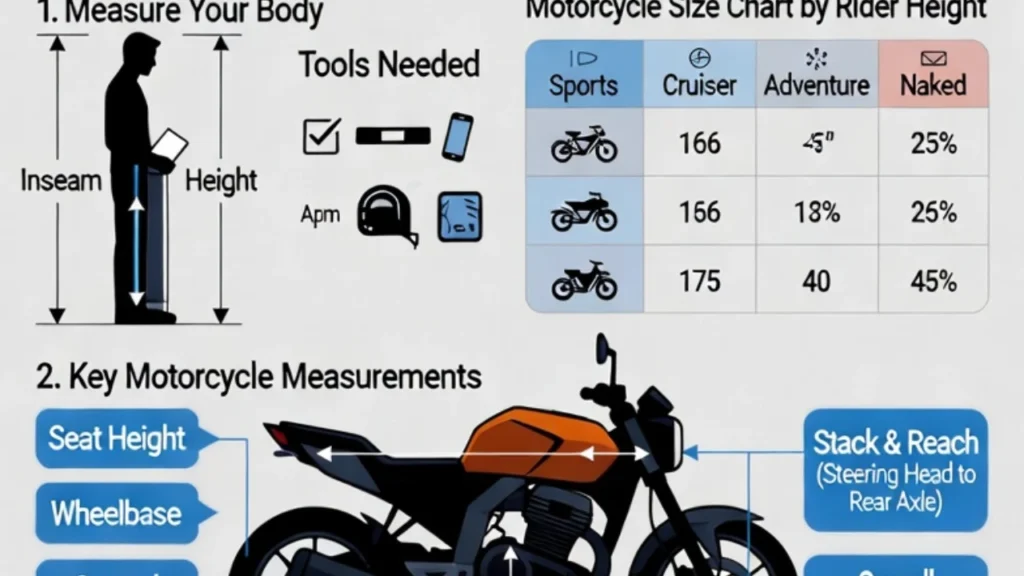
Learn the correct way to measure motorcycle frame and geometry for perfect rider fit. Includes inseam guide, wheelbase, seat height, and size recommendations for different motorcycle types.
Bike Size Charts
General Adult Bike Size Chart by Height (Approximate):
| Rider Height | Road/Gravel (cm) | MTB (S/M/L) | Hybrid (inches) | Inseam Range |
| 5’0″ – 5’4″ (152-163 cm) | 48-52 | XS/S | 15-17″ | 28-30″ |
| 5’4″ – 5’8″ (163-173 cm) | 52-54 | S/M | 17-19″ | 30-32″ |
| 5’8″ – 6’0″ (173-183 cm) | 54-56 | M/L | 19-21″ | 32-34″ |
| 6’0″ – 6’4″ (183-193 cm) | 56-58 | L/XL | 21-23″ | 34-36″ |
| 6’4″+ (193+ cm) | 58-62 | XL/XXL | 23″+ | 36″+ |
Road Bike Example Chart (by Inseam):
| Inseam (cm) | Suggested Frame (cm) |
| 70-76 | 48-51 |
| 77-83 | 52-54 |
| 84-89 | 55-57 |
| 90+ | 58+ |
Always cross-reference with specific brand charts, as geometries vary.
Differences by Bike Type
Road Bikes: Measured mainly in cm (seat tube). Prioritize stack/reach for aggressive or endurance positions. Smaller sizes for racing; taller stacks for comfort.
Mountain Bikes (MTB): Often S/M/L/XL with emphasis on standover clearance. Slacker geometries and larger wheels (27.5″ or 29″). Size down for playfulness, up for stability.
Gravel Bikes: Blend road and MTB traits. Check standover and stack for mixed terrain comfort.
Hybrid/City Bikes: Upright position, measured in inches. Focus on standover and effective top tube for everyday use.
Kids Bikes: Primarily by wheel diameter (12″, 16″, 20″, 24″, 26″) and age/height. Standover is crucial for safety.
E-Bikes: Similar to hybrids but account for added motor/battery weight affecting handling.
Women-Specific or Gender-Neutral: Many brands now offer unisex with adjusted top tubes and contact points rather than purely “women’s” frames.
Common Mistakes & How to Avoid Them
- Relying solely on height charts (ignore inseam and proportions).
- Ignoring brand differences or assuming S/M/L is universal.
- Measuring incorrectly (e.g., including seat post in frame size).
- Skipping test rides.
- Buying without checking standover (risk of injury in emergencies).
- Overlooking future adjustments (stems, saddles, spacers).
Avoidance Tip: Use stack/reach matching when comparing models. Test ride similar geometries.
How to Compare Bikes & Choose the Right Size
- Measure your body.
- Shortlist bikes using charts.
- Compare geometry tables (use sites like Geometry Geeks or Bike Insights).
- Match stack/reach as closely as possible.
- Adjust with components: shorter/longer stem, saddle fore/aft, spacers.
- For second-hand: Measure the actual bike and verify against original specs.
- Get a professional bike fit for serious riding.
When to Size Up/Down:
- Size up for relaxed touring/comfort.
- Size down for aggressive handling/racing.
Pros and Cons of Different Sizing Approaches
Traditional Seat Tube Sizing:
- Pros: Simple, familiar, easy to measure.
- Cons: Less accurate with modern sloping frames; poor for cross-brand comparison.
Stack & Reach:
- Pros: Consistent, geometry-focused, best for performance.
- Cons: Requires charts; less intuitive for beginners.
S/M/L Labeling:
- Pros: User-friendly for casual buyers.
- Cons: Vague; hides important differences.
FAQs
A: Both—road often cm, hybrids/MTBs inches or alphabetic.
A: From ground to top of top tube at its highest point near the seat tube.
A: Consider riding style: smaller for agility, larger for stability. Test ride both.
A: Not necessarily—focus on geometry and fit rather than “women’s” labels.
A: Basic estimates are possible, but accuracy suffers. Use a tape measure for best results.
Conclusion
Measuring a bike frame size combines art and science. Start with your inseam and height, understand stack and reach, measure carefully, and always test ride when possible. This approach ensures comfort, efficiency, and joy on every ride.
At BikesLover.com, we aim to equip you with complete knowledge for informed decisions. Measure your inseam today, check your current bike, and share your measurements or questions in the comments. Need help with specific models or comparisons? Explore our other guides on bike types, buying advice, and maintenance.
