
How Do You Measure for a Bike Frame? (Complete 2026 Beginner-to-Pro Guide)
Introduction
Choosing the right How do you measure for a bike frame is one of the most important decisions any cyclist can make. Whether you’re buying your first bike or upgrading to a high-performance machine, knowing how to measure for a bike frame ensures comfort, efficiency, and injury prevention.
A poorly sized bike doesn’t just feel awkward—it can lead to knee pain, back strain, poor posture, and reduced control. On the other hand, a perfectly sized bike improves pedaling efficiency, enhances handling, and makes every ride enjoyable.
In this comprehensive guide, you’ll learn everything from basic inseam measurements to advanced bike geometry concepts like reach and stack. This article is designed for beginners and experienced riders alike, helping you confidently choose the right frame size anywhere in the world.
What Does “Bike Frame Size” Mean?
Bike frame size typically refers to the length of the seat tube, which is measured from:
- The center of the bottom bracket
- To the top of the seat tube
Common Measurement Units:
- Centimeters (cm) → Road bikes
- Inches (“) → Mountain bikes
- General sizing (S, M, L) → Hybrid and modern bikes
However, modern bike sizing has evolved beyond just seat tube length. Today, geometry factors like reach and stack play a crucial role in determining overall fit.
Why Proper Bike Frame Measurement Matters
Understanding how to measure bike frame size isn’t just technical—it’s practical.
Key Benefits:
- Prevents injuries (knees, back, shoulders)
- Improves riding comfort
- Enhances pedaling efficiency
- Boosts bike control and stability
- Maximizes performance
Step-by-Step — How to Measure for a Bike Frame
This is the most accurate and beginner-friendly method used worldwide.
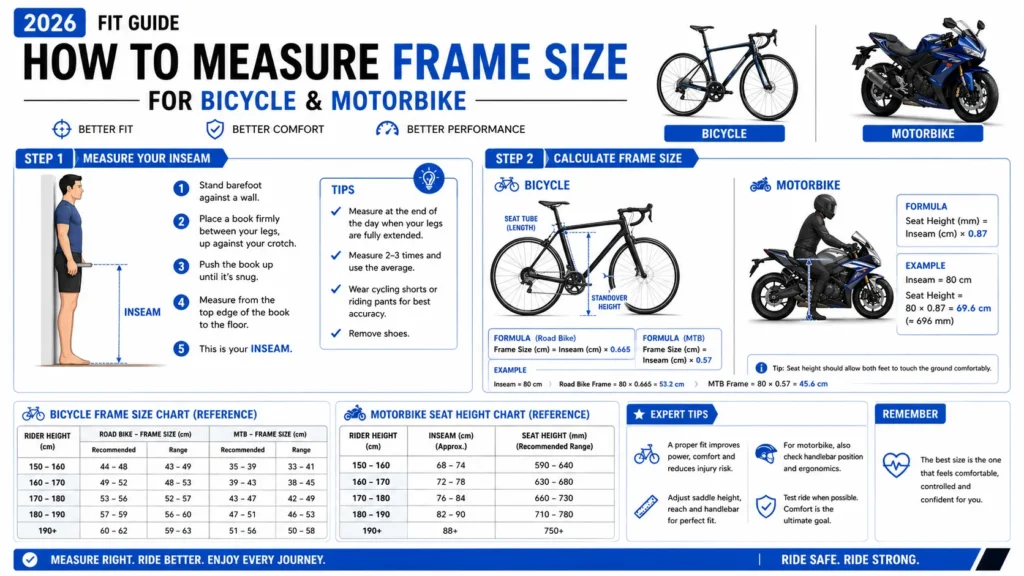
Step 1 — Measure Your Inseam (Most Important)
Your inseam length is the foundation of bike sizing.
How to Measure Inseam:
- Stand barefoot against a wall
- Place a book between your legs (like a saddle)
- Keep it snug against your body
- Measure from the floor to the top of the book
This measurement (in cm) is your inseam length
Step 2 — Use the Bike Frame Size Formula
Once you have your inseam, apply these formulas:
Road Bike Formula:
Inseam (cm) × 0.665 = Frame Size (cm)
Mountain Bike Formula:
Inseam (cm) × 0.225 = Frame Size (inches)
Hybrid Bike Formula:
Inseam (cm) × 0.685 = Frame Size (cm)
Step 3 — Match With Manufacturer Size Charts
After calculating your size:
- Compare with brand-specific charts
- Adjust based on riding preference
- Consider bike type (road, MTB, hybrid)
Bike Frame Size Chart (Quick Reference)
| Rider Height | Road Bike Size | Mountain Bike Size | Hybrid Bike Size |
| 5’3″–5’6″ | 50–52 cm | 15–16″ | S |
| 5’6″–5’9″ | 52–54 cm | 16–17″ | M |
| 5’9″–6’0″ | 54–56 cm | 17–18″ | M/L |
| 6’0″–6’3″ | 56–58 cm | 18–19″ | L |
| 6’3″+ | 58–62 cm | 19–21″ | XL |
Pro Tip: Height charts are helpful, but inseam-based sizing is far more accurate.
Alternative Method — Measure an Existing Bike
If you already own a bike, you can measure it directly.
Steps:
- Locate the Bottom bracket
- Measure to the top of the seat tube
- Compare with standard sizing charts
Advanced Bike Fit Factors (Where Most Guides Fail)
Most competitors stop at basic formulas—but real bike fitting goes deeper.
1. Reach & Top Tube Length
Reach determines how far you stretch to the handlebars.
- Too long → Back pain, shoulder strain
- Too short → Cramped posture
Why It Matters:
Modern bikes often use effective top tube length, not actual tube length.
2. Stack Height
Stack refers to the vertical distance from the bottom bracket to the handlebars.
- Higher stack → More upright (comfortable)
- Lower stack → Aggressive (racing position)
3. Riding Style Impact
| Riding Style | Ideal Frame Choice |
| Racing | Smaller frame (aggressive) |
| Touring | Larger frame (comfort) |
| Commuting | Balanced fit |
| Off-road | Slightly smaller for control |
4. Bike Type Differences
Road Bikes
- Aggressive posture
- Smaller frames preferred
Mountain Bikes
- Upright position
- More control-focused geometry
Hybrid Bikes
- Comfort-oriented
- Balanced sizing approach
Common Mistakes to Avoid
Many riders make these critical errors:
- Choosing size based only on height
- Ignoring the inseam measurement
- Overlooking brand size differences
- Not considering riding style
- Buying without test riding
Real-World Example
Let’s say your inseam is 80 cm:
- Road bike → 80 × 0.665 = 53.2 cm
- MTB → 80 × 0.225 = 18 inches
Ideal fit:
- Road bike: 52–54 cm
- Mountain bike: 17–18 inches
Fine-Tuning Your Bike Fit
Even after choosing the right frame, adjustments matter.
Key Adjustments:
- Saddle height
- Saddle position (forward/back)
- Handlebar height
- Stem length
Bike Sizing Process Table
| Step | Action | Importance Level |
| 1 | Measure inseam | ⭐⭐⭐⭐⭐ |
| 2 | Apply formula | ⭐⭐⭐⭐ |
| 3 | Check the size chart | ⭐⭐⭐⭐ |
| 4 | Adjust for riding style | ⭐⭐⭐ |
| 5 | Test ride | ⭐⭐⭐⭐⭐ |
Pros & Cons of Different Sizing Methods
Inseam-Based Method
Pros:
- Most accurate
- Personalized fit
- Widely used globally
Cons:
- Requires careful measurement
Height-Based Method
Pros:
- Quick and easy
- Beginner-friendly
Cons:
- Less accurate
- Ignores body proportions
Bike Measurement Method
Pros:
- Useful for upgrades
- Practical comparison
Cons:
- Depends on the current bike accuracy
Global Bike Sizing Differences
Bike sizing may vary across regions:
🇪🇺 Europe
- Uses cm-based sizing
- Precise geometry charts
🇺🇸 USA
- Mix of inches and S/M/L
- Brand-specific sizing common
Asia (Pakistan, India, China)
- More generic sizing
- Limited geometry data in budget bikes
Always check manufacturer-specific charts before buying.
Expert Tips for Perfect Bike Fit
- If between sizes → choose smaller for control
- Prioritize inseam over height
- Always test ride if possible
- Consider professional bike fitting
- Adjust components after purchase
FAQs
A: The inseam-based formula method is the most reliable and widely recommended.
A: But it’s less accurate and should only be used as a rough estimate.
A: You may experience:
Poor control
Back pain
Difficulty handling the bike
A: Choose:
Smaller frame → Better control
Larger frame → More comfort
A: Absolutely. Road, mountain, and hybrid bikes all have different geometries and fit requirements.
Final Verdict
Measuring for a bike frame may seem simple, but doing it correctly makes a massive difference in your riding experience.
The Golden Formula:
- Measure your inseam
- Apply the correct formula
- Adjust based on Riding style
- Fine-tune with real-world testing
By following this complete system, you’ll avoid common mistakes and choose a bike that feels perfectly tailored to your body.
