
Introduction
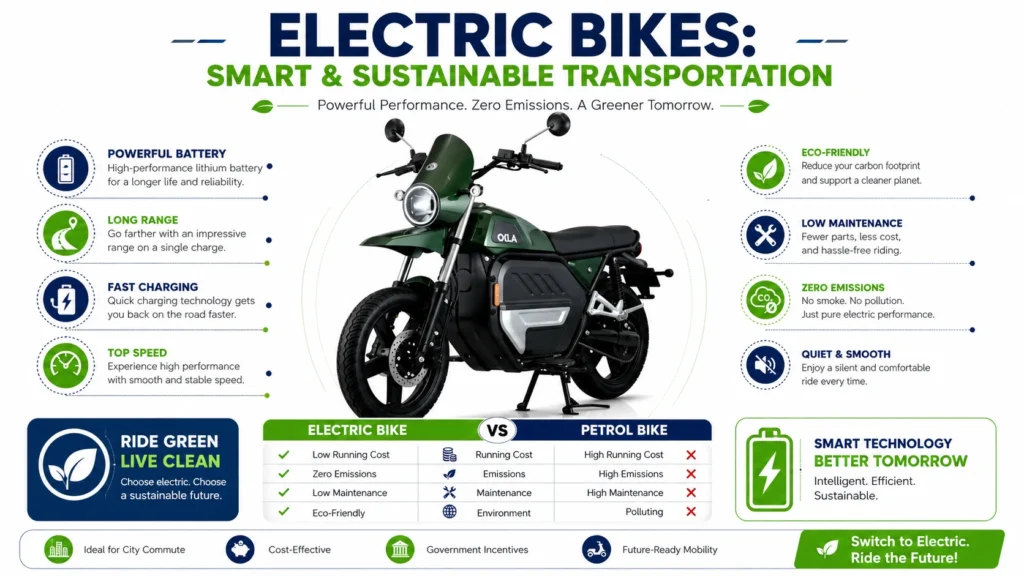
Electric Bikes have revolutionized personal transportation by combining the freedom of traditional cycling with the convenience of electric assistance. Whether you’re commuting to work, exploring scenic trails, reducing fuel costs, or simply looking for a healthier way to travel, an electric bike offers a practical and enjoyable solution. With advancements in battery technology, motor efficiency, and smart features, today’s e-bikes are faster, lighter, and more reliable than ever before.
The popularity of electric bikes continues to grow worldwide as more people seek eco-friendly transportation options. Riders appreciate their ability to conquer steep hills with ease, travel longer distances without excessive fatigue, and replace short car trips with a cleaner alternative. From city commuters and weekend adventurers to seniors and fitness enthusiasts, electric bikes cater to a wide range of riders and lifestyles.
This comprehensive guide explains everything you need to know about electric bikes, including how they work, the different types available, motor and battery technologies, maintenance tips, safety practices, legal regulations, and expert buying advice. Whether you’re purchasing your first e-bike or upgrading to a more advanced model, this guide will help you make an informed decision.
What Is an Electric Bike?
An electric bike, commonly called an e-bike, is a bicycle equipped with an electric motor and a rechargeable battery that provide pedal assistance while riding. Unlike motorcycles or scooters, most electric bikes still require the rider to pedal, with the motor supplying additional power to reduce effort. Some models also include a throttle that allows the bike to move without pedaling, depending on local laws and regulations.
Modern electric bikes are designed to enhance the cycling experience rather than replace it. Riders can choose different levels of assistance, making it easy to climb hills, ride against strong winds, or travel longer distances while still enjoying the health benefits of cycling. This combination of human power and electric assistance makes e-bikes suitable for people of all ages and fitness levels.
Main Components of an Electric Bike
An electric bike consists of several essential components that work together to deliver smooth and efficient performance:
- Electric Motor: Provides pedal assistance and determines the bike’s power and climbing ability.
- Rechargeable Battery: Supplies energy to the motor and influences the bike’s riding range.
- Pedal Assist System (PAS): Detects pedaling and automatically activates motor assistance.
- Controller: Manages the flow of electricity between the battery and motor for smooth acceleration.
- Display Panel: Shows speed, battery level, assist mode, distance traveled, and other ride information.
- Frame and Drivetrain: Built similarly to a traditional bicycle but designed to support the additional weight of the motor and battery.
Each component plays an important role in the overall performance, comfort, and reliability of an electric bike.
How Does an Electric Bike Work?
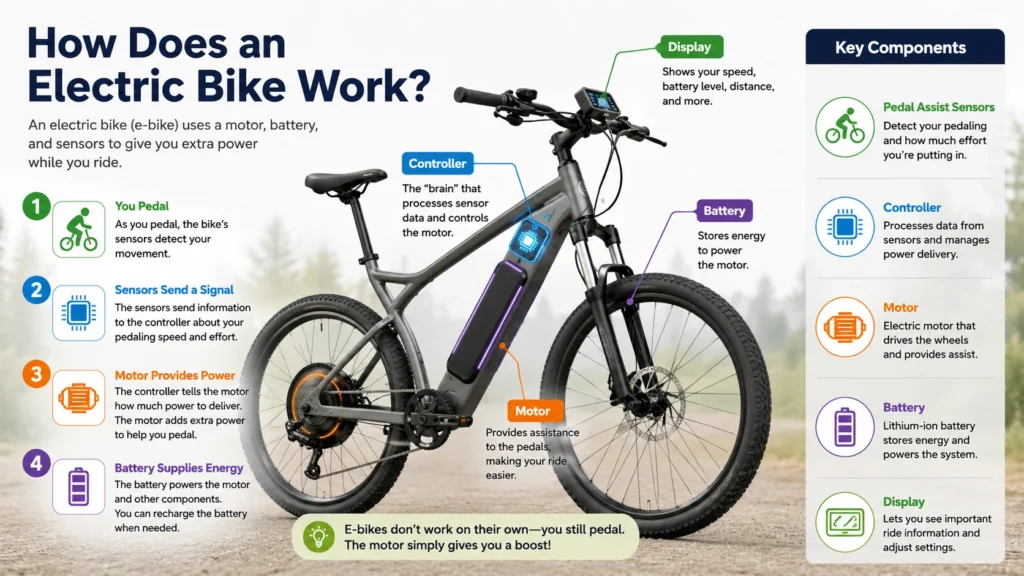
Electric bikes operate by combining human pedaling with electric motor assistance. When the rider begins pedaling, sensors detect the movement and signal the controller to deliver power from the battery to the motor. The amount of Assistance depends on the selected riding mode and the bike’s sensor technology.
Most e-bikes offer multiple assistance levels, allowing riders to choose between minimal support for exercise or maximum assistance for steep climbs and long-distance commuting. Advanced models equipped with torque sensors automatically adjust motor output based on how hard the rider pedals, creating a smooth and natural riding experience.
The battery is rechargeable using a standard electrical outlet, and charging typically takes between three and seven hours depending on battery capacity and charger type. Once fully charged, an electric bike can travel anywhere from 20 to over 100 miles on a single charge, depending on terrain, rider weight, assist level, weather conditions, and battery size.
Electric bikes are also equipped with sophisticated safety systems, including battery management systems (BMS), waterproof electrical connections, integrated lighting, hydraulic disc brakes, and smart displays that monitor performance in real time. These technologies improve reliability while making electric bikes easier and safer to use for everyday transportation.
Types of Electric Bikes
Electric bikes are available in several categories, each designed to meet different riding needs and lifestyles. Choosing the right type depends on where you ride, how often you ride, and what features matter most to you.
Commuter Electric Bikes
Commuter electric bikes are built for everyday urban travel. They feature comfortable riding positions, efficient motors, integrated lights, fenders, luggage racks, and puncture-resistant tires. These bikes are ideal for replacing short car trips, reducing commuting costs, and navigating city traffic with ease.
Electric Mountain Bikes (eMTBs)
Electric mountain bikes are designed for off-road adventures and challenging terrain. Equipped with powerful mid-drive motors, full or front suspension systems, aggressive tires, and durable frames, they help riders tackle steep climbs and technical trails while maintaining excellent control and stability.
Folding Electric Bikes
Folding electric bikes are compact and portable, making them perfect for apartment living, RV travel, and mixed-mode commuting. Their foldable frames allow for easy storage in small spaces and convenient transport on buses, trains, or in car trunks.
Fat Tire Electric Bikes
Fat tire electric bikes feature oversized tires that provide exceptional grip and stability on loose surfaces such as sand, snow, gravel, and mud. They are popular among adventure riders who enjoy exploring varied terrain throughout the year.
Cargo Electric Bikes
Cargo electric bikes are built to carry heavy loads, making them ideal for families, grocery shopping, delivery services, and small business transportation. Reinforced frames and high-capacity motors enable them to transport children, equipment, and cargo safely and efficiently.
Road Electric Bikes
Road electric bikes combine lightweight frames with aerodynamic designs to maximize speed and efficiency on paved roads. They are an excellent choice for long-distance rides, fitness training, and recreational cycling, offering subtle motor assistance while preserving the feel of a traditional road bike.
Electric Bike Motors Explained
The motor is the heart of every electric bike. It determines how much assistance you receive while pedaling, how well the bike climbs hills, how quickly it accelerates, and how smoothly it performs on different terrains. Choosing the right motor is one of the most important decisions when buying an electric bike because it directly affects performance, efficiency, and riding comfort.
Modern electric bike motors are available in different power ratings and configurations to suit various riding styles. Some are designed for city commuting and everyday transportation, while others are built for mountain biking, cargo hauling, or high-performance off-road adventures.
Hub Drive Motors
Hub motors are located in either the front or rear wheel and are one of the most common motor types found on entry-level and mid-range electric bikes. They operate independently of the bike’s drivetrain, making them simple, reliable, and cost-effective.
Advantages of Hub Motors
- Affordable and widely available
- Low maintenance requirements
- Quiet operation
- Smooth acceleration
- Ideal for flat roads and city commuting
- Easier to replace if needed
Disadvantages of Hub Motors
- Less efficient on steep hills
- Slightly heavier wheel weight
- Reduced traction on challenging terrain
- Less natural riding feel compared to mid-drive systems
Hub-drive motors are an excellent choice for commuters, recreational riders, and beginners looking for an affordable electric bike.
Mid-Drive Motors
Mid-drive motors are positioned at the center of the bike near the pedals. Instead of powering the wheel directly, they transfer power through the bike’s chain and gears, resulting in more efficient performance and better weight distribution.
Advantages of Mid-Drive Motors
- Superior hill-climbing ability
- Better balance and handling
- Increased battery efficiency
- More natural pedaling experience
- Excellent performance on rough terrain
- Higher torque for steep climbs
Disadvantages of Mid-Drive Motors
- Higher purchase price
- Increased drivetrain wear
- More expensive repairs
- Requires regular maintenance
Mid-drive motors are preferred by experienced cyclists, mountain bikers, and riders who frequently encounter hills or uneven terrain.
Front Hub vs Rear Hub Motors
| Feature | Front Hub Motor | Rear Hub Motor |
| Cost | Lower | Moderate |
| Installation | Easier | Slightly complex |
| Weight Distribution | Front-heavy | Better balanced |
| Hill Performance | Moderate | Better |
| Traction | Less | Excellent |
| Best For | Casual riders | Daily commuting |
Understanding Electric Bike Motor Power
Motor power is measured in watts (W). While a higher wattage generally means more power, selecting the appropriate motor depends on your riding needs rather than simply choosing the biggest number.
250W Motors
A 250W motor is the standard option for many commuter bikes and is commonly used in countries with stricter e-bike regulations. It offers smooth assistance for city riding, paved roads, and light hills while maximizing battery efficiency.
Best for:
- Urban commuting
- Bike paths
- Flat roads
- Beginners
- Daily transportation
350W Motors
A 350W motor provides a noticeable increase in acceleration and climbing ability while maintaining good battery efficiency. It is suitable for riders who encounter moderate hills or carry light cargo during their daily commute.
Best for:
- Suburban riding
- Moderate hills
- Recreational cycling
- Weekend adventures
500W Motors
A 500W motor delivers strong performance for riders seeking greater versatility. It can handle steeper inclines, heavier riders, and longer commutes without sacrificing comfort.
Best for:
- Mixed terrain
- Daily commuting
- Fitness riding
- Moderate off-road use
750W Motors
One of the most popular options in North America, a 750W motor offers excellent power for challenging terrain and demanding rides. It provides faster acceleration and improved climbing performance while remaining practical for everyday use where regulations permit.
Best for:
- Steep hills
- Heavy riders
- Cargo bikes
- Long-distance commuting
- Off-road trails
1000W and Higher
Motors rated at 1000W or above are typically designed for private land or off-road use, depending on local regulations. They deliver exceptional acceleration and hill-climbing capabilities but often consume more battery power.
Best for:
- Off-road riding
- Extreme terrain
- Adventure riding
- High-performance applications
Electric Bike Batteries
The battery is the power source of an electric bike and plays a major role in determining how far you can travel on a single charge. Advances in lithium-ion technology have made modern batteries lighter, safer, and more energy-efficient than ever before.
Battery performance depends on several factors, including capacity, riding conditions, terrain, rider weight, weather, and assist level. Understanding battery specifications will help you choose an electric bike that meets your daily travel requirements.
Battery Capacity
Battery capacity is usually measured in watt-hours (Wh). A higher watt-hour rating generally provides a longer riding range.
| Battery Capacity | Average Riding Range | Ideal Use |
| 360Wh | 20–35 miles | Short city trips |
| 500Wh | 30–50 miles | Daily commuting |
| 625Wh | 40–70 miles | Weekend adventures |
| 750Wh | 50–90 miles | Long-distance rides |
| 1000Wh+ | 70–120+ miles | Touring and off-road |
Actual range depends on terrain, rider weight, tire pressure, weather conditions, and riding style.
Battery Lifespan
Most modern lithium-ion batteries last between 3 and 7 years with proper care. Many manufacturers estimate a lifespan of approximately 700 to 1,000 full charge cycles before noticeable capacity loss occurs.
To maximize battery life:
- Avoid completely draining the battery.
- Recharge after each ride if possible.
- Store the battery in a cool, dry place.
- Keep the charge between 20% and 80% for long-term storage.
- Protect the battery from extreme heat and freezing temperatures.
Electric Bike Range
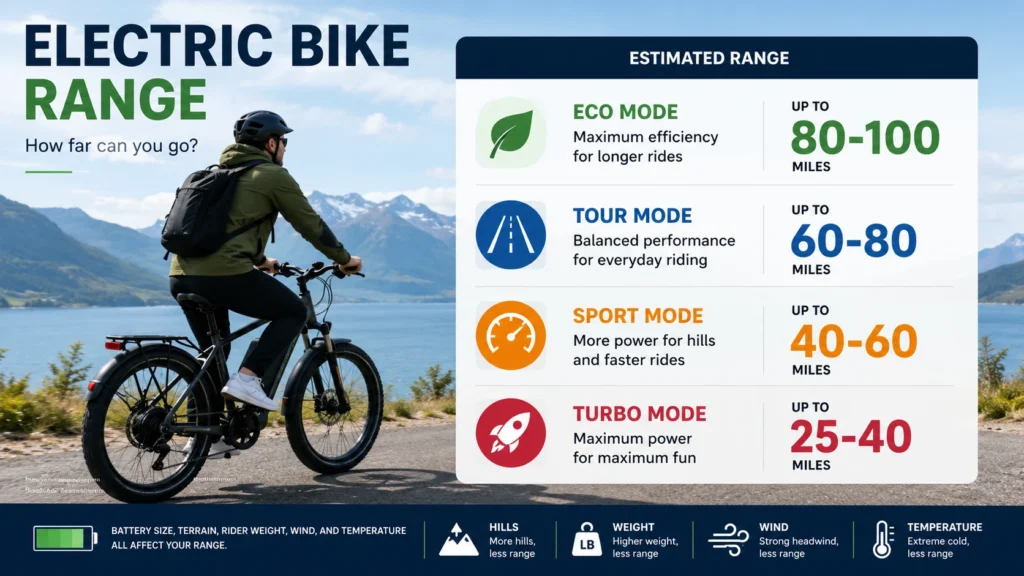
One of the most common Questions buyers ask is, “How far can an electric bike travel on a single charge?” The answer depends on several real-world factors rather than battery size alone.
Factors That Affect Range
- Battery capacity
- Motor efficiency
- Rider weight
- Terrain
- Wind resistance
- Tire pressure
- Assist level
- Average riding speed
- Cargo weight
- Weather conditions
Using lower pedal-assist settings and maintaining proper tire pressure can significantly extend the distance you can travel before recharging.
Charging an Electric Bike
Charging an electric bike is straightforward and similar to charging a laptop or smartphone. Most batteries can be charged using a standard household power outlet.
Average Charging Times
| Charger Type | Charging Time |
| Fast Charger | 2–4 hours |
| Standard Charger | 4–6 hours |
| Large Battery | 6–8 hours |
Charging time varies depending on battery capacity and charger output.
Electric Bike Maintenance Tips
Regular maintenance helps extend the lifespan of your electric bike while ensuring safe and reliable performance.
Daily Maintenance
- Check tire pressure before every ride.
- Inspect brakes for proper operation.
- Clean dirt and mud after riding.
- Verify battery charge level.
Weekly Maintenance
- Lubricate the chain.
- Tighten loose bolts.
- Inspect cables and wiring.
- Clean the drivetrain.
Monthly Maintenance
- Check brake pads for wear.
- Inspect tires for damage.
- Update display firmware if available.
- Examine battery connectors for corrosion.
Proper maintenance not only improves performance but also helps prevent costly repairs over time.
continue
Electric Bike Safety Tips
Owning an electric bike is about more than speed and convenience—it also comes with the responsibility of riding safely. Because e-bikes can travel faster than traditional bicycles and often weigh more, understanding safe riding practices is essential. Whether you’re a beginner or an experienced cyclist, following basic safety guidelines can reduce the risk of accidents and improve your confidence on the road.
Always Wear Protective Gear
Safety equipment should be your first priority before every ride.
Essential protective gear includes:
- Certified cycling helmet
- Reflective clothing
- Cycling gloves
- Safety glasses or goggles
- Bright-colored jacket
- Closed-toe shoes
A properly fitted helmet can significantly reduce the risk of serious head injuries.
Perform a Pre-Ride Safety Check
Before heading out, inspect your electric bike to ensure everything is working correctly.
Check the following:
- Battery is securely locked
- Tires are properly inflated
- Brakes respond smoothly
- Lights are functioning
- Chain is clean and lubricated
- Display shows no warning messages
- Wheels are securely attached
A quick two-minute inspection can help prevent unexpected problems during your ride.
Ride Responsibly
Safe riding habits protect both you and others on the road.
Remember to:
- Follow local traffic laws
- Obey speed limits
- Use hand signals when turning
- Stay visible to drivers
- Keep both hands on the handlebars
- Avoid distractions such as mobile phones
- Leave enough stopping distance
- Slow down in wet conditions
Defensive riding is one of the most effective ways to stay safe.
Electric Bike Laws and Regulations
Electric bike regulations vary from country to country and even between states or provinces. Before purchasing an e-bike, familiarize yourself with local laws regarding speed limits, motor power, helmet requirements, and where e-bikes are permitted to ride.
Common E-Bike Classes
Class
- Pedal assist only
- Maximum assisted speed: 20 mph (32 km/h)
- No throttle
Suitable for bike paths and recreational cycling.
Class
- Pedal assist
- Throttle included
- Maximum speed: 20 mph (32 km/h)
Ideal for commuting and everyday transportation.
Class
- Pedal assist only
- Maximum assisted speed: 28 mph (45 km/h)
- Higher-performance commuter bikes
Some areas restrict Class 3 bikes from shared-use trails.
Always check your local transportation authority for the latest regulations before riding.
Electric Bike Advantages
Electric bikes have become increasingly popular because they offer numerous benefits for both transportation and recreation.
Eco-Friendly Transportation
Electric bikes produce zero tailpipe emissions, making them a cleaner alternative to cars and motorcycles. By choosing an e-bike for short trips, riders can reduce their carbon footprint and contribute to a healthier environment.
Lower Transportation Costs
Compared to owning a car, electric bikes require less maintenance, lower operating costs, and no fuel expenses. Charging a battery typically costs only a small fraction of filling a fuel tank.
Easier Hill Climbing
Steep hills become much more manageable with pedal assistance, allowing riders of different fitness levels to enjoy challenging routes without excessive fatigue.
Improved Health
Although the motor provides assistance, riders still pedal throughout the journey. Regular cycling supports cardiovascular health, strengthens muscles, improves endurance, and encourages a more active lifestyle.
Longer Riding Distance
Battery assistance enables riders to travel much farther than they could on a traditional bicycle, making e-bikes ideal for commuting, touring, and weekend adventures.
Reduced Traffic Stress
Electric bikes can often bypass traffic congestion using bike lanes and dedicated cycling paths, helping commuters save valuable time.
Electric Bike Disadvantages
While electric bikes offer many benefits, they also have some limitations that buyers should consider.
Higher Initial Cost
Quality electric bikes generally cost more than conventional bicycles because of their motor, battery, and electronic components.
Heavier Weight
The addition of a battery and motor makes e-bikes heavier, which can make carrying or transporting them more difficult.
Battery Replacement
Lithium-ion batteries eventually lose capacity and require replacement after several years of use. Battery replacement can be one of the most significant long-term ownership costs.
Charging Requirements
Unlike traditional bicycles, electric bikes require regular charging. Riders planning long-distance trips should consider battery range and charging availability.
Legal Restrictions
Some regions limit motor power, top speed, or where electric bikes can be ridden. Understanding local laws is important before making a purchase.
How to Choose the Best Electric Bike
Selecting the right electric bike depends on your riding habits, budget, and personal preferences. Instead of focusing only on motor power or top speed, evaluate the complete package to ensure long-term satisfaction.
Define Your Riding Purpose
Ask yourself where you’ll ride most often:
- City commuting
- Weekend recreation
- Mountain trails
- Fitness riding
- Grocery shopping
- Long-distance touring
Choosing the right bike category will help narrow your options.
Consider Battery Capacity
If your daily commute is less than 20 miles, a 400–500Wh battery may be sufficient. Riders planning longer trips should consider batteries with 625Wh or more for extended range.
Choose the Right Motor
- 250W: Urban commuting and flat roads
- 350W: Moderate hills and recreational riding
- 500W: Mixed terrain and daily commuting
- 750W: Heavy riders, cargo bikes, and steep climbs
- 1000W+: Off-road and high-performance use (where legal)
Select the Correct Frame Size
A properly sized frame improves comfort, handling, and pedaling efficiency. Most manufacturers provide sizing charts based on rider height.
Check the Braking System
Hydraulic disc brakes provide superior stopping power, especially in wet conditions or on steep descents. Mechanical disc brakes are also reliable for everyday riding.
Evaluate Warranty and Customer Support
Choose brands that offer comprehensive warranties, responsive customer service, and easy access to replacement parts.
Electric Bike Accessories
The right accessories can improve safety, convenience, and riding comfort.
Popular accessories include:
- Helmet
- Bike lock
- Front and rear lights
- Rear cargo rack
- Waterproof pannier bags
- Phone holder
- Water bottle cage
- Bike computer
- Portable tire pump
- Spare inner tube
- Multi-tool repair kit
- Fenders
- Rearview mirror
Investing in quality accessories enhances both daily commuting and long-distance rides.
Who Should Buy an Electric Bike?
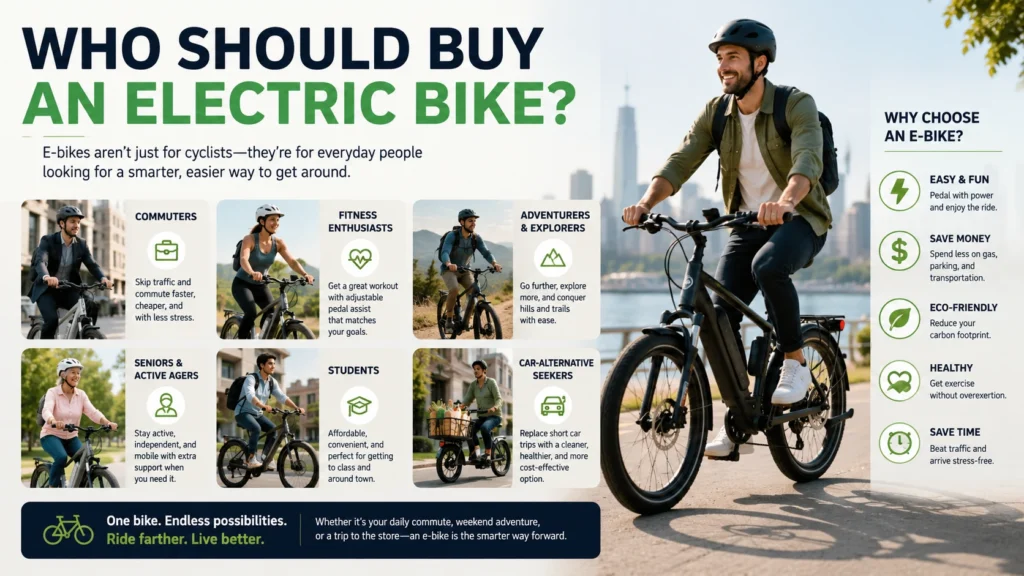
Electric bikes are Suitable for a wide variety of riders.
They are ideal for:
- Daily commuters
- College students
- Senior citizens
- Delivery riders
- Recreational cyclists
- Mountain biking enthusiasts
- Travelers
- Fitness beginners
- Environmentally conscious individuals
- Families seeking an alternative to car trips
No matter your experience level, an electric bike can make cycling more accessible, enjoyable, and practical.
FAQs
Q1; Are electric bikes worth the investment?
A; Yes. They reduce commuting costs, make cycling more accessible, and offer a convenient, eco-friendly transportation option.
Q2; How long does an electric bike battery last?
A; Most lithium-ion batteries last between 3 and 7 years or approximately 700–1,000 charging cycles, depending on usage and maintenance.
Q3; Can I ride an electric bike in the rain?
A; Most electric bikes are water-resistant and designed for riding in light rain. However, avoid submerging the bike or exposing the battery to excessive moisture.
Conclusion
Electric bikes have transformed the way people commute, exercise, and explore the outdoors. They combine the efficiency of modern electric Technology with the timeless benefits of cycling, offering riders an environmentally friendly, cost-effective, and enjoyable mode of transportation. Whether you’re navigating busy city streets, climbing mountain trails, or replacing short car trips, an electric bike provides the flexibility and performance to suit nearly every lifestyle.
When choosing an e-bike, focus on your riding needs, battery capacity, motor type, frame design, safety features, and long-term maintenance. Investing in a high-quality electric bike not only improves your daily travel experience but also promotes a healthier and more sustainable future. With the right knowledge and careful selection, you can confidently choose an electric bike that delivers years of reliable performance, comfort, and adventure.
