
Introduction
Getting Kids away from screens and moving their bodies does not have to feel like a daily battle. Physical activity can be simple, playful, affordable, and enjoyable.
The best activities for children often do not look like exercise at all. Running, cycling, dancing, jumping, climbing, playing tag, and exploring outdoors can turn everyday play into healthy movement.
For children ages 3 to 5, activity should happen throughout the day. Children and teens ages 6 to 17 should aim for at least 60 minutes of moderate-to-vigorous physical activity each day, including a variety of aerobic, muscle-strengthening, and bone-strengthening activities.
The key is not to force children into workouts they dislike. Instead, help them discover activities they genuinely enjoy.
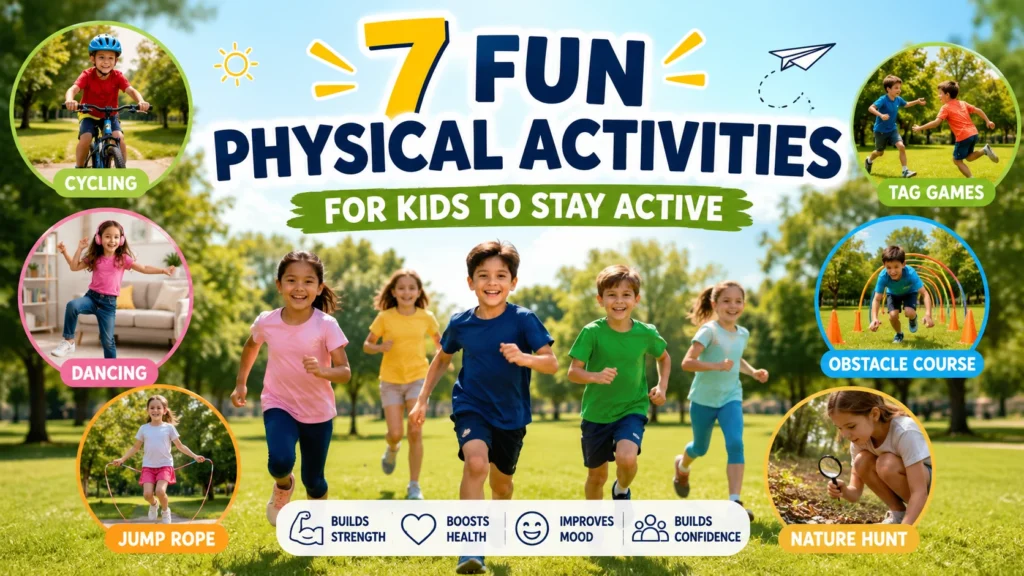
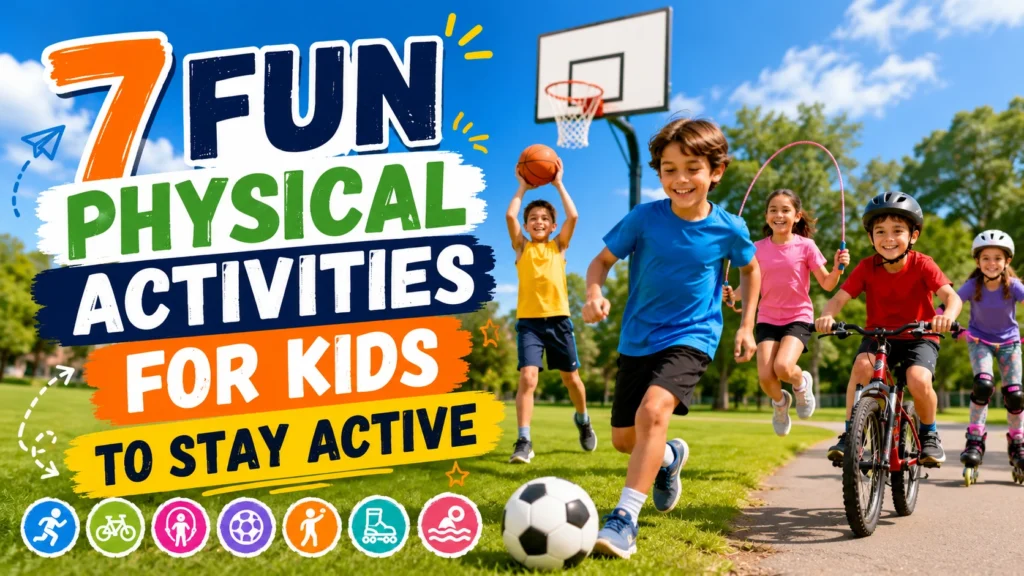
In this guide, you’ll find 7 fun physical activities for kids to stay active, along with indoor games, outdoor ideas, no-equipment activities, age-specific suggestions, cycling ideas, motivation tips, safety advice, and a simple weekly activity plan.
Why Physical Activity Is Important for Kids
Physical activity does much more than help children burn off extra energy.
Regular movement can help children develop strength, balance, coordination, endurance, and confidence. Active play can also support brain health, attention, memory, cognition, and academic performance.
Physical activity can help kids:
- Build stronger muscles and bones
- Improve balance and coordination
- Develop cardiovascular fitness
- Improve movement skills
- Practice teamwork
- Build confidence
- Spend less time sitting
- Explore their surroundings
- Develop healthy habits
- Enjoy quality time with family and friends
Most importantly, children are more likely to remain active when they associate movement with fun rather than pressure.
The goal is not to make every activity feel like a workout. The goal is to make children want to move again tomorrow.
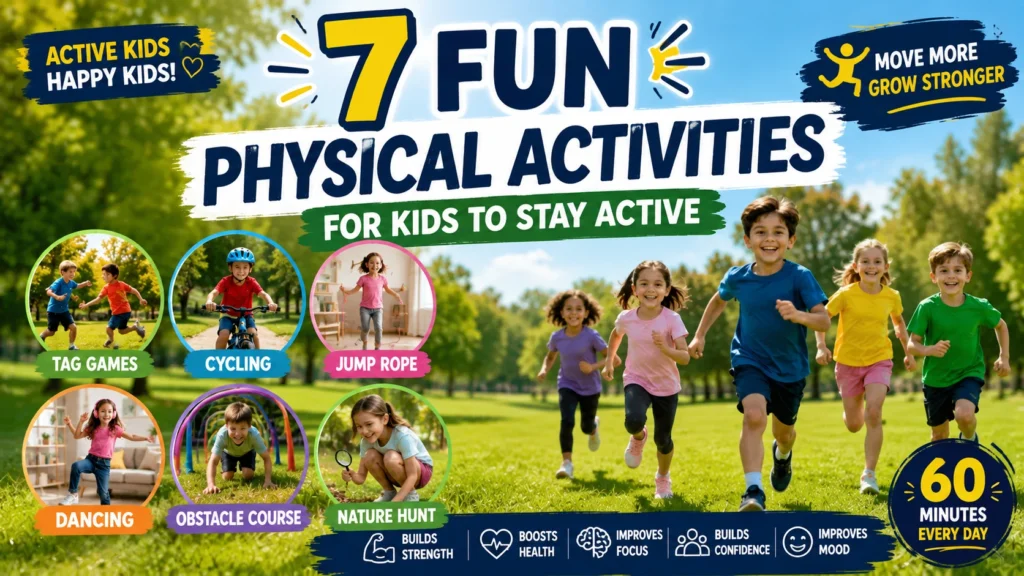
1. Tag, Chase, and Running Games
Tag is one of the easiest physical activities for kids because it requires almost no equipment.
One child becomes “it” and tries to tag another player. Once someone is tagged, they can become “it,” depending on the version of the game.
The simplicity is what makes tag so useful. You can play it in a backyard, playground, park, gym, or another safe open area.
Fun tag variations
Try changing traditional tag into:
- Freeze tag
- Animal tag
- Color tag
- Shadow tag
- Team tag
- Follow-the-leader running
- Relay races
- Red Light, Green Light
- Treasure tag
- Tunnel tag
You can also let children create their own rules.
What does running play develop?
Running games can encourage:
- Speed
- Agility
- Reaction time
- Coordination
- Cardiovascular fitness
- Direction changes
- Social interaction
Make running feel like an adventure
Instead of saying, “Let’s exercise,” create a story.
For example:
“The floor is lava! Can you reach the safe zone before the lava monster catches you?”
A simple imaginary mission can turn ordinary running into an exciting game.
2. Cycling and Bike Adventures
Cycling is an excellent way for kids to stay active while developing balance, coordination, endurance, and leg strength.
Depending on age and ability, children may use a tricycle, balance bike, regular bicycle, or another suitable cycle.
A short bike ride can become much more exciting when you turn it into an adventure.
Try a cycling challenge
Give children a small mission during the ride:
- Ride to the park
- Find five interesting things
- Count different types of trees
- Visit three safe checkpoints
- Complete a family bike route
- Practice controlled stopping
- Explore a suitable new trail
- Spot different colors along the route
Cycling can be particularly appealing to children who do not enjoy traditional sports because it combines movement with exploration.
Bike safety for children
Safety should always come before distance or speed.
Parents should consider:
- Properly fitted protective equipment
- A suitable bicycle
- Safe riding surfaces
- Traffic conditions
- Weather
- Visibility
- The child’s riding ability
- Appropriate adult supervision
For younger riders, a protected area away from traffic is generally preferable to a busy road.
3. Jump Rope and Jumping Games
Jumping is a simple way to add active movement to a child’s day.
A jump rope can be used outdoors or indoors when there is enough clear, safe space.
Children who are new to jump rope should begin with basic movements rather than complicated tricks.
Jump-rope games to try
- Count your jumps
- Try to beat your previous score
- Jump to music
- Practice single-foot jumps
- Take turns with siblings
- Create a rhythm challenge
- Combine jumping with simple movement patterns
- Create a jump-and-freeze game
Jumping activities can also contribute to the bone-strengthening component of physical activity recommended for children and adolescents.
Beginner jump-rope challenge
Start small:
10 jumps → rest → 10 jumps → rest → 15 jumps
The purpose is to create a sense of achievement rather than pressure.
4. Dance and Freeze Dance
Not every child enjoys running or competitive sports.
For children who love music, dancing can be one of the easiest ways to make movement enjoyable.
Put on some music and let children move however they want.
How to play freeze dance
- Start the music.
- Everyone dances.
- Stop the music.
- Everyone freezes.
- Start the music again.
You can make each round different by giving children movement challenges.
Try:
- Dance like a robot
- Dance like a dinosaur
- Move like a superhero
- Dance like a monkey
- Move in slow motion
- Copy the leader
- Create your own dance
Dancing can involve coordination, balance, rhythm, endurance, creative expression, and full-body movement.
It is also useful indoors when bad weather prevents outdoor play.
Make it a family activity
Parents can join the dance too.
When adults participate, movement can become family bonding time instead of another task children are being told to complete.
5. Build an Indoor or Outdoor Obstacle Course
Obstacle courses can turn ordinary spaces into exciting movement adventures.
You do not need expensive equipment.
Depending on the space, you can use safe items such as:
- Cushions
- Pillows
- Cones
- Tape
- Cardboard boxes
- Soft balls
- Hula hoops
- Low stepping points
A simple course might look like this:
Start → crawl under an obstacle → follow a taped line → jump over a soft marker → throw a ball into a basket → finish
Movement ideas for an obstacle course
Children can:
- Crawl
- Walk
- Jump
- Balance
- Step
- Throw
- Catch
- Change direction
- Move around obstacles
Obstacle courses are particularly useful because they combine physical movement with problem-solving.
Change the course regularly
You can create a different challenge each day.
Monday: Crawling course
Tuesday: Balance course
Wednesday: Jumping course
Thursday: Treasure hunt course
Friday: Family challenge
Changing the course helps prevent boredom and encourages children to think creatively.
6. Playground Climbing, Swinging, and Active Play
A playground can provide several types of physical activity in one location.
Depending on the equipment and the child’s ability, playground play may involve:
- Climbing
- Walking
- Running
- Balancing
- Swinging
- Hanging
- Sliding
- Crawling
- Jumping
Instead of controlling every minute of playground time, give children simple challenges.
7. Nature Walks and Scavenger Hunts
Walking does not have to feel like exercise.
Turn it into a mission.
A nature scavenger hunt can encourage children to walk, search, bend, observe, and explore their surroundings.
Easy scavenger-hunt ideas
Ask your child to:
- Find a yellow flower
- Find three different leaves
- Spot a bird
- Find a smooth stone
- Find something shaped like a circle
- Find something interesting to smell
- Spot an insect
- Find something taller than them
- Find something with an unusual texture
- Find three different colors
You can do this in a garden, park, trail, or another appropriate outdoor environment.
Instead of asking:
“Do you want to go for a walk?”
try:
“Let’s see if we can find 10 interesting things before we go home.”
Now the walk becomes an adventure.
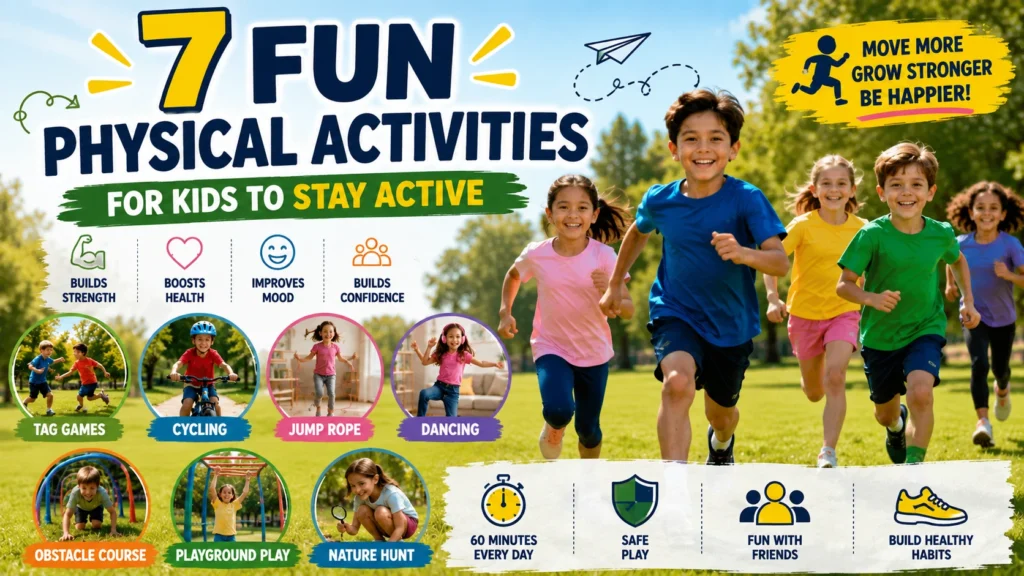
Fun Indoor Physical Activities for Kids
Outdoor play is excellent, but weather, schedules, space, and other circumstances can make indoor activity necessary.
Fortunately, children can still get plenty of movement indoors.
Try:
- Freeze dance
- Balloon keep-up
- Indoor obstacle courses
- Animal walks
- Indoor scavenger hunts
- Follow-the-leader
- Movement stories
- Simon Says
- Dancing games
- Jumping challenges
- Hide-and-seek
- Indoor relay games
Movement story idea
Create a story where every part requires movement.
For example:
“The explorers entered the jungle. They crawled under branches, jumped over logs, climbed a mountain, balanced across a bridge, and ran away from the storm.”
The story becomes the activity.
Fun Outdoor Physical Activities for Kids
Outdoor spaces give children more room for large movements and exploration.
Good outdoor choices include:
- Bike Rides
- Walking
- Hiking
- Tag
- Soccer
- Basketball
- Playground games
- Nature scavenger hunts
- Relay races
- Jump rope
- Swimming
- Frisbee
- Family walks
Outdoor activities can also combine movement with fresh air, exploration, creativity, and social interaction.
No-Equipment Physical Activities for Kids
You do not need to buy sports equipment to help children become active.
Many activities require nothing except safe space.
Try:
- Running
- Jumping
- Dancing
- Animal walks
- Follow-the-leader
- Freeze dance
- Tag
- Hide-and-seek
- Red Light, Green Light
- Simon Says
- Balance challenges
- Imaginary adventures
- Walking
- Scavenger hunts
This makes active play accessible even when families have limited equipment or space.
Physical Activities for Kids by Age
Children develop different physical and social skills at different ages, so activities should be adjusted to their abilities.
Ages 3–5
Young children benefit from playful movement throughout the day.
Good options include:
- Dancing
- Animal walks
- Short running games
- Playground play
- Ball games
- Tricycle riding
- Balance-bike riding
- Simple obstacle courses
- Nature walks
- Jumping games
Keep instructions short and allow plenty of room for exploration.
Ages 6–8
Children can usually handle more structured games.
Consider:
- Tag
- Relay races
- Cycling
- Jump rope
- Dance games
- Scavenger hunts
- Obstacle courses
- Swimming
- Playground challenges
- Beginner sports
Ages 9–12
Older children may enjoy challenges, teamwork, and skill development.
Options include:
- Basketball
- Soccer
- Cycling
- Hiking
- Swimming
- Jump-rope challenges
- Team relay races
- Dance
- Martial arts
- More advanced obstacle courses
Teenagers
Older children can choose activities according to their interests.
Possibilities include:
- Running
- Cycling
- Swimming
- Team sports
- Hiking
- Dancing
- Age-appropriate strength-building activities
- Martial arts
- Recreational sports
The most important factor is finding an activity they actually enjoy.
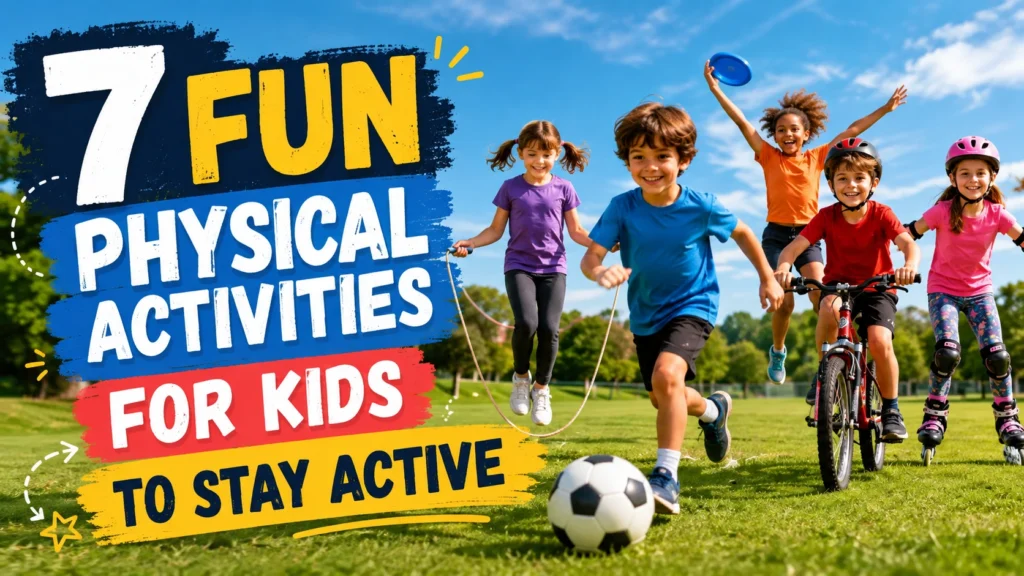
How to Get Kids Excited About Physical Activity
One of the biggest mistakes parents can make is presenting physical activity as punishment.
Instead of:
“Stop Playing and exercise.”
Try:
“Let’s see who can complete this challenge first.”
The second approach makes movement feel like play.
1. Let kids choose
Offer two or three options:
“Do you want to ride bikes, play tag, or do a scavenger hunt?”
Giving children a choice can make participation feel more enjoyable.
2. Join them
Play tag together.
Dance together.
Ride bikes together.
Take a family walk.
Build an obstacle course together.
3. Turn movement into a game
Give activities a:
- Mission
- Story
- Challenge
- Goal
- Treasure hunt
- Personal record
4. Do not make everything competitive
Some children love competition.
Others do not.
Instead of always asking who won, ask:
- Did you beat your previous score?
- Did you learn something new?
- Did you try something difficult?
- Did you have fun?
5. Keep activities varied
Rotate between:
Running + cycling + dancing + climbing + jumping + walking + games
Variety can make physical activity feel fresh.
How to Fit 60 Minutes of Activity Into a Child’s Day
For school-aged children, daily activity does not necessarily need to feel like one long workout.
Movement can happen throughout the day.
For example:
| Part of Day | Activity | Approx. Time |
| Before school | Walking or active play | 10 minutes |
| After school | Cycling, running, or playground | 20 minutes |
| Evening | Family activity | 20 minutes |
| Short movement breaks | Dancing or jumping | 10 minutes |
| Total | Daily movement | 60 minutes |
The exact routine should depend on the child’s age, interests, schedule, environment, and abilities.
Physical Activities for Kids That Improve Balance and Coordination
Some activities naturally combine movement with balance and coordination.
Useful options include:
- Cycling
- Balance-bike riding
- Playground climbing
- Obstacle courses
- Jump rope
- Dancing
- Ball games
- Animal walks
- Follow-the-leader
- Balance challenges
Rather than isolating one skill, parents can combine several activities into one playful session.
For example:
Cycle → balance challenge → ball game → short running game
This gives children variety while keeping movement enjoyable.
What If My Child Doesn’t Like Exercise?
This is common.
The solution may be to stop presenting movement as “exercise.”
A child might dislike jogging but love cycling.
They might dislike organized sports but enjoy dancing.
They might dislike structured workouts but happily spend an hour exploring a playground.
Look for the type of movement that matches their personality.
If they like music
Try dancing.
If they like competition
Try races and challenges.
If they like animals
Try animal walks.
If they like adventure
Try hiking or scavenger hunts.
If they like friends
Try team games.
If they like independence
Let them choose the activity.
The goal is to build a positive relationship with movement.
How to Reduce Screen Time Without Constant Arguments
You do not necessarily need to declare war on screens.
Instead, create alternatives that are genuinely interesting.
| Screen Activity | Active Alternative |
| Video games | Backyard challenge |
| Watching videos | Dance session |
| Phone time | Scavenger hunt |
| TV | Family walk |
| Sitting indoors | Indoor obstacle course |
A five-minute movement game can also be easier to introduce than immediately demanding an hour of activity.
Make the alternative attractive.
Simple 7-Day Active Kids Plan
A weekly plan can make active play easier for families.
| Day | Activity | Fun Challenge |
| Monday | Tag games | Create 3 tag variations |
| Tuesday | Cycling | Explore a safe route |
| Wednesday | Dance | Freeze-dance challenge |
| Thursday | Obstacle course | Beat a personal best |
| Friday | Playground | Try 5 movements |
| Saturday | Nature walk | Complete a scavenger hunt |
| Sunday | Family activity | Let the child choose |
The goal is not perfection.
The goal is to create regular opportunities for enjoyable movement.
Physical Activity Safety Tips for Kids
Fun should always be paired with sensible safety precautions.
Choose age-appropriate activities
A game suitable for a 10-year-old may not be appropriate for a 3-year-old.
Adjust activities according to the child’s development, confidence, and ability.
Check the environment
Before active play, look for:
- Sharp objects
- Slippery surfaces
- Traffic
- Unstable furniture
- Dangerous heights
- Damaged playground equipment
- Excessive heat
- Other hazards
Use appropriate equipment
For cycling and other activities, make sure equipment is suitable and properly fitted.
Stay hydrated
Children can lose fluids during active play, particularly in hot weather.
Offer water regularly.
Consider weather
Very hot, cold, or poor weather may require changing the activity or moving indoors.
Supervise when necessary
Young children and activities involving water, roads, heights, climbing, or specialized equipment may require closer adult supervision.
The aim is not to remove every challenge. It is to create an environment where children can explore movement safely.
How to Choose the Best Physical Activity for Your Child
There is no single “best” activity for every child.
A better approach is to consider five factors:
| Factor | Question to Ask |
| Interest | Does my child actually enjoy it? |
| Age | Is it appropriate for their developmental stage? |
| Space | Can we do it safely where we live? |
| Equipment | Do we need anything special? |
| Variety | Can we combine it with other activities? |
If an activity scores well across these areas, it is more likely to become a regular habit.
People Also Ask
What are the best physical activities for kids?
Some excellent options include running games, cycling, jumping rope, dancing, obstacle courses, playground play, walking, swimming, and active sports. The best choice is usually safe, age-appropriate, enjoyable, and practical for the child.
How much physical activity should kids get each day?
Children ages 3–5 should have opportunities to be physically active throughout the day. Children and teens ages 6–17 should aim for at least 60 minutes of moderate-to-vigorous physical activity each day.
What are fun indoor physical activities for kids?
Freeze dance, balloon keep-up, indoor obstacle courses, animal walks, movement stories, scavenger hunts, and follow-the-leader are simple indoor options.
What physical activities can kids do without equipment?
Kids can run, dance, jump, play tag, play hide-and-seek, perform animal walks, create imaginary adventures, do movement games, and go for walks without specialized equipment.
How can I motivate my child to be more active?
Make movement playful rather than treating it like a chore. Let children choose between activities, participate with them, create challenges, and regularly introduce new activities.
