
The Two Numbers That Define a Bike Wheel
Whether you are a seasoned road racer in the UK, a gravel adventurer in Germany, or a mountain bike enthusiast in the USA, your entire riding experience rests on two specific numbers printed on the side of your tires. These numbers are the DNA of your bike’s handling, comfort, and safety.
Understanding the relationship between The Two Numbers That Define a Bike Wheel and width is the difference between a bike that glides effortlessly over tarmac and one that feels sluggish, or worse. This tire blows off the rim mid-descent. In the modern era of cycling—where the lines between road, gravel, and mountain bikes are increasingly blurred—relying on old-school “inch” measurements is no longer enough.
At BikesLover.com, we believe every rider should be a master of their machine. This guide will take you through the labyrinth of French, Imperial, and International sizing systems, explain the “Tubeless Revolution,” and provide the technical charts you need to make an informed decision for your next upgrade.
Why These Two Numbers Matter More Than You Think
In the cycling world, “close enough” isn’t good enough. The two numbers defining your wheel and tire dictate every physical interaction between your bike and the ground.
1. Diameter (The First Number)
The diameter—often expressed as 700c, 29″, or 650b—refers to the overall size of the wheel.
- Rolling Efficiency: Larger diameters maintain momentum better and hit obstacles at a shallower angle, resulting in smoother rides over bumps.
- Geometry: The wheel size determines the bike’s “trail” and “mechanical trail,” which dictates how stable or “twitchy” the steering feels.
- Acceleration: Smaller diameters are generally lighter and easier to spin up to speed, which is why they remain popular in technical mountain biking and for smaller riders.
Width (The Second Number)
The width—expressed in millimeters (e.g., 28mm) or inches (e.g., 2.4″)—defines the tire’s “footprint.”
- Traction: A wider tire allows for a larger contact patch with the ground, crucial for cornering and climbing on loose dirt.
- Comfort: Wider tires hold more air volume. This acts as a primary suspension system, absorbing high-frequency vibrations from the road or trail.
- Rolling Resistance: Contrary to old myths, wider tires often have lower rolling resistance at the same pressure because they deform less deeply, creating a rounder contact patch.
Decoding the Markings: What Do the Numbers Actually Mean?
If you look at the sidewall of a tire, you’ll likely see a confusing string of text. Depending on where the tire was manufactured or the style of bike it was designed for, it might use one of three systems.
The Three Main Sizing Systems
| System | Example | Usage | Note |
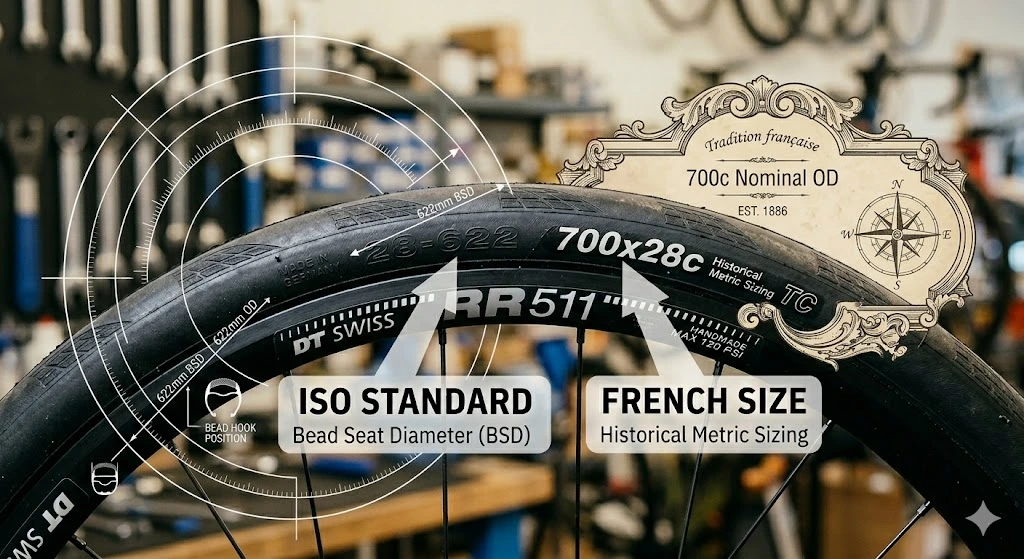
| French | 700 x 28c | Road, Gravel, Hybrid | The “c” is a historical width designation, not “centimeters.” |
| Imperial (Inches) | 29 x 2.3″ | Mountain Bikes, Cruisers | Very approximate; does not always guarantee rim fit. |
| ISO / ETRTO | 28-622 | Industry Standard | The only 100% reliable system for compatibility. |
The Secret Key: Bead Seat Diameter (BSD)
The most important number you will ever learn is the Bead Seat Diameter. This is the second number in the ISO system (e.g., the “622” in 28-622).
The BSD is the exact measurement in millimeters of the “shelf” on the rim where the tire bead sits. If your rim has a 622mm BSD, you must buy a tire with a 622mm BSD. You cannot stretch a 584mm tire onto a 622mm rim.
Expert Tip: Did you know that a 29-inch MTB tire and a 700c road tire have the exact same BSD? Both are 622mm. The difference in name is purely marketing and tradition!
Comprehensive Bike Wheel/Tire Size Chart
Use this table to identify your wheel type and the standard ISO measurements used by professional mechanics worldwide.
| Common Name | ISO / BSD | Typical Widths | Common Bike Types |
| 700c | 622mm | 23mm – 45mm | Road, Gravel, Commuter |
| 29 Inch | 622mm | 2.0″ – 2.6″ | XC, Trail, and Enduro MTB |
| 650b / 27.5″ | 584mm | 42mm – 2.8″ | Gravel, Trail MTB, Bikepacking |
| 26 Inch | 559mm | 1.5″ – 4.0″ | Vintage MTB, Fat Bikes, Dirt Jump |
| 700b / 28″ | 635mm | 35mm – 40mm | Vintage Dutch / English Roadsters |
| 650c | 571mm | 23mm – 28mm | Triathlon, Small Frame Road |
How Tire Width Interacts with Rim Width
A common mistake is focusing only on whether the tire fits the frame, while ignoring the internal rim width.
In the past, road rims were very narrow (13–15mm internal). If you tried to put a modern 32mm tire on such a narrow rim, the tire would take on a “lightbulb” shape. This makes the tire unstable during cornering because the sidewalls lack support.
The Rule of Proportions
For the best performance and safety, follow these guidelines:
- Narrow Rims (15-19mm): Best for 23mm to 32mm tires.
- Mid-Range Rims (21-25mm): Ideal for gravel tires (35mm-45mm) or XC mountain bikes.
- Wide Rims (27mm-35mm): Designed for high-volume MTB tires (2.3″ and up).
Modern Trend: Wide is the New Fast
In the 2025–2026 season, professional road cyclists have almost entirely moved away from 23mm tires. The standard is now 28mm or even 32mm. Why? Because wider tires on wider rims allow for lower air pressure, which keeps the tire in contact with the ground more consistently, resulting in more speed and significantly less rider fatigue.
Performance Impacts: Diameter vs. Width Trade-offs
Choosing the right combination is about balancing the physics of your specific riding environment.
Larger Diameter (e.g., 29″ / 700c)
- Pros: Exceptional “rollover” capability. If you hit a pothole or a tree root, the larger wheel spans the gap more easily. It also provides a longer “contact patch” for better braking traction.
- Cons: Higher rotational weight. It takes more energy to get a 29″ wheel moving from a standstill compared to a 26″ wheel.
Wider Tires (e.g., 2.4″ or 45mm)
- Pros: Comfort is the primary benefit. By increasing the volume of air, you create a pneumatic cushion. Wider tires also allow you to run lower pressures without the risk of “pinch flats” (where the tube gets bitten by the rim).
- Cons: Aerodynamic drag increases significantly at speeds above 30 km/h. They also add weight, which you will feel on long, steep climbs.
The Tubeless Revolution: Changing the Sizing Equation
In recent years, the move to Tubeless technology (where sealant and a special valve replace the inner tube) has changed how we view these numbers.
Because tubeless setups don’t have an inner tube to “pinch,” we can run much wider tires at significantly lower pressures. A 28mm tubeless road tire at 60 PSI (4.1 bar) is often faster and more comfortable than a 23mm tire with a tube at 100 PSI (6.9 bar).
When buying tires, check if your rim is “Tubeless Ready” (TR or TC). Using a non-tubeless tire on a tubeless rim (or vice versa) can lead to safety risks.
Pros and Cons of Common Wheel Standards
700c (622mm) / 29-inch
- Pros: Best rolling speed; massive selection of tires available worldwide; superior for long-distance touring.
- Cons: Can feel cumbersome on very small bike frames; slightly higher weight.
650b (584mm) / 27.5-inch
- Pros: Very “flickable” and agile; allows for much wider tires to be fitted into standard frames (popular for gravel bikes).
- Cons: Does not roll over obstacles as smoothly as 29″; becoming less common in high-end XC racing.
26-inch (559mm)
- Pros: Strongest wheel structure due to shorter spokes; very easy to find spare parts in developing countries or remote areas.
- Cons: Outdated for modern performance racing; limited high-end tire options.
Real-World Examples: The “Perfect” Setup
| Riding Style | Recommended Diameter | Recommended Width | Why? |
| Criterium Racing | 700c | 25mm – 28mm | Max aero and high-speed cornering. |
| Casual Commuting | 700c | 32mm – 38mm | Pothole protection and durability. |
| Technical Enduro | 29″ | 2.4″ – 2.5″ | Max grip and obstacle rollover. |
| Bikepacking | 650b | 47mm – 50mm | Comfort for 8+ hours in the saddle. |
How to Measure Your Current Bike for New Tires
Before you click “Buy” on that shiny new pair of tires, follow these four steps:
- Read the Sidewall: Look for the ISO number (e.g., 40-622). This tells you your current width and diameter.
- Measure the Clearance: Use a set of calipers (or a hex wrench) to measure the gap between your current tire and the frame/fork. You should have at least 4mm to 6mm of “mud clearance” on all sides.
- Check Rim Internal Width: Remove your tire and measure the width between the inside hooks of the rim. Ensure your new tire width is compatible (refer to the 1.4x – 2.2x rule).
- Brake Compatibility: If you have rim brakes (calipers), ensure the brake arms can open wide enough to accommodate a wider tire. If you have disc brakes, this is rarely an issue.
Common Myths and Mistakes to Avoid
- Myth: “Higher pressure is always faster.”
- Reality: On anything but a perfectly smooth wooden velodrome, over-inflated tires bounce off imperfections, wasting energy. Lower pressure in a wider tire is often faster.
- Myth: “A 29-inch wheel is bigger than a 700c wheel.”
- Reality: They are identical in diameter at the rim. The “29 inches” includes the height of a thick mountain bike tire.
- Mistake: Buying by “Inches” alone.
- Reality: There are multiple types of “26-inch” wheels (ISO 559, 590, and 597mm) that are not interchangeable. Always use the ISO/ETRTO number.
2025–2026 Trends: What’s Next?
The industry is currently stabilizing after a decade of rapid change. We are seeing:
- The Death of the Narrow Road Tire: Even entry-level road bikes now ship with 28mm or 30mm tires as standard.
- Mullet Setups: In the mountain bike world, “Mullet” bikes (29″ wheel in the front for rollover, 27.5″ in the back for agility) have become the go-to for downhill and enduro racing.
- Hookless Rims: A new rim design that is lighter but requires very specific tire compatibility. Always check if your tire is “Hookless Compatible” if you have modern carbon wheels.
FAQs
A: Usually, no. While the diameter (622mm) is the same, the width of a 29-inch MTB tire (usually 50mm+) is far too wide to fit between the stays of a road bike frame or under rim brake calipers.
A: The tire will lack lateral support. When you lean into a corner, the tire may “squirm” or fold over, which can cause a crash. It also increases the risk of the tire bead unseating from the rim.
A: These are two names for the same thing. “650b” is the French name, and “27.5-inch” is the MTB marketing name. Both use a 584mm BSD.
A: by law in most regions, the ISO/ETRTO number must be molded into the tire sidewall, though it is sometimes small and hard to find.
A: A wider tire is usually taller, which increases the total circumference of the wheel. If you have a cycle computer that uses a wheel magnet, you must recalibrate it when changing tire widths.
Final Expert Verdict
Mastering the “Two Numbers” is the ultimate “level up” for any cyclist. By focusing on the ISO/ETRTO (Width-BSD) system, you eliminate the guesswork and technical frustration of buying new gear.
If you want speed, look to optimize your diameter (700c/29″). If you want comfort and control, look to maximize your width within the limits of your frame’s clearance. At BikesLover.com, we recommend every rider keeps a small notebook with their bike’s ISO specs—it is the most reliable tool in your maintenance kit.
