
Bike Tires for Mountain Bike
Introduction
Bike tires for mountain bikes are one of the most thrilling ways to explore nature—but your entire riding experience depends heavily on one crucial component: bike tires for mountain bikes.
Whether you’re tackling muddy forest trails, rocky terrains, or smooth dirt paths, your tires determine your grip, speed, control, and safety. Even the most expensive mountain bike can feel unstable and inefficient if paired with the wrong tires.
Yet, many riders—especially beginners—either overlook tire selection or get overwhelmed by confusing options like tread patterns, widths, compounds, and tubeless systems.
This guide is designed to simplify everything.
By the end of this comprehensive 2026 guide, you’ll understand:
- Different types of MTB tires
- How to choose the right tire for your terrain
- Tire size and width explained
- Tubeless vs tube systems
- Expert tips and real-world use cases
Let’s break it down step-by-step.
What Are Mountain Bike Tires?
Mountain bike (MTB) tires are specially engineered for off-road riding. Unlike road bike tires, they are:
- Wider for stability
- Knobbier for grip
- Stronger to handle rough terrain
Key Functions of MTB Tires:
- Provide traction on uneven surfaces
- Absorb shocks from rocks and roots
- Maintain stability during cornering
- Improve braking efficiency
In simple terms: Your tires are your connection to the trail.
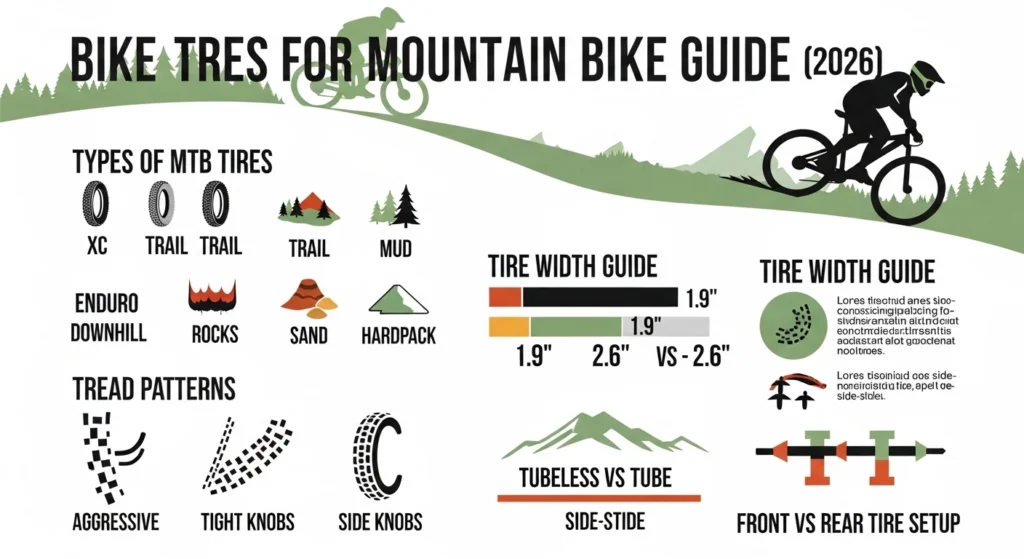
Types of Mountain Bike Tires (Complete Breakdown)
Choosing the right MTB tire starts with understanding the different types available.
1. Cross-Country (XC) Tires
Best for: Speed, racing, smooth trails
Characteristics:
- Lightweight construction
- Low rolling resistance
- Minimal tread pattern
Pros:
- Fast acceleration
- Efficient pedaling
Cons:
- Less grip on technical terrain
2. Trail Tires (Most Versatile)
Best for: All-around riding
Characteristics:
- Balanced tread design
- Medium width (2.25–2.4”)
- Moderate grip and speed
Ideal for 80% of riders worldwide
3. Enduro / All-Mountain Tires
Best for: Aggressive riding, downhill trails
Characteristics:
- Thick casing
- Large, aggressive knobs
- High durability
Pros:
- Excellent grip
- Great control on descents
Cons:
- Heavier
- Slower rolling
4. Downhill (DH) Tires
Best for: Extreme terrain, bike parks
Characteristics:
- Maximum traction
- Reinforced sidewalls
- Soft rubber compounds
Built for performance, not efficiency
How to Choose the Right MTB Tires (Step-by-Step Framework)
Most competitors fail to give a clear system—here’s a practical framework used by experienced riders.
Step 1: Identify Your Terrain
| Terrain Type | Recommended Tire |
| Mud | Wide spaced knobs |
| Hardpack | Low-profile tread |
| Rocky | Reinforced casing |
| Sand | Wide tires |
Rule: The terrain dictates your tire choice—not brand.
Step 2: Choose Tire Width
| Riding Style | Ideal Width |
| XC | 1.9–2.25” |
| Trail | 2.25–2.4” |
| Enduro | 2.3–2.5” |
| Downhill | 2.4–2.6” |
Key Insight:
- Wider = more grip + comfort
- Narrower = faster + efficient
Step 3: Select Rubber Compound
- Soft compound: Maximum grip, faster wear
- Hard compound: Longer life, less traction
Pro tip: Many riders use dual-compound tires.
Step 4: Front vs Rear Tire Setup
| Position | Priority |
| Front Tire | Grip & control |
| Rear Tire | Speed & durability |
Advanced riders often mix tires for optimal performance.
MTB Tire Size & Width Explained
Mountain bike tires come in three main wheel sizes:
1. 26-inch (Legacy)
- Older bikes
- Agile handling
2. 27.5-inch (650B)
- Balanced performance
- Great for technical riding
3. 29-inch (Modern Standard)
- Better rollover ability
- Faster on rough terrain
Comparison Table
| Size | Speed | Control | Best For |
| 26” | Medium | High | Tight trails |
| 27.5” | Balanced | Balanced | All-round use |
| 29” | High | Medium | Long-distance & rough terrain |
Pro Insight: 29” wheels dominate modern MTB riding.
Tread Patterns & Terrain Matching
Tread pattern is where most beginners get confused—but it’s actually simple.
Types of Tread:
1. Aggressive Knobs
- Best for mud & loose terrain
- Maximum traction
2. Tight Knobs
- Best for hardpack
- Faster rolling
3. Side Knobs
- Improve cornering grip
Real-World Example:
- Riding in UK muddy trails → aggressive tread
- Riding in dry California trails → low-profile tread
Golden Rule: Bigger knobs = more grip but slower speed.
Tubeless vs Tubed Tires (Head-to-Head Comparison)
Comparison Table
| Feature | Tubeless Tires | Tube Tires |
| Puncture Resistance | High | Low |
| Grip | Better (low pressure) | Moderate |
| Maintenance | Moderate | Easy |
| Cost | Higher | Lower |
Tubeless Tires (Recommended)
Advantages:
- Fewer punctures
- Better traction
- Lower pressure capability
Disadvantages:
- Higher initial cost
- Setup complexity
Tube Tires
Advantages:
- Affordable
- Easy to install
Disadvantages:
- More flats
- Limited performance
Verdict: Tubeless is the future of MTB riding.
Best MTB Tires for Different Riding Styles
1. Trail Riding
- Balanced tires
- Medium tread
2. Mud Riding
- Wide spacing knobs
- Self-cleaning design
3. Rocky Terrain
- Reinforced casing
- Durable sidewalls
4. XC Racing
- Lightweight
- Low rolling resistance
Quick Decision Table (Save This)
| Rider Type | Recommended Setup |
| Beginner | Trail tires (2.3”) |
| Intermediate | Mixed setup (grip front, fast rear) |
| Advanced | Terrain-specific tires |
Common Mistakes to Avoid
Avoid these costly mistakes:
- Choosing tires based only on brand
- Ignoring terrain type
- Using identical front and rear tires blindly
- Going too wide for your bike frame
- Running incorrect tire pressure
These mistakes can ruin performance—even with premium bikes.
Pro Tips from Experienced Riders
Here are insights gathered from real-world MTB communities:
- “Tires sit on a spectrum between speed and grip.”
- “Your front tire matters more than your rear.”
- “Lower pressure = more traction, but higher risk.”
Advanced Tips:
- Use tubeless sealant regularly
- Adjust tire pressure based on terrain
- Rotate tires to extend lifespan
Pros & Cons of MTB Tires (General Overview)
Pros:
- Improved off-road performance
- Better control and safety
- Customizable for any terrain
- Enhances overall ride quality
Cons:
- Can be expensive
- Confusing for beginners
- Requires maintenance (especially tubeless)
Global Considerations (Important for International Riders)
Europe (UK, Germany, France)
- Wet and muddy conditions
- Aggressive tread preferred
USA & Australia
- Mixed terrain
- Trail tires dominate
Asia (India, Pakistan, UAE)
- Dusty + rocky terrain
- Durable tires with reinforced casing recommended
Always adapt your tire choice to your local environment.
Real-World Scenario: Choosing the Perfect Tire
Let’s say:
You ride:
- Weekend trails
- Mixed terrain (dry + rocky)
- Moderate speed
Ideal Setup:
- Front: 2.4” aggressive tread
- Rear: 2.3” fast-rolling tire
- Tubeless system
This gives you grip + efficiency balance.
FAQs
A: 2.25” to 2.4” is ideal for most riders, offering a balance between grip and speed.
A: for traction and comfort, but they reduce speed and efficiency.
A: Tubeless tires provide better grip and fewer punctures.
A: MTB tires are designed specifically for off-road conditions.
A: Every 1,500–3,000 km, depending on usage and terrain.
Final Expert
Choosing the right bike tires for a Mountain bike is not just about buying a product—it’s about transforming your riding experience.
The biggest takeaway?
There is no “perfect tire”—only the right tire for your riding style and terrain.
If you follow this guide:
- Understand your terrain
- Choose the correct width
- Use tubeless if possible
- Optimize front vs rear setup
You’ll unlock a completely new level of control, confidence, and performance.
