
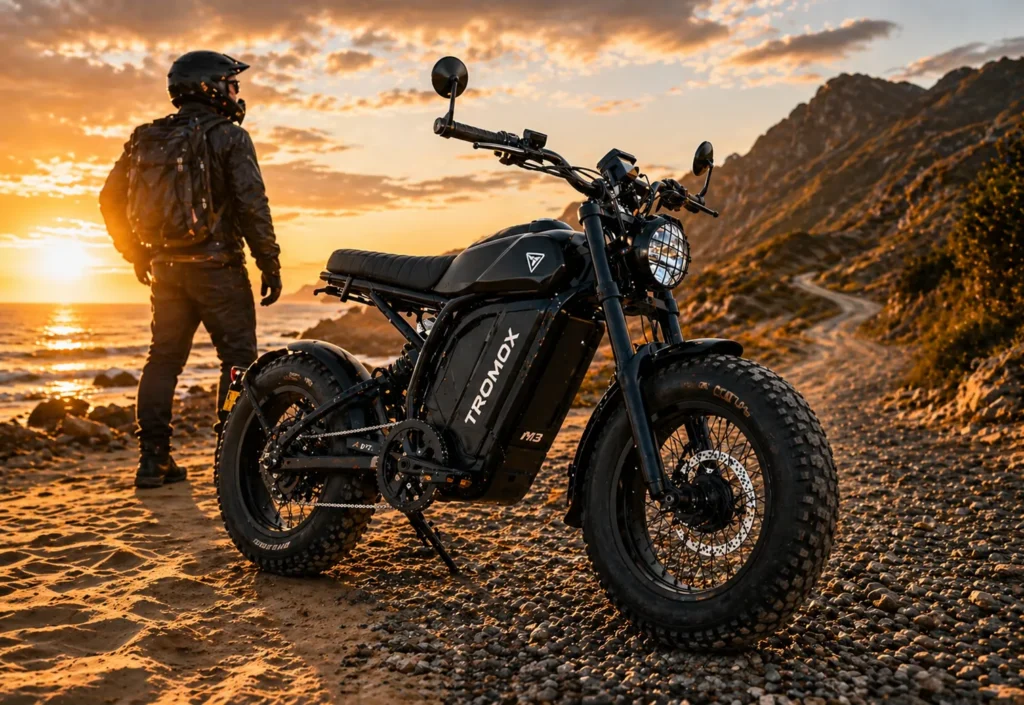
Best Fat Tire Electric Bike 2026 – The Ultimate Buyer’s Guide
Introduction
Fat tyre electric bikes are best suited for riders who want maximum stability, comfort, and control on uneven terrain. Their wide tyres make them ideal for sand, snow, gravel, and rough rural roads, where normal e-bikes often struggle. Beginners also benefit from the extra balance and smoother ride feel, especially when carrying loads or riding long distances.
However, they are not perfect for everyone. Fat tyre e-bikes are usually heavier, slower to accelerate, and less energy-efficient compared to standard models, which can reduce range. They can also feel bulky in tight city spaces or crowded streets. If your riding is mostly on smooth urban roads, a lighter commuter e-bike may be a better and more practical choice.
Are Fat Tire Electric Bikes Worth It?
Fat tyre electric bikes are worth it if you prioritise traction, stability, and comfort over speed and efficiency.
When a fat tyre ebike is the right choice
- You ride on sand, snow, mud, or loose gravel.
- You want a more forgiving ride for joints/back compared with a hardtail or road ebike.
- You enjoy off‑road cruising or light trail riding rather than technical mountain biking.
- You live in a hilly area and want a powerful motor to help with climbs.
When a standard e-bike may be better
- You commute daily on paved roads and care about range and agility.
- You want lighter weight and faster acceleration for frequent on/off‑road use.
- You’re sensitive to higher prices and increased rolling resistance.
If you mainly care about city riding, look for a hybrid or commuter ebike with slimmertyress; if you want to crush sand, snow, and gravel, keep reading.
How Fat Tire Electric Bikes Work
A fat tyre electric bike is a standard ebike with a battery‑powered motor plus very wide tyres (typically ≥2.8″, many 3–4.8″).
Key components
- Motor type:
- Rear‑hub – common, affordable, easy to service.
- Mid‑drive – smoother, more efficient, better for hills, but usually pricier.
- Battery:
- Usually 48V systems; capacity ranges from 400Wh to 800Wh+ on higher‑end models.
- Range in real‑world conditions is often 20–60 miles, depending on terrain, rider weight, and assist level.
- Tires:
- 3–4 inch fat tyres dramatically increase traction and floatation on soft surfaces.
- They also add weight and rolling resistance, which can reduce acceleration and range vs standard ebikes.
If you want a smooth, natural feel, prioritise torque‑sensor motors; if you want maximum off‑road power and cargo capacity, look at 750W+ hub‑drive or high‑torque mid‑drive systems.
Pros and Cons of Fat Tire Electric Bikes
This is where many competitors just copy‑paste a short list. We’ll go deeper so you can actually decide if a fat tyre ebike fits your lifestyle.
Pros
- Unmatched traction on soft terrain
Big tyres spread the load, so the bike floats better on sand, snow, loose gravel, and mud.
This makes them excellent for beach rides, winter commuting, and backcountry trails. - Superior stability
A wider tyre contact patch = more stable, especially at low speeds or when carrying cargo.
Great choice if you’re new to ebikes or want a confidence‑building ride. - “Natural suspension” effect
High‑volume tyres act like extra shock absorption, smoothing out potholes and rough roads.
You can comfortably ride on poorly maintained paths without a full suspension bike. - All‑terrain, all‑season versatility
Well‑spec’d fat tyre ebikes can double as city commuters by day and weekend trail riders.
Cons
- Heavier and bulkier
Most fat tyre ebikes weigh 65–80+ lbs, which makes them harder to lift, store, and transport.
This matters if you live in an apartment or need to carry it up stairs. - Shorter range on the same battery
More rolling resistance means the motor works harder, so range can be 10–25% lower than a slim‑tire ebike with the same battery. - Slower acceleration and braking
Extra weight and tyre drag slightly reduce top speed perception and braking efficiency.
You’ll still easily keep up with traffic, but expect more “tractor‑like” than “sport‑bike” feel. - Higher price and maintenance cost
Fat tyres, stronger rims, and often larger motors increase the bill.
Tire and brake replacement can also cost more than on entry‑level ebikes.
If you mainly ride on paved roads and care about range and efficiency, a standard or commuter ebike may be better. If you want a fun, stable, all‑terrain ride, the trade‑offs are usually worth it.
How to Choose the Best Fat Tire Electric Bike
Let’s turn this into a step‑by‑step selector your readers can actually follow.
Define your main use case
Fat tyre ebikes excel in different scenarios:
| Use case | What to prioritize |
| Beach/sand riding | 4″ tyres, powerful motor (750W+), high payload. |
| Winter/snow commuting | Tubeless‑ready tyres, good battery, hydraulic brakes. |
| City commuting | Lights, fenders, rear rack, 250–500W motor. |
| Off‑road trail fun | Suspension fork, torque sensor, 750W+ system. |
| Small apartment / RV | Folding frame, integrated rear rack, <70 lbs. |
Ask your readers: “Where will you ride 70% of the time?” The answer determines which model type they should lean toward.
Motor power and class
- 250W–400W – Enough for flat or gentle hills; good for light commuting.
- 500W–750W – Ideal for most riders, including hills, cargo, and off‑road use.
- 750W+ peak – Great if you’re heavy, carry loads, or live in very hilly areas.
Also consider class:
- Class 1 – 20 mph pedal‑assist only.
- Class 2 – 20 mph with throttle allowed.
- Class 3 – 28 mph pedal‑assist only (no throttle).
Check your local laws on where you can legally ride Class 2/3 bikes (paths, trails, roads).
Battery and range
Aim for at least 500–700Wh if you plan regular off‑road or mixed‑use riding.
Real‑world range estimates:
- 20–30 miles – Light assist, hilly terrain, heavy rider.
- 40–60 miles – Moderate assist, mixed terrain.
If you hate range anxiety, prioritise bikes with removable batteries so you can charge indoors or swap cells.
Weight, frame style, and storage
- Standard frame – Best for pure performance and comfort.
- Folding frame – Ideal for apartments, RVs, and small garages.
Even if a model is marketed as “best overall,” tell your readers to honestly ask:
- “Can I lift this bike into my car or upstairs?”
- “Will another bike fit in this space later?”
If the answer is “no,” folding or lighter models become more important than raw power.
Safety and comfort features
Look for:
- Hydraulic disc brakes – Better modulation and stopping power than mechanical discs.
- Integrated lights and fenders – Crucial for city commuting and all‑weather use.
- Rear rack or cargo options – If they plan to carry groceries, kids, or bags.
If you’re targeting families or commuters, emphasise these features in your “best for” picks.
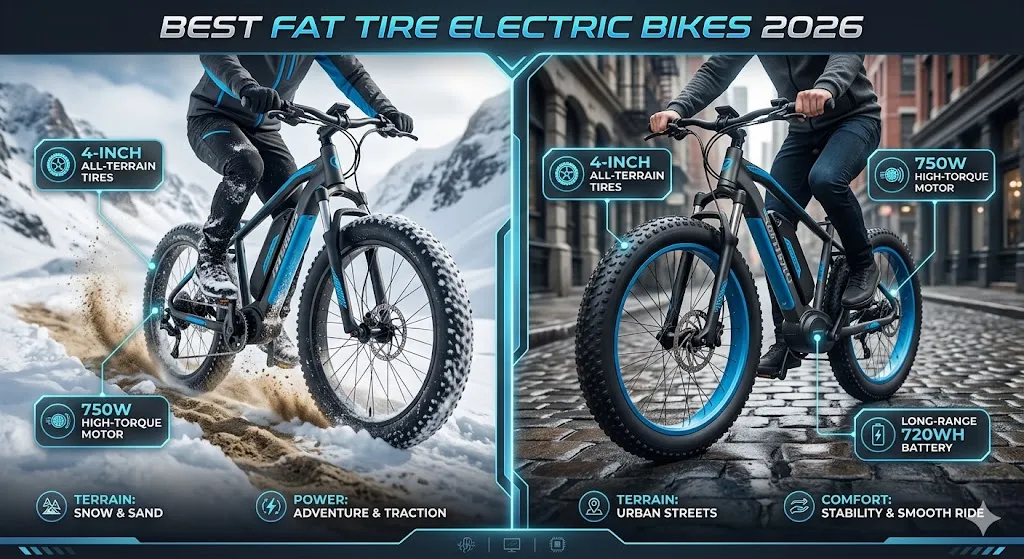
The Best Fat Tire Electric Bikes by Use Case
Instead of dumping a 15‑bike list, we’ll group picks by user need and then add a comparison table. This is more SEO‑friendly and user‑friendly than pure spec‑dumping.
Best fat tyre electric bike overall (all‑round pick)
Aventon Aventure 3
- Why it’s great:
- 4″ fat tyres, 750W motor, torque sensor, strong range (~60–65 miles).
- Includes fenders, lights, rear rack, and turn signals.
- Best for: Riders who want one bike that handles city, gravel, sand, and light trails without compromise.
Best fat tyre electric bike for snow and sand
Lectric XPeak 2.0
- Why it’s great:
- 4″ fat tyres, very powerful 1300W‑peak rear hub motor, 750W continuous.
- Designed for rough terrain, doubletrack, and loose surfaces.
- Best for: Beach trips, backcountry roads, and soft snow where traction is king.
Best budget fat tyre electric bike
Engwe L20 2.0
- Why it’s great:
- Under $800, 750W motor, 3″ fat tyres, foldable frame.
- Surprisingly punchy acceleration and decent range for the price.
- Best for: Riders on a tight budget who still want true fat‑tire capability and portability.
Best folding fat tyre electric bike
Lectric XP4
- Why it’s great:
- Folding 20″ frame with 3″ tyres, 500–750W options, integrated rear rack.
- One of the most versatile foldable fat‑tire ebikes on the market.
- Best for: Apartment dwellers, RVers, and anyone who needs to store or transport the bike frequently.
Best high‑performance fat tyre ebike
Aventon Aventure M
- Why it’s great:
- 750W mid‑drive motor, 4″ fat tyres, premium components, up to ~85 miles range.
- More refined ride feel and smoother power delivery than hub‑drive models.
- Best for: Riders who want a powerful, well‑built fat‑tire ebike for commuting and adventure.
You can add a few more “best for …” sub‑sections (e.g., “best for city”, “best for cargo”, “best for seniors”) to capture more long‑tail traffic and keep readers engaged.
Best Fat Tire Electric Bikes Comparison Table
Search engines love well‑structured tables that answer “how do these models compare?” on one screen.
| Model | Price (approx.) | Tire size | Motor | Battery (Wh) | Range (mi) | Weight (lbs) | Best use case |
| Aventon Aventure 3 | $1,999 | 4″ | 750W | 733 Wh | 60–65 | 77 | All‑round |
| Lectric XPeak 2.0 | $1,499 | 4″ | 750W | 720 Wh | 60 | 67 | Sand/snow |
| Engwe L20 2.0 | $799 | 3″ | 750W | 624 Wh | 60 | 68 | Budget |
| Lectric XP4 | $999–$1,299 | 3″ | 500W/750W | 500–690 Wh | 25–85 | 64–69 | Folding city |
| Aventon Aventure M | $2,899 | 4″ | 750W | 700–800 Wh | 70–85 | 74 | Performance |
You can expand this table with more rows (e.g., RadPower, Ride1Up, Velotric) and keep it sortable for SEO.
FAQs
A: If you prioritise traction, stability, and comfort on rough terrain over raw speed and efficiency.
They’re ideal for beach, snow, gravel, and forest trails, but less efficient on long paved‑road commutes.
A: The extra weight and rolling resistance of fat tyres mean the motor works harder, typically reducing range by 10–25% versus a slim‑tire ebike with the same battery.
To compensate, choose models with 500–700Wh+ batteries and removable cells you can charge indoors.
A: They can be, but only if you accept heavier weight, slower acceleration, and shorter range.
For pure city use, look for models with integrated lights, fenders, rear racks, and 250–500W motors.
A: Most “best fat tyre electric bike” models for commuting or cargo include integrated rear racks or strong rack‑ready frames.
Key picks:
Aventon Aventure 3 – Full rack, fenders, and lights.
Lectric XP4 – Foldable frame with built‑in rear rack for urban riders.
A: Most fat tyre ebikes weigh 65–80+ lbs, with some lighter folding models around 60–70 lbs.
Conclusion
Choosing the Best fat tyre electric bike in 2026 ultimately comes down to how and where you ride. These bikes aren’t built for speed records or ultra-efficient commuting—they’re designed for confidence, comfort, and all-terrain freedom. If your routes include sand, snow, gravel, or broken roads, a fat tyre e-bike delivers a level of grip and stability that standard e-bikes simply can’t match.
That said, they do come with trade-offs. Extra weight, slightly reduced range, and higher cost mean they’re not the perfect fit for every rider. If your daily routine is smooth city commuting, a slimmer-tire electric bike may be the smarter long-term choice. But if you want a fun, versatile, go-anywhere ride that handles real-world conditions without stress, fat tyre models are absolutely worth it.
The smartest move is to match the bike to your lifestyle. Think about your terrain, storage space, and how often you’ll ride. Whether you choose a powerful all-rounder like the Aventon Aventure series, a folding commuter like the Lectric XP lineup, or a budget-friendly option like Engwe, the right fat tyre e-bike can transform how—and where—you ride.
