
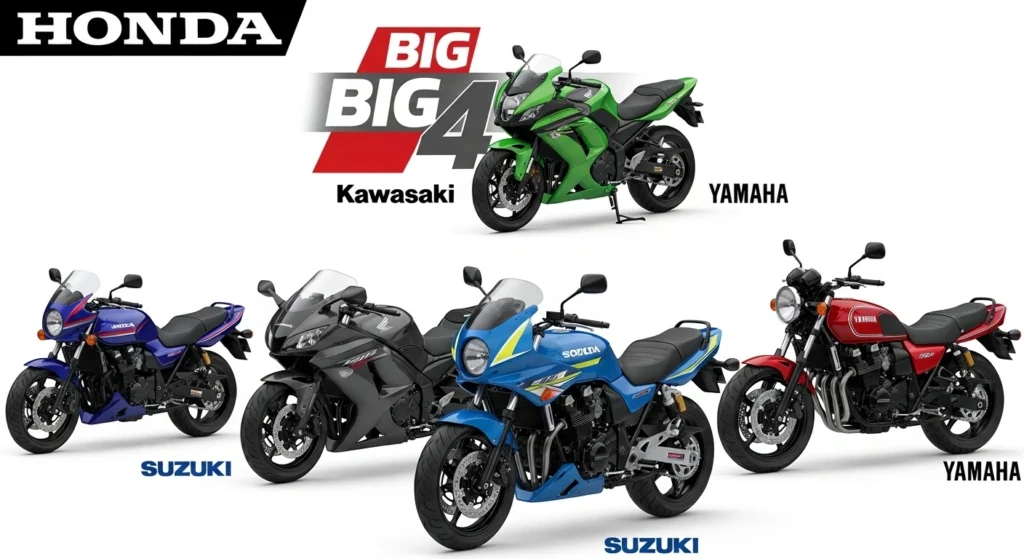
What Are the Big 4 Motorcycles?
Introduction
If you have even a slight curiosity about motorcycles, chances are you’ve encountered the phrase “Big 4 motorcycles.” But what exactly does this expression signify? Why do these manufacturers consistently dominate highways, racetracks, and rider preferences across continents?
The term refers to four influential Japanese motorcycle giants:
- Honda
- Yamaha
- Kawasaki
- Suzuki
These corporations revolutionized the global motorcycle landscape by introducing machines that are dependable, economical, technologically refined, and widely accessible.
In this comprehensive 2026 guide, you will discover:
- The fundamental reasons behind their worldwide supremacy
- Their historical evolution and industrial rise
- A detailed comparison of all four manufacturers
- The most iconic motorcycles from each brand
- And most importantly, how to determine which one suits your riding needs
Whether you’re a novice rider or a seasoned motorcyclist, this guide will provide clarity, insight, and confident decision-making.
What Does “Big 4 Motorcycles” Mean?
The phrase Big 4 motorcycles simply represents the four largest and most influential motorcycle producers originating from Japan:
- Honda
- Yamaha
- Kawasaki
- Suzuki
These companies are industry leaders in mass production, engineering excellence, and innovation.
Why the Big 4 Matter Globally
The Big 4 hold immense importance in the worldwide motorcycle ecosystem because they:
- Manufacture millions of units annually
- Provide motorcycles across every category (commuter, cruiser, sport, touring, adventure)
- Maintain a reputation for durability and longevity
- Operate expansive distribution and service networks across Asia, Europe, and North America
Simple Explanation:
If the motorcycle world had a hierarchy, the Big 4 would consistently occupy the top tier.
The Big 4 Motorcycle Brands Explained
Honda – The King of Reliability
Honda is the largest motorcycle producer globally, known for its unmatched dependability.
Key Strengths
- Exceptional reliability
- Superior fuel economy
- Beginner-friendly engineering
- Strong resale value
Popular Models
- CBR Series
- Africa Twin
- Gold Wing
Real-World Use Case
Honda motorcycles are extensively utilized for daily commuting, especially in densely populated regions.
Best For: Beginners, commuters, long-term riders
Yamaha – Performance Meets Innovation
Yamaha blends cutting-edge technology with thrilling performance.
Key Strengths
- Racing heritage
- Smooth power delivery
- Advanced electronics
- Precision handling
Popular Models
- YZF-R1
- MT-09
- Tenere 700
Real-World Use Case
Yamaha bikes are favored by sport riders and enthusiasts seeking excitement.
Best For: Performance seekers and sporty riders
Kawasaki – Power and Aggression
Kawasaki is synonymous with raw power and aggressive styling.
Key Strengths
- High-output engines
- Bold, edgy design
- Exceptional top-end speed
Popular Models
- Ninja ZX-10R
- Z900
- Ninja H2
Real-World Use Case
Kawasaki motorcycles appeal to riders who crave adrenaline and high-speed thrills.
Best For: Experienced riders and speed enthusiasts
Suzuki – Affordable and Practical
Suzuki emphasizes value, simplicity, and dependability.
Key Strengths
- Cost-effective pricing
- Proven mechanical reliability
- Low maintenance requirements
Popular Models
- GSX-R Series
- V-Strom
- Hayabusa
Real-World Use Case
Suzuki is widely adopted in budget-conscious and touring segments.
Best For: Budget riders and long-distance touring
Why Are They Called the Big 4?
The label “Big 4 motorcycles” emerged due to their global dominance and industrial scale.
Reasons Behind the Name
- Massive production capacity
- Continuous technological advancement
- Worldwide distribution infrastructure
Industry Shift (1960s–1970s)
During this transformative era, Japanese manufacturers overtook Western competitors in:
- Reliability
- Affordability
- Mass production efficiency
This shift reshaped the entire motorcycle industry.
History of the Big 4 Motorcycles
Post-WWII Boom (1940s–1950s)
After World War II, Japan required affordable transportation solutions.
- Honda began with motorized bicycles
- Yamaha emphasized performance engineering
- Suzuki produced lightweight machines
- Kawasaki expanded from heavy industry
Global Expansion (1960s–1980s)
This period marked their international breakthrough.
Key Developments
- Introduction of inline-4 engines
- Launch of legendary models like the Honda CB750
- Expansion into Western markets
Performance Revolution (1990s–2000s)
This era defined the superbike evolution.
Innovations
- Aerodynamic design
- Fuel injection systems
- High-performance engines
Iconic motorcycles included:
- Yamaha R1
- Suzuki Hayabusa
Modern Era (2010s–2026)
Today, the Big 4 lead in:
- Ride-by-wire systems
- Traction control technologies
- Hybrid and electric mobility
What Makes the Big 4 So Popular?
Reliability
These motorcycles can exceed 100,000 km in lifespan with proper maintenance.
Affordability
Compared to European brands:
- Lower acquisition cost
- Reduced servicing expenses
Global Support
- Easy availability of spare parts
- Extensive dealership networks
Wide Product Range
From entry-level commuter bikes to high-performance superbikes.
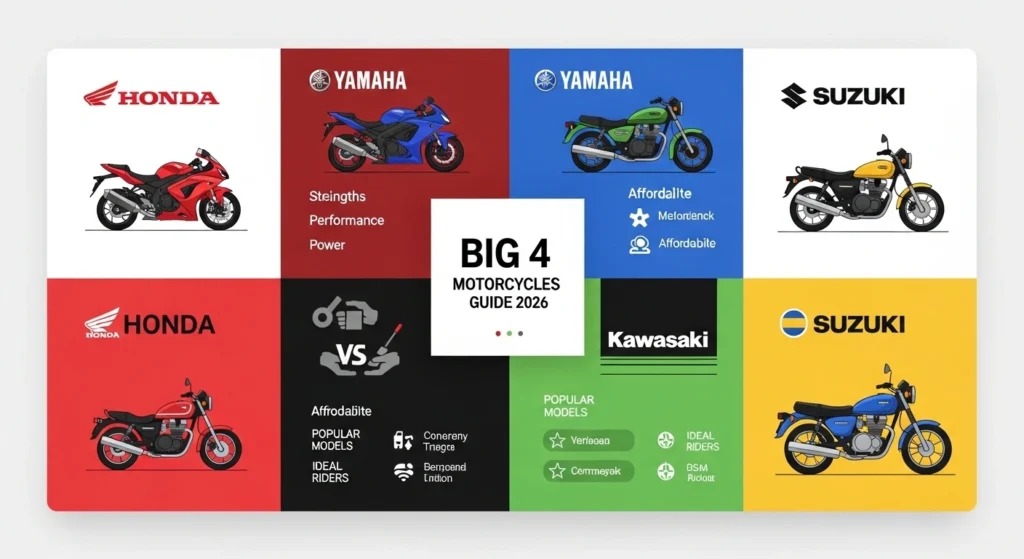
Honda vs Yamaha vs Kawasaki vs Suzuki
Comparison Overview
| Brand | Strength | Weakness | Best For |
| Honda | Reliability | Conservative styling | Beginners |
| Yamaha | Innovation | Slightly costly | Sport riders |
| Kawasaki | Power | Fuel consumption | Speed lovers |
| Suzuki | Value | Slower innovation | Budget riders |
Detailed Breakdown
Honda
Pros: dependable, efficient, durable
Cons: less aggressive styling
Yamaha
Pros: innovative, responsive, refined
Cons: relatively expensive
Kawasaki
Pros: powerful, bold, fast
Cons: less fuel-efficient
Suzuki
Pros: economical, practical, comfortable
Cons: fewer modern features
Which Big 4 Motorcycle Brand Is Best?
There is no universally superior brand—it depends entirely on your requirements.
Choose Based on Riding Style
- Beginner → Honda
- Performance → Yamaha
- Speed → Kawasaki
- Budget → Suzuki
Best Motorcycles from Each Brand
- Honda → CBR500R (balanced, user-friendly)
- Yamaha → YZF-R1 (track-focused, high-tech)
- Kawasaki → Ninja ZX-10R (race-proven, powerful)
- Suzuki → GSX-R1000 (iconic, value-packed)
Big 4 vs European Brands
Big 4 Advantages
- Affordable pricing
- High reliability
- Easy maintenance
- Wide accessibility
European Brands
- Premium aesthetics
- High-end engineering
- Advanced electronics
Verdict: The Big 4 offer the best balance of cost, reliability, and usability.
Which Big 4 Motorcycle Should You Choose?
Budget
- Low → Suzuki
- Mid → Honda / Yamaha
- High → Kawasaki / Yamaha
Experience Level
- Beginner → Honda
- Intermediate → Yamaha
- Advanced → Kawasaki
Usage
- Daily commuting → Honda
- Weekend rides → Yamaha
- Racing → Kawasaki
- Touring → Suzuki
Pros & Cons of Big 4 Motorcycles
Pros
- Durable engines
- Affordable ownership
- Simple maintenance
- Global availability
- Diverse options
Cons
- Less exclusivity
- Conservative designs
- Some models lack cutting-edge innovation
FAQs
A: They are Honda, Yamaha, Kawasaki, and Suzuki.
A: Because they dominate global production and innovation.
A: Honda is considered the most reliable.
A: Honda offers beginner-friendly bikes.
Final Verdict
The Big 4 motorcycles—Honda, Yamaha, Kawasaki, and Suzuki—continue to dominate the industry due to their unmatched blend of:
- Dependability
- Affordability
- Performance
Regardless of your skill level, there is a motorcycle within these brands that perfectly aligns with your needs.
