
Introduction
Electric mountain bikes swept through biking lately, especially off-road, where things move differently now. Power assists hide inside rugged frames, shifting how people explore wild paths on two wheels. Riding feels different when motors help push beyond old limits of strength and stamina. Up hills once too tough now open up, revealing new ground to cross repeatedly. Adventures stretch longer without wearing out fast as before.
A sturdy frame built for rough trails meets hidden electronics that boost your ride – this is what defines an e-powered off-road bicycle. Not like gas-guzzling bikes or stand-up scooters, these machines expect you to keep pedaling. Power flows when legs turn cranks, sensors detect motion, and then help kicks in just enough to cut fatigue. Effort stays part of the experience, only now hills feel less punishing. Muscle works alongside machinery without fading fast.
What is an Electric Mountain Bike?
A sudden burst of power comes from a small motor tucked into the frame of a rugged two-wheeler built for trails. Instead of relying only on leg strength, the cyclist gets help pushing forward whenever the path turns steep. Hidden inside is a battery that fills up again when plugged in. This setup makes climbing rocky hills feel lighter, yet still demands effort. Motion keeps going smoother through rough spots where regular bikes might slow down too much.
When you turn the pedals, sensors wake up the motor right away on many e-MTBs. Instead of a throttle, these bikes boost your effort as you ride. The added push comes only when motion is sensed beneath you.
- Easier hill climbing
- Extended riding range
- Reduced fatigue
- Enhanced exploration opportunities
- Improved accessibility for beginners
That surge in demand came straight from what riders gained. Market numbers jumped because of it.
Key Components of an Electric Mountain Bike
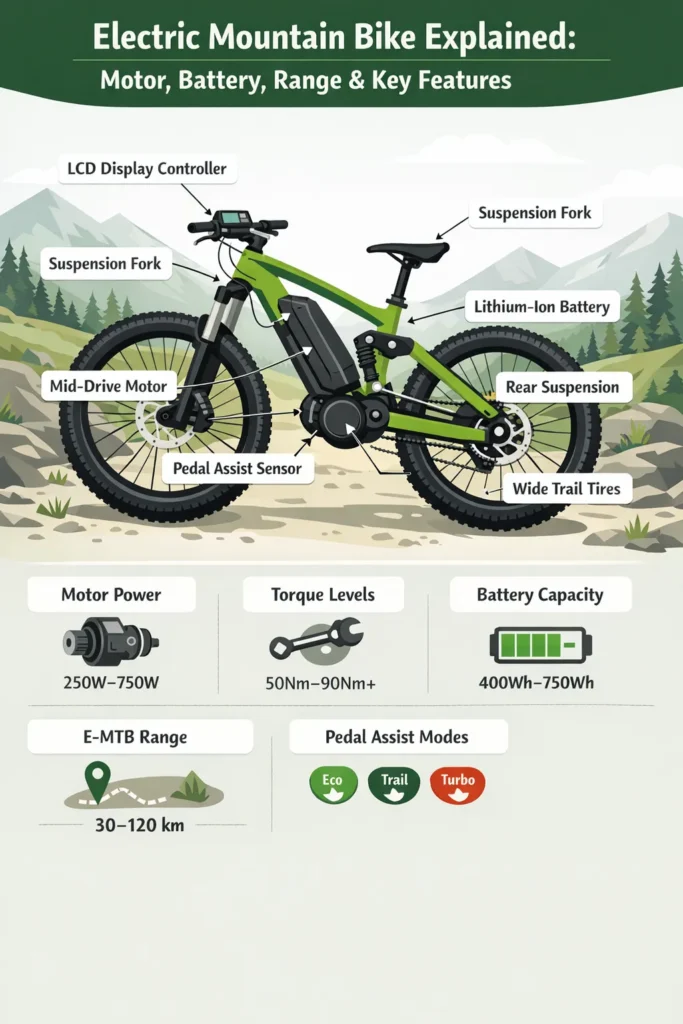
Every electric mountain bike contains several essential mechanical and electronic elements that work together to deliver performance.
Electric Motor
The electric motor generates additional power that assists pedaling. This motor significantly enhances acceleration and hill-climbing capability.
Rechargeable Battery
Most electric mountain bikes use lithium-ion battery packs because they provide excellent energy density, durability, and efficiency.
Pedal Assist System
The pedal assist system activates the motor when the rider pedals. Assist levels can usually be adjusted through handlebar controls.
Display and Controller
A handlebar display allows riders to monitor:
- speed
- battery level
- assist mode
- distance traveled
- power output
Reinforced Frame
Because electric mountain bikes carry additional components like motors and batteries, manufacturers design frames with increased strength and durability.
Advanced Suspension
High-quality suspension systems absorb impacts from rocks, roots, and rough terrain.
Together, these components create a powerful off-road cycling machine capable of tackling demanding trails.
How Electric Mountain Bikes Work
Electric mountain bikes operate through a coordinated system that combines human power, electric assistance, and intelligent sensors.
When the rider begins pedaling, sensors detect movement and signal the motor controller. The motor then delivers additional torque to the drivetrain, amplifying the rider’s effort.
The entire process occurs within milliseconds, ensuring smooth and responsive performance.
Three primary systems enable this technology.
Motor System
The motor is the heart of any electric mountain bike. It produces the mechanical energy that supplements the rider’s pedaling force.
Motor power is measured in watts, while motor strength during climbs is measured in torque (Nm).
Typical Motor Power Levels
| Motor Power | Typical Use |
| 250W | Standard eMTB |
| 500W | Strong trail riding |
| 750W | High-performance off-road riding |
Higher wattage usually delivers stronger acceleration and climbing ability.
Understanding Torque
Torque indicates how powerful a motor feels when tackling steep hills.
Typical torque ratings include:
- 50Nm – entry-level electric MTBs
- 70Nm – strong trail performance
- 90Nm+ – aggressive mountain terrain
Greater torque allows riders to conquer steep gradients with minimal effort.
Battery System
The battery powers the electric motor and determines how far an electric mountain bike can travel.
Most bikes use removable lithium-ion batteries because they are lightweight, efficient, and rechargeable.
Battery capacity is measured in watt-hours (Wh).
Common Battery Capacities
| Battery Capacity | Estimated Range |
| 400Wh | 30–40 km |
| 500Wh | 40–60 km |
| 625Wh | 60–80 km |
| 750Wh+ | 80–120 km |
However, the actual range depends on multiple variables.
Factors Affecting Electric Mountain Bike Range
- Terrain steepness
- Rider weight
- Assist level
- Weather conditions
- Tire pressure
- Riding style
Using lower assist levels can dramatically increase battery efficiency.
Pedal Assist Modes
Most electric mountain bikes provide several assist levels that regulate motor output.
Common modes include:
Eco Mode
Minimal motor assistance that maximizes battery efficiency.
Trail Mode
Balanced power and efficiency for everyday riding.
Turbo Mode
Maximum motor output for steep climbs and difficult terrain.
These modes allow riders to customize performance according to terrain conditions.
Types of Electric Mountain Bikes
Electric mountain bikes are available in several configurations designed for different riding environments.
Understanding these types helps riders choose the ideal bike.
Hardtail Electric Mountain Bikes
Hardtail e-MTBs include front suspension but no rear suspension.
Advantages:
- lighter weight
- lower price
- simpler maintenance
- efficient pedaling performance
Best suited for:
- beginners
- cross-country riding
- smooth trails
Hardtail electric mountain bikes are often more affordable and efficient.
Full Suspension Electric Mountain Bikes
Full suspension e-MTBs feature both front and rear suspension systems.
Advantages:
- superior comfort
- improved traction
- better downhill control
- increased stability
Best for:
- Rocky Mountain Trails
- technical terrain
- aggressive trail riding
Many premium electric mountain bikes use full suspension for enhanced performance.
Lightweight Electric Mountain Bikes
Lightweight e-MTBs focus on delivering a natural riding experience similar to traditional mountain bikes.
Characteristics include:
- compact motors
- Smaller batteries
- lightweight frames
These bikes are popular among experienced riders who prefer agility and speed.
Electric Mountain Bike Motor Types
Electric mountain bikes typically use two motor configurations.
Mid-Drive Motors
Mid-drive motors are mounted near the crankset in the center of the frame.
Advantages:
- optimal weight distribution
- superior climbing efficiency
- improved drivetrain integration
- better performance on steep terrain
Most high-end electric MTBs use mid-drive motor systems.
Hub Motors
Hub motors are installed inside the front or rear wheel hub.
Advantages:
- simpler design
- lower manufacturing cost
- easier maintenance
However, hub motors are generally less efficient for demanding off-road trails.
Key Features to Look for in an Electric Mountain Bike
Choosing the best electric mountain bike requires understanding several technical features.
Suspension Travel
Suspension travel refers to the distance a suspension system can compress to absorb impacts.
| Suspension Travel | Terrain Type |
| 100–120mm | Cross-country |
| 130–150mm | Trail riding |
| 160–170mm | Enduro |
| 180mm+ | Downhill |
More travel improves comfort on rugged terrain.
Frame Materials
Aluminum Frames
Advantages:
- durable
- affordable
- widely used
Carbon Fiber Frames
Advantages:
- extremely lightweight
- high performance
- premium quality
However, carbon frames are typically more expensive.
Braking Systems
Electric mountain bikes are heavier than traditional bikes, so they require powerful braking systems.
Most models use hydraulic disc brakes, which provide reliable stopping power in wet and steep conditions.
Tire Width
Wide tires improve traction and stability on loose surfaces.
Common tire sizes include:
- 2.4 inches – general trail riding
- 2.6 inches – rough terrain
- 2.8 inches – maximum grip
Electric Mountain Bike Range and Performance
Range is one of the most important considerations when choosing an electric MTB.
Average Range Estimates
| Battery | Estimated Range |
| 500Wh | 40–60 km |
| 625Wh | 60–80 km |
| 750Wh | 80–120 km |
Using eco mode and smooth pedaling techniques can significantly extend riding range.
Electric Mountain Bike vs Traditional Mountain Bike
| Feature | Electric Mountain Bike | Traditional Mountain Bike |
| Motor Assistance | Yes | No |
| Hill Climbing | Easier | Physically demanding |
| Weight | Heavier | Lighter |
| Range | Battery dependent | Unlimited |
| Price | Higher | Lower |
Mountain Bike Maintenance Guide
Maintaining an electric mountain bike properly ensures long-term reliability.
Essential Maintenance Steps
- Keep the drivetrain clean
- Inspect brakes regularly
- Monitor suspension pressure
- Update firmware when necessary
- Check battery health periodically
Routine maintenance extends the lifespan of both mechanical and electronic components.
Battery Care Tips
Proper battery care can significantly increase lifespan.
Best practices include:
- avoiding extreme temperatures
- storing batteries partially charged
- using original chargers
- preventing full discharge
Most lithium batteries last 3–5 years under normal conditions.
Safety Tips for Electric Mountain Bike Riders
Safety is essential when riding high-performance electric MTBs.
Recommended Safety Gear
- helmet
- gloves
- knee protection
- protective eyewear
Riding Safety Practices
- maintain correct body position
- slow down on steep descents
- Choose the appropriate assist mode
- Keep both hands on the handlebars
These habits reduce accident risk and improve control.
Pros and Cons
Pros
- easier hill climbing
- longer riding distance
- beginner friendly
- reduced fatigue
- environmentally friendly
- enables exploration of remote trails
Cons
- higher purchase cost
- heavier than traditional bikes
- battery charging required
- complex components
- battery replacement expenses
Despite these drawbacks, most riders find electric mountain bikes extremely rewarding.
How to Choose the Best Electric Mountain Bike
Selecting the right electric mountain bike depends on several factors.
1. Riding Style
Choose a bike designed for your terrain:
- cross-country
- trail riding
- enduro
- downhill
2. Motor Torque
For steep mountain climbs, choose motors delivering 70–90Nm torque.
3. Battery Capacity
For longer rides, choose batteries 600Wh or higher.
4. Suspension Type
Hardtail for smoother trails
Full suspension for rough terrain
5. Budget
Electric mountain bikes vary widely in price.
| Price Range | Category |
| $1500 – $2500 | Entry-level |
| $2500 – $5000 | Mid-range |
| $5000 – $10,000+ | Premium |
Popular brands include:
- Trek
- Specialized
- Giant
- Cube
- Canyon
Who Should Buy an Electric Mountain Bike?
Electric mountain bikes are ideal for several types of riders.
Beginners
Motor assistance helps new riders build confidence quickly.
Older Riders
Electric assistance reduces strain and makes cycling more accessible.
Adventure Riders
Long battery range enables extended off-road exploration.
Mountain Climbers
Powerful motors make steep ascents manageable.
FAQs
A: Electric mountain bikes help riders climb hills, travel longer distances, and explore challenging trails more comfortably.
A: Most electric mountain bikes are limited to 20 mph (32 km/h), although some performance models reach 28 mph.
A: Most batteries last 3–5 years, depending on riding habits and charging practices.
A: Most electric mountain bikes weigh between 20 and 25 kg (45–55 lbs) due to the motor and battery.
A: Riders can pedal normally even when the motor is turned off.
Final Expert
Electric mountain bikes have transformed modern cycling by combining mechanical engineering with intelligent electric technology.
These bikes allow riders to travel farther, climb higher, and explore more remote landscapes than ever before. Beginners benefit from easier rides, while experienced cyclists can push their limits and discover new trails.
As motor efficiency, battery capacity, and suspension technology continue to improve, electric mountain bikes will become even more powerful and versatile.
For anyone who loves outdoor adventure and trail riding, investing in an electric mountain bike is a decision that can unlock countless unforgettable experiences.
