
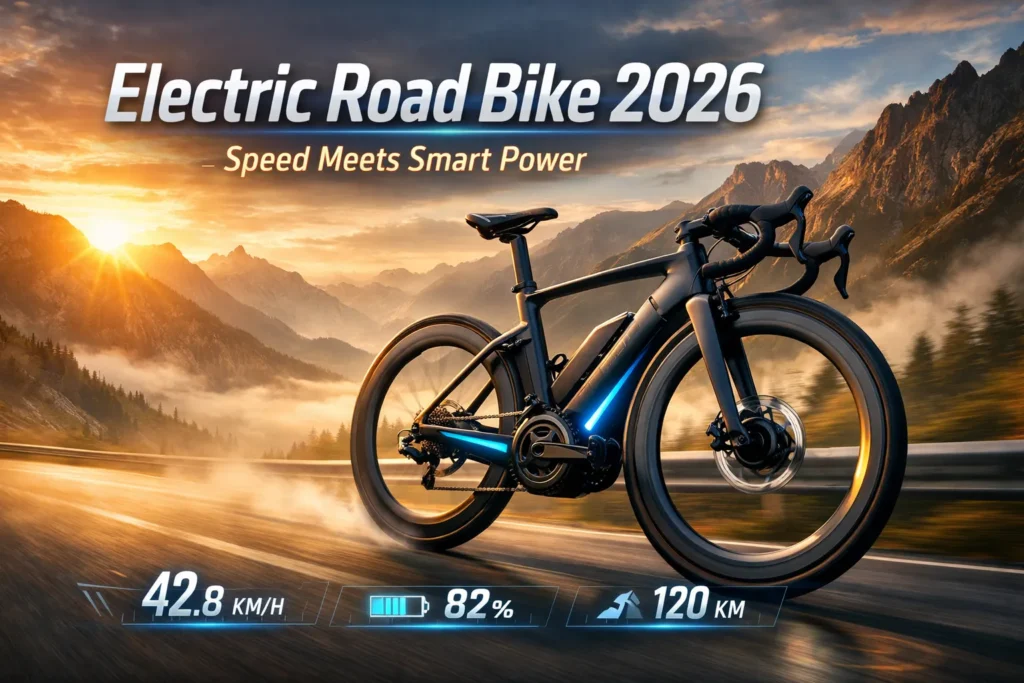
Introduction
A sudden shift in how people ride began with the arrival of the electric Road bike. Built for speed yet powered behind the scenes, it takes slim frames and sharp handling – then adds hidden support when legs tire. Smooth motion comes not just from design but from unseen tech syncing effort to pace. Pushing forward feels lighter because help arrives exactly when needed, blending muscle with machine in ways once thought impossible.
- Environmental sustainability
- Commuting efficiency
- Long-distance endurance capability
- Accessibility for diverse age groups
- Technological innovation
Jumping into 2026, this full look at e-road bikes covers it all – how they’re built, types of motors, and figuring out how far they go. Buying tips sit beside care routines, rules that apply where you ride, then wrap up with top models rolling today. Details unfold without shortcuts, each piece fitting like gears turning together.
What Is an Electric Road Bike?
An electric road bike (commonly referred to as an e-road bike) is a lightweight, performance-oriented bicycle equipped with:
- A built-in engine that runs on electricity
- A rechargeable lithium-ion battery
- A pedal assist system (PAS)
- Electronic control modules
When you pedal, the electric road bike’s motor kicks in – no motion, no power. Riding feels active because effort comes from legs, not just electricity. Motion triggers assistance instead of replacing it entirely. Pedals moving means help arrives; stop turning them, the boost fades away. The experience stays close to regular cycling, only smoother. Power joins when legs work, never takes full control.
Intended Use Cases
Electric road bikes are engineered specifically for:
- High-speed paved road cycling
- Long-distance endurance training
- Mountain pass climbing
- Urban commuting on asphalt
- Group rides with mixed fitness levels
Hidden wires snake through the frame, tucked neatly inside the downtube where the battery lives. A clean look emerges, so smooth it could pass for a regular race bike at first glance.
Core Components of an Electric Road Bike
Understanding the mechanical and electronic framework enhances buyer confidence and decision-making.
| Component | Function |
| Motor | Delivers pedal-assisted propulsion |
| Battery | Stores electrical energy |
| Controller | Regulates energy output |
| Torque & cadence sensors | Detect pedaling force and rotation |
| Display unit | Shows speed, assist level, battery status |
| Wiring harness | Connects electronic subsystems |
Each element operates in synchronized harmony to deliver smooth, proportional power assistance.
How Electric Road Bikes Work
Electric road bikes utilize a Pedal Assist System (PAS). This mechanism detects rider input and provides supplemental torque proportionate to pedaling intensity.
Operational Sequence
- Rider begins pedaling.
- Sensors measure cadence and torque.
- The controller calculates the required assistance.
- Motor engages proportionally.
- Assistance ceases when pedaling stops.
The result feels natural — comparable to having significantly stronger legs without artificial acceleration.
Pedal Assist Levels Explained
Most electric road bikes feature multiple assist modes designed for terrain variability and energy management.
- Eco Mode – Minimal support, maximum battery efficiency
- Tour Mode – Balanced output for general riding
- Sport Mode – Increased torque for faster cruising
- Turbo Mode – Maximum acceleration and hill-climbing power
Higher modes consume energy more rapidly but enhance performance significantly.
Electric Road Bike Motor Types Explained
Bike performance hinges on picking a motor setup that fits how you ride. Choosing wrong could mean extra effort uphill or awkward handling around turns. Some motors deliver power smoothly, others respond instantly when you pedal harder. Each type changes how the bicycle feels during daily use. The decision shapes acceleration, range, and even tire wear over time. Matching your needs to the right system avoids frustration later.
1. Hub Motor
Built right into the back wheel’s center. Inside that round part where the spokes meet, it sits tight.
Advantages:
- Lightweight configuration
- Quiet operation
- Cost-effective
- Simplified maintenance
Limitations:
- Reduced climbing efficiency
- Less natural pedaling feel
- Rear weight bias
Folks who ride to work or are just starting will find this fits their budget well. While price matters, ease of use stands out too.
2. Mid-Drive Motor
Built close to the crankset, it sends power straight into the drivetrain. Torque flows right where needed – into the chain system. Near the pedals, force transfers without delay. Right by the cranks, motion kicks off down the drive path. Close at hand to the rotating arms, effort moves forward instantly.
Advantages:
- Superior climbing power
- Balanced weight distribution
- Highly natural riding sensation
- Greater efficiency on varied terrain
Limitations:
- Higher acquisition cost
- Complex mechanical system
Perfect when long rides drain energy fast. Cyclists chasing speed often find it helps them push harder.
Battery System & Electric Road Bike Range
Battery capacity is measured in watt-hours (Wh). Most modern electric road bikes utilize batteries ranging from 250Wh to 500Wh.
Typical Electric Road Bike Range
| Assist Mode | Estimated Range |
| Eco | 120–180 km |
| Tour | 80–120 km |
| Sport | 60–90 km |
| Turbo | 40–70 km |
Factors Influencing Range
- Rider body mass
- Elevation gain
- Wind resistance
- Tire pressure
- Ambient temperature
- Assist level selection
- Drivetrain efficiency
Lithium-ion batteries generally last between 3 and 7 years, depending on charging cycles and storage conditions.
Electric Road Bike vs Road Bike
| Feature | Electric Road Bike | Traditional Road Bike |
| Motor | Yes | No |
| Weight | 10–14 kg | 7–9 kg |
| Hill Climbing | Excellent | Fitness-dependent |
| Fatigue | Lower | Higher |
| Speed Consistency | High | Rider-based |
| Cost | Premium | Moderate |
Advantages of an Electric Road Bike
- Easier endurance rides
- Superior climbing support
- Accessible for beginners
- Increased travel radius
Disadvantages
- Higher initial investment
- Slightly heavier frame
- Requires battery charging
Electric Road Bike vs Gravel vs Hybrid E-Bike
| Feature | Road E-Bike | Gravel E-Bike | Hybrid E-Bike |
| Terrain | Asphalt | Mixed surfaces | Urban |
| Speed | Highest | Moderate | Moderate |
| Comfort | Performance-oriented | Balanced | Comfort-focused |
| Weight | Lightest | Medium | Heaviest |
Choose a road e-bike for aerodynamic efficiency and maximum velocity on paved roads.
Electric Road Bike Weight Guide
Weight significantly impacts ride dynamics and acceleration.
| Category | Average Weight |
| Premium | 10–11 kg |
| Mid-range | 11–13 kg |
| Budget | 13–15 kg |
A lightweight electric road bike closely replicates the handling characteristics of a standard racing bicycle.
How Fast Can an Electric Road Bike Go?
Speed regulations vary by region:
- Europe & UK: Assistance limited to 25 km/h
- USA: Assistance limited to 32 km/h
Riders may exceed these speeds manually while pedaling downhill or on flat terrain.
Who Should Buy an Electric Road Bike?
Beginners
Provides smooth entry into road cycling without overwhelming physical demand.
Urban Commuters
Often faster than city traffic during peak hours.
Senior Cyclists
Reduces joint strain and improves ride sustainability.
Endurance Riders
Enhances distance without excessive exhaustion.
Rehabilitation Athletes
Allows controlled effort during recovery training.
Electric Road Bike Price Guide
| Category | Price Range |
| Budget | $1,800 – $3,000 |
| Mid-range | $3,000 – $6,000 |
| Premium | $6,000 – $12,000+ |
Premium variants typically include carbon frames, integrated cockpit systems, high-torque mid-drives, and advanced electronics.
Best Electric Road Bikes in the World (2026)
1. Specialized Turbo Creo SL
- Carbon endurance frame
- Lightweight construction
- Smooth pedal assistance
- Ideal for long-distance riders
2. Trek Domane+ SLR
- Comfort-focused geometry
- High-capacity battery
- Integrated cockpit design
- Excellent for touring
3. Orbea Gain M20
- Natural ride feel
- Competitive pricing
- Balanced performance
- Lightweight build
4. Metro SuperSix EVO Neo
- Aerodynamic race geometry
- Performance-driven engineering
- Fast acceleration
5. Ribble Endurance SL e
- Affordable premium features
- Comfortable endurance geometry
- Strong value proposition
Electric RoadBike Buying Guide
Frame Material
Fine threads of carbon woven tight make things featherlight. Yet they soak up shakes without fuss. High-end stuff, really
Strong metal stuff that won’t quit on you. Costs less than most think
Stepor Selection
Fitted near the pedals, mid-drive motors tend to balance power most effectively. Yet their position helps channel force smoothly through the drivetrain.
Step Three Battery Size
A solid pick? Around 300Wh fits most needs well. Power enough kicks in when tasks shift midday. Flexibility shows up best here – no guesswork needed later.
Weight Included
Weight below thirteen kilograms hits the sweet spot when racing matters most.
Brand Reliability Step Five
Few makers stand out by backing their gear with solid support – expect replacements, repairs, and software fixes built in. Some brands just last longer because they plan.
Electric Road Bike Maintenance Guide
Battery Care
- Avoid complete discharge
- Store indoors at a moderate temperature
- Charge periodically
Drivetrain Maintenance
Clean the chain every 200–300 km and lubricate properly.
Firmware Updates
Modern electric road bikes often require software updates for optimal performance and bug fixes.
Running Cost of Electric Road Bikes
| Expense | Annual Cost |
| Electricity | $20–50 |
| Maintenance | $100–300 |
| Battery Replacement | $500–900 (every 5 years approx.) |
Operating costs remain substantially lower than those of cars or motorcycles.
Real-World Use Cases
Daily Commuting
Bypass traffic congestion and reduce fuel dependency.
Fitness Training
Adjust assistance levels for interval workouts.
Long-Distance Touring
Travel extended routes with controlled exertion.
Pros and Cons
Pros
- Simplified climbing
- Extended range
- Faster commuting
- Beginner accessibility
- Environmentally responsible
Cons
- Higher purchase cost
- Requires charging
- Battery replacement expense
Future of Electric Road Bikes
Faster machines arrive every year now. Expect what comes next to change how tasks get done – through smarter tools appearing quietly in daily routines
- Ultra-light solid-state batteries
- Fully integrated invisible motors
- AI-driven power optimization
- Rapid charging systems
- Advanced smartphone connectivity
Folks who study market trends expect a big jump in how many people ride electric road bikes by 2030, particularly across cities in Europe. While city dwellers there show growing interest, the shift gains momentum mostly near urban hubs where commuting patterns are changing fast.
FAQs
A: They improve efficiency and reduce fatigue.
A: 3–7 years, depending on usage.
A: Most weigh between 10 and 14 kg.
A: like a normal bicycle.
A: with a 250W motor and a 25 km/h limit.
Final Expert Verdict
Built for speed, the electric road bike blends classic riding feel with modern tech. Not just a nod to racing roots – this machine extends your range, opens up longer routes, reaches tougher climbs. Feel the rush of the ride, only now it lasts farther, welcomes more riders, leans lighter on the planet.
Starting and want to feel steady? Need quick routes without sweat? Or already ride far but crave more reach? E-bikes on pavement open new paths through today’s travel needs.
With better roads and longer-lasting batteries, electric bicycles are becoming more than just popular – they’re reshaping how people ride worldwide. One step at a time, they’re shifting what cycling means across continents. Charging patterns change, so does travel rhythm. Suddenly, hills matter less. Distance feels shorter. Cities adapt slowly, then all at once. Riders stay out later. Work commutes turn into glide sessions. Sweat fades from concern. What was niche now rolls through main streets. Not because it’s flashy – but because it fits. Movement gains new pace. Culture bends around ease. Wheels spin differently now.
