

Introduction
Electric cargo bikes are transforming modern transportation. What once seemed like a specialized product in cycling-focused countries such as the Netherlands and Denmark has now expanded across Europe, the UK, North America, Australia, and many Asian cities.
Urban families are replacing their second cars. Entrepreneurs and small enterprises are lowering operational expenses. Municipal governments are addressing air pollution, traffic density, and carbon emissions.
With increasing fuel prices, tighter environmental regulations, and a strong global movement toward sustainable mobility, electric cargo bikes (e-cargo bikes) have emerged as one of the most practical, economical, and eco-conscious transportation solutions in 2026.
This in-depth pillar guide will cover:
- What electric cargo bikes are
- Different types and configurations
- Motor & battery technology explained
- Environmental, economic, and lifestyle advantages
- Real-world family and commercial use cases
- Best 2026 model comparisons
- Pros & cons
- Market growth projections
- Frequently Asked Questions
- Expert buying recommendations
The language is simple, clear, and informative — suitable for beginners, families, business owners, and cycling enthusiasts alike.
What Are Electric Cargo Bikes?
Electric cargo bikes are specially engineered bicycles designed to transport heavy loads while using an electric motor to assist pedaling. They combine the carrying ability of a small vehicle with the efficiency of a bicycle.
Unlike standard e-bikes, cargo variants are longer, sturdier, and reinforced to handle substantial weight.
Key Characteristics
- Extended or elongated frame geometry
- Spacious cargo compartment (front or rear mounted)
- Increased load-bearing capacity
- Strengthened frame structure
- Advanced motor assistance system
Common Uses
- Transporting children safely
- Carrying groceries and supplies
- Commercial parcel and food delivery
- Daily urban commuting
- Pet transportation
Simply put:
A traditional e-bike is like carrying essentials in a backpack.
An electric cargo bike is like operating a compact electric utility vehicle on two wheels.
How Electric Cargo Bikes Differ from Regular E-Bikes
| Feature | Standard E-Bike | Electric Cargo Bike |
| Payload Capacity | 100–120 kg | 180–250+ kg |
| Frame Design | Standard geometry | Extended & reinforced |
| Cargo Area | Limited | Large storage box/rack |
| Motor Output | 250W typical | 250W–750W (region dependent) |
| Main Purpose | Personal commuting | Carrying goods & passengers |
Cargo bikes are purpose-built for transportation beyond simple commuting.
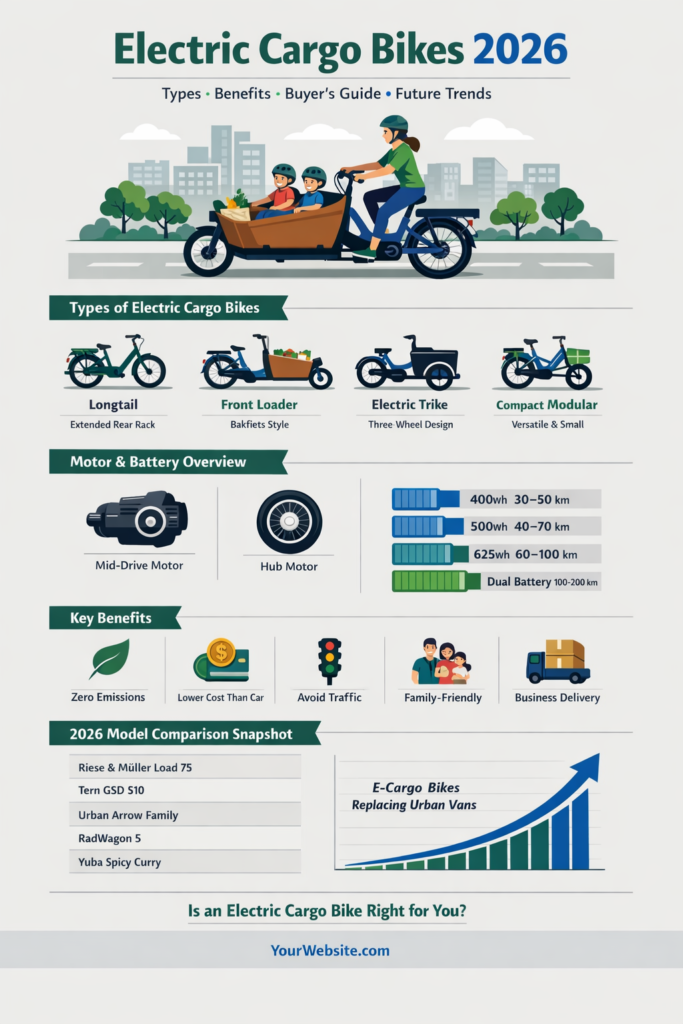
Types of Electric Cargo Bikes
Understanding the different categories ensures you select the correct model for your lifestyle or business.
1. Longtail Electric Cargo Bikes
Longtail models feature an extended rear rack that increases cargo space without drastically altering riding dynamics.
Features
- Slim, streamlined profile
- Balanced ride feel
- Seating for two children
- Compatible with panniers and baskets
Ideal For
- Families
- Grocery shopping
- Urban mobility
Popular in Germany, France, and the UK.
2. Front Loader (Bakfiets Style)
In this design, the cargo container is positioned in front of the rider.
Features
- Spacious front box
- Capacity for 2–4 children
- Low center of gravity
- Weather-resistant covers available
Ideal For
- School transport
- Family outings
- Urban commercial delivery
Widely used in Amsterdam and Copenhagen.
3. Electric Cargo Tricycles
These incorporate three wheels for enhanced balance and load stability.
Features
- Maximum stability
- Oversized cargo area
- No balancing difficulty
Ideal For
- Commercial logistics
- Heavy deliveries
- Riders seeking extra stability
4. Compact & Modular Cargo Bikes
Designed for metropolitan environments with limited storage space.
Features
- Reduced footprint
- Adaptable cargo systems
- Innovative storage solutions
Ideal For
- Apartment dwellers
- High-density cities
Motor & Battery Explained
Electric cargo bikes require stronger propulsion systems because they move heavier cargo loads.
Motor Types
Mid-Drive Motors (Recommended)
- Positioned centrally
- Improved weight distribution
- Superior torque output
- Better hill-climbing capability
Hub Motors
- Located in front of or rear wheel
- More affordable
- Mechanically simpler
Torque Requirements
| Usage | Recommended Torque |
| Family Use | 60–85 Nm |
| Business Use | 85–120 Nm |
Greater torque ensures efficient climbing and acceleration under load.
Battery Capacity & Estimated Range
| Battery (Wh) | Approximate Range |
| 400Wh | 30–50 km |
| 500Wh | 40–70 km |
| 625Wh | 60–100 km |
| Dual Battery | 100–200 km |
Range varies based on:
- Cargo weight
- Topography
- Assist level
- Temperature
- Tire inflation
Key Benefits of Electric Cargo Bikes
The surge in popularity of electric cargo bikes is supported by measurable advantages.
1. Environmental & Urban Impact
Electric cargo bikes generate zero direct exhaust emissions. Research in multiple European cities indicates they can replace up to half of short-distance urban van journeys.
Environmental Benefits
- Lower greenhouse gas output
- Reduced congestion
- Quieter streets
- Improved urban air quality
Cities including Paris, London, and Berlin offer incentives to promote e-cargo bike adoption.
2. Everyday Advantages for Families
For parents, a cargo bike for families can completely transform daily routines.
Family Benefits
- Safe transportation for 2–3 children
- Large storage capacity (80–200 liters)
- Avoid school traffic
- Weather protection options
- Significant fuel savings
Many families report improved well-being and more engaging commuting experiences.
3. Business & Logistics Benefits
Cargo bikes for last-mile delivery are revolutionizing urban logistics.
Business Advantages
- Eliminate fuel costs
- Avoid congestion charges
- Simplified parking
- Access restricted emission zones
- Lower maintenance expenses
Common users include:
- Restaurants
- Bakeries
- Florists
- Parcel couriers
How to Choose the Best Electric Cargo Bike
Selecting the right model requires evaluating multiple technical and practical factors.
Step 1: Select Appropriate Motor Power
- Minimum 75Nm for family usage
- 85Nm+ recommended for commercial operations
Step 2: Assess Payload Capacity
| Category | Payload |
| Entry Level | 180 kg |
| Premium | 250 kg+ |
Ensure total system weight rating supports rider plus cargo.
Step 3: Inspect Braking System
Hydraulic disc brakes are essential.
Look for:
- 4-piston calipers
- 180–203mm brake rotors
Step 4: Evaluate Frame Construction
- Aluminum: Lightweight & corrosion-resistant
- Steel: Durable & resilient
A lower center of gravity improves handling stability.
Step 5: Consider Essential Accessories
- Rain protection covers
- Child seats
- Locking cargo lids
- GPS tracking
- High-security locks
Best Electric Cargo Bikes
Leading brands across Europe and North America include:
- Riese & Müller Load 75
- Tern GSD S10
- Urban Arow Family
- Rad Power Bikes RadWagon 5
- Yuba Spicy Curry
2026 Electric Cargo Bike Comparison Table
| Model | Motor | Battery | Payload | Price (EUR) | Best For |
| Riese & Müller Load 75 | Bosch Mid-drive | 625Wh | 200kg | €6,000–€8,000 | Premium families |
| Tern GSD S10 | Bosch | 500Wh | 200kg | €4,500–€5,500 | Compact power |
| Urban Arrow Family | Bosch | 500Wh | 250kg | €5,000–€6,500 | Kids transport |
| RadWagon 5 | Hub motor | 750W | 158kg | €2,000–€2,500 | Budget buyers |
| Yuba Spicy Curry | Bosch | 500Wh | 200kg | €4,000–€5,000 | Balanced option |
Pros & Cons of Electric Cargo Bikes
Pros
- Sustainable transport option
- Lower operating expenses
- Reduced traffic stress
- Strengthens family interaction
- Efficient commercial tool
- Subsidy eligibility in many regions
Cons
- Higher initial investment
- Requires storage space
- Learning adaptation period
- Battery replacement cost after several years
Real-World Applications
Family & Everyday Use
- School commuting
- Supermarket trips
- Leisure rides
- Pet outings
Small Businesses
- Courier deliveries
- Bakery distribution
- Floral transport
- Online order fulfillment
Urban Infrastructure Development
Countries expanding cycling networks:
- Netherlands
- Germany
- United Kingdom
- France
Dedicated lanes continue expanding annually.
Common Myths About Electric Cargo Bikes
“They Are Hard to Ride”
Modern mid-drive systems simplify operation.
Cannot Replace Cars.”
They effectively substitute second vehicles for urban households.
They Are Too Expensive
Five-year ownership costs are typically lower than maintaining a car.
Future Trends & Market Growth
The global electric cargo bike market is experiencing rapid expansion.
Electric Cargo Bike Trends
- Integrated GPS systems
- Advanced anti-theft technology
- Data-driven ride analytics
- Modular cargo platforms
- Experimental solar charging
Governments increasingly provide:
- Purchase grants
- Tax rebates
- Fleet incentives
By 2030, electric cargo bikes may become standard equipment for urban logistics networks.
FAQs
A: They produce zero tailpipe emissions and reduce fossil fuel use.
A: Families prefer front-loaders. Businesses may prefer trikes.
A: Electric versions provide motor assistance for heavy loads.
A: Typically 3–5 years.
A: with certified seats and harness systems.
Final Expert
Electric cargo bikes represent a modern evolution in urban mobility. They combine efficiency, sustainability, and practicality in one powerful package.
They empower:
- Families to reduce expenses
- Businesses to enhance productivity
- Cities to lower emissions
If you live in an urban area and want smarter, cleaner, and more economical transportation, investing in an electric cargo bike in 2026 is a forward-thinking decision.
At BikesLover.com, we recommend selecting a model based on torque capacity, battery range, and payload requirements — always considering long-term value rather than just initial price.
