
Introduction:
Nowhere is Affordable Electric Bike transport more accessible than it used to be. By 2026, cheap e-bikes will sit right at the front edge of how fast things are changing in traffic and city movement worldwide.
Across Europe, students walking between city campuses change how they move each day. In Pakistan, workers avoiding busy roads find new ways forward. Suburbs in America see residents saving fuel by choosing lighter modes of transport. Every path shifted slightly shapes a different routine.
Still, there’s something many shoppers don’t see coming:
Many online articles simply compile product lists.
They rarely analyze:
- Real-world battery efficiency
- Long-term operational expenses
- Regional pricing variations
- Electricity charging cost
- Motor torque performance
- Warranty dependability
- Lifecycle ownership value
This comprehensive pillar guide solves that gap.
As electric mobility analysts at BikesLover.com, we developed this deeply researched, data-backed resource to help you:
- Understand what truly defines an electric bike as “affordable.”
- Compare the best value-driven electric bicycles worldwide
- Prevent costly purchasing errors
- Select the right battery configuration and motor system
- Optimize cost-per-kilometer value
- Maximize performance without compromising safety standards
If you’re searching for the best affordable electric bike in 2026, this is your complete roadmap.
What Is an Affordable Electric Bike?
A cheap electric bike means one called a budget e-bike, low-cost electric bicycle, or starter electric commuter bike, built to do certain things by design:
- Lower upfront cost for first purchase
- Minimal charging expenses
- Practical commuting capability
- Dependable but simplified battery systems
- Energy-efficient motor performance
- Cost-effective maintenance
Not like high-end e-bikes priced from three thousand to five grand or further, budget options emphasized on:
- Core functionality
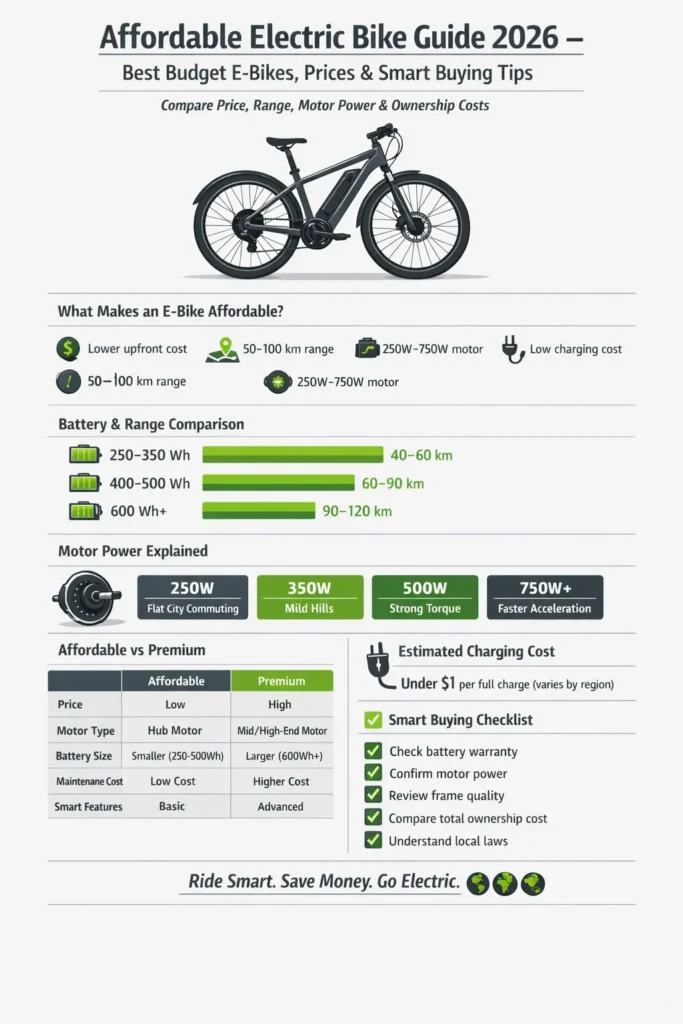
- Moderate riding distance (50–100 km per charge)
- 250W–750W motor outputs
- Efficiency over luxury
- Accessibility for mass adoption
They are particularly suitable for:
- College students
- Daily urban commuters
- Food delivery riders
- First-time electric bike buyers
- Budget-conscious families
- Fuel-cost reduction for households
In straightforward terms:
A well-selected, affordable electric bike delivers approximately 80% of the practical advantages at nearly 40% of the cost compared to high-end alternatives.
Why Affordable E-Bikes Save You Money
Lower Total Cost of Ownership
When evaluated against petrol scooters, motorcycles, or small engine vehicles, affordable e-bikes present significantly lower operational expenditure.
They eliminate:
- Fuel consumption
- Engine oil change
- Spark plug replacements
- Gearbox repairs
- Clutch maintenance
- Complex mechanical servicing
One reason? Fewer parts that grind or rub together. That means less damage over time.
Across parts of Europe, recharging a full battery usually falls between 0.50 and 1 euro, influenced by battery dimensions plus local power rates. In countries like Pakistan and India, swapping electrons for driving power tends to cost far less compared to the cost of gasoline.
With electric cars, over three years, less money is spent compared to gas models, especially where prices on petrol rise fast in city centers.
From power sources, electric bikes turn energy into motion – doing so with surprisingly little waste, which helps keep costs manageable for daily trips.
Environmentally Sustainable Urban Mobility
Affordable e-bikes produce:
- Zero tailpipe emissions
- Reduced noise pollution
- Lower greenhouse gas output
- Improved air quality
Countries such as:
- Germany
- Netherlands
- United Kingdom
- France
have strengthened cycling infrastructure, introduced subsidies, and implemented electric mobility incentives to encourage adoption.
As cities expand bike lanes and regulate car congestion, affordable electric bicycles become practical and policy-supported alternatives.
Ideal for Short-Distance Daily Travel
Urban mobility data consistently shows that most daily commutes fall below 20 kilometers.
A budget electric bicycle offering 60–80 km range easily accommodates:
- Office commutes
- University transportation
- Grocery trips
- Social visits
- Weekend leisure rides
For many riders, charging once every two to three days is sufficient.
Simple. Reliable. Economical.
How to Choose the Best Affordable Electric Bike
Purchasing an electric bicycle should not revolve around selecting the lowest price.
Instead, focus on value per kilometer, long-term durability, and energy efficiency.
1. Battery Capacity & Range
The battery functions as the central energy reservoir of an electric bike.
Core Battery Metrics
- Watt-hours (Wh) – Total stored energy
- Volts (V) – Electrical pressure output
- Amp-hours (Ah) – Storage capacity
Real-World Range Estimates
| Battery Capacity | Estimated Practical Range |
| 250–350 Wh | 40–60 km |
| 400–500 Wh | 60–90 km |
| 600 Wh+ | 90–120 km |
For European city riders → 400–500 Wh is generally optimal.
For delivery workers or extended riders → 600 Wh or higher is recommended.
Important insight: Real-world range is typically 15–25% Lower than advertised laboratory figures due to rider weight, terrain, wind resistance, and riding style.
Motor Power Explained
Motor wattage influences:
- Acceleration capability
- Hill climbing strength
- Torque output
- Load-bearing performance
- Rider weight handling
Common Motor Ratings
| Motor Power | Ideal Usage | Legal Context |
| 250W | Flat urban terrain | EU legal limit |
| 350W | Light inclines | Widely accepted |
| 500W | Moderate hills | Strong torque |
| 750W | US market | Faster response |
For flat cities like Amsterdam → 250W is adequate.
For hilly areas like Lisbon → 500W is advisable.
Hub motors dominate the affordable segment due to simplicity and lower manufacturing costs.
Frame & Structural Integrity
Frame durability directly impacts longevity and safety.
Look for:
- Aluminum alloy construction
- Corrosion-resistant finish
- Disc braking systems (hydraulic preferred)
- Recognized battery cell manufacturers
- Weather-sealed wiring
Avoid extremely cheap imports lacking after-sales service or compliance certifications.
Warranty & After-Sales Coverage
Affordability should never equal vulnerability.
Verify:
- Battery warranty (minimum 1–2 years)
- Motor guarantee
- Controller coverage
- Spare parts accessibility
- Local service support
Battery replacement constitutes the most significant long-term expense, so warranty reliability is crucial.
Best Affordable Electric Bikes in 2026
Below are dependable performers within the budget electric mobility segment.
🇵🇰 Best Budget Electric Bikes in Pakistan
| Model | Approx Price | Range | Top Speed | Ideal Use |
| Jolta JE-70D | ~Rs. 140,000 | 70–90 km | 70 km/h | City commute |
| Pakzon PE-70D | ~Rs. 150,000 | 80 km | 55 km/h | Students |
| MS Jaguar E-70 | ~Rs. 239,000 | ~80 km | 75 km/h | Daily riders |
| Chang Jiang N21 | ~Rs. 245,000 | ~100 km | 80 km/h | Long-range |
Rising petrol costs have accelerated adoption across Pakistan’s urban centers.
🇺🇸 Best Affordable Electric Bikes Under $1000 (USA)
Typical entry-level specifications include:
- 500W hub motor
- 48V lithium battery
- 40–80 km range
- Mechanical disc brakes
- LCD display
These bikes are well-suited for suburban commuting and recreational riding.
🇪🇺 & 🇬🇧 Best Budget Electric Bikes
European regulations limit pedal-assist motors to 250W and 25 km/h.
Affordable European models generally include:
- 250W rear hub motor
- 400–500 Wh battery
- Lightweight aluminum frame
- Integrated lighting
These configurations align with EU compliance standards and insurance exemptions.
Affordable vs Premium Electric Bikes – Full Comparison
| Feature | Affordable E-Bikes | Premium E-Bikes |
| Price | $400–$1200 | $1500–$5000+ |
| Motor | Hub-driven | Mid-drive |
| Battery | 400–600 Wh | 600–900 Wh |
| Suspension | Basic fork | Advanced air |
| Connectivity | Minimal | GPS, App |
| Warranty | 1–2 years | 2–5 years |
Affordable models prioritize practicality.
Premium bikes prioritize refinement and advanced technology.
Pros of Affordable Electric Bikes
- Lower acquisition cost
- Reduced operating expenses
- Fuel independence
- Beginner accessibility
- Straightforward maintenance
- Lightweight structure
- Easy component replacement
Cons
- Limited smart features
- Lower resale valuation
- Basic suspension systems
- Reduced brand prestige
Common Mistakes to Avoid
Selecting the absolute cheapest option without a warranty
Ignoring battery cell quality
Purchasing overly heavy frames
Overlooking regional legal restrictions
Skipping protective safety equipment
Electric Bike Maintenance & Safety Guide
Essential Safety Practices
- Always wear a helmet
- Install front and rear lights
- Maintain optimal tire pressure
- Use reflective apparel
- Inspect brakes regularly
Battery Care Recommendations
- Avoid complete deep discharge cycles
- Store between 20–25°C
- Use a manufacturer-approved charger
- Disconnect after full charge
With appropriate care, batteries typically last 3–5 years.
Who Should Buy an Affordable Electric Bike?
You are an ideal candidate if:
- Your daily travel is under 30 km
- You aim to reduce fuel expenditure
- You are a student or young professional
- You prefer sustainable commuting
- You want a practical urban solution
Future of Affordable Electric Bikes
The affordable electric mobility sector is projected to expand rapidly.
Key trends include:
- Higher energy-density battery cells
- Rapid charging advancements
- Lighter alloy frames
- Government financial incentives
- Growing adoption in South Asia
- Improved supply chain localization
Electric mobility is transitioning from alternative transport to mainstream infrastructure.
Final Expert
Our assessment:
Pick the right basic electric bike. It brings real city benefits without extra cost.
If you:
- Pick trusted battery makers
- Confirm warranty coverage
- Avoid unknown sellers
- Keep things useful in everyday reach.
- Benefits to you include:
- Fuel usage drops noticeably. One key finding stands out clearly.
- Infrequent upkeep
- Sustainable transportation
In 2026, learners, delivery Riders, and budget-conscious travelers can still see clear benefits from this kind of smart transport spending.
FAQs
A:Most reliable options range from $600 to $1200.
A: Typically, 3–5 years with proper maintenance.
A: If the motor is 500W+ or the torque is sufficient.
A: Usually less than €1 or $1 per full charge.
A: Depends on the country. Most EU 250W bikes don’t require registration.
