
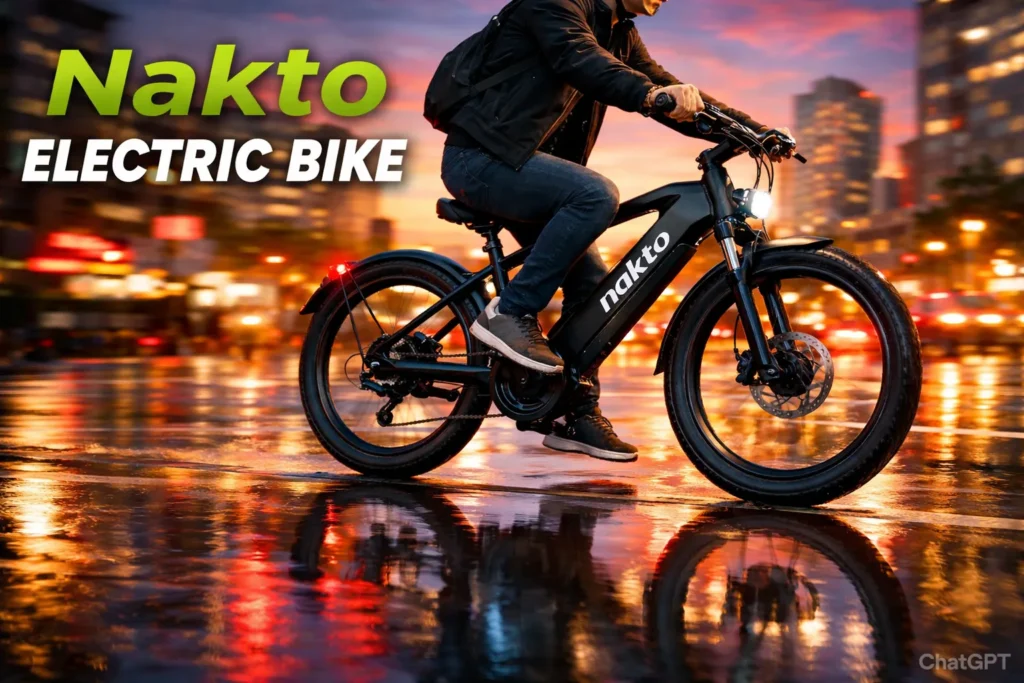
Introduction:
Nakto electric bike are no longer premium gadgets reserved for enthusiasts. They have evolved into practical, economical, energy-efficient transportation solutions for students, commuters, gig workers, urban professionals, and weekend adventurers.
are no longer premium gadgets reserved for enthusiasts. They have evolved into practical, economical, energy-efficient transportation solutions for students, commuters, gig workers, urban professionals, and weekend adventurers.
In this Nakto Electric Bike Review (2026), we provide a comprehensive breakdown covering:
- Every major Nakto electric bicycle model
- Detailed technical specifications comparison
- Nakto battery efficiency & riding range
- Real-world durability and dependability insights
- Transparent advantages and disadvantages
- Maintenance expectations and long-term ownership costs
- Nakto vs competitor evaluation
- Clear guidance on who should — and should not — purchase one
What Is Nakto?
Nakto is an entry-level electric bicycle manufacturer known for producing cost-effective, beginner-oriented commuter e-bikes. Rather than competing with premium brands on advanced digital integration or high-end materials, Nakto concentrates on affordability, accessibility, and straightforward mechanical design.
The company prioritizes functionality over sophistication.
Brand Positioning
Nakto’s strategic positioning in the market includes:
- Budget-friendly electric bicycle
- Simple mechanical construction
- Urban commuting orientation
- Recreational leisure cycling
- Minimal advanced electronics
Unlike performance-focused brands that integrate torque sensors, Bluetooth connectivity, GPS tracking, and app ecosystems, Nakto designs straightforward electric bikes that emphasize basic pedal-assist and throttle systems.
Their philosophy is clear:
Make electric mobility accessible to everyday riders.
Country of Origin & Global Distribution
Nakto electric bikes are primarily manufactured in China and distributed internationally, including:
- United States
- United Kingdom
- Europe
- Australia
- Select Asian markets
In a marketplace where many premium electric bicycles cost between €2,000 and €4,000, Nakto’s significantly lower pricing makes it attractive in budget-sensitive regions.
Why Nakto Electric Bikes Remain Popular
Even in 2026, Nakto maintains steady demand among first-time buyers and cost-conscious consumers.
Here are the core reasons.
Affordable Pricing Structure
Nakto electric bikes are substantially less expensive than mid-tier competitors. This affordability lowers financial risk for:
- Students
- Entry-level commuters
- Casual riders
- Gig economy workers
For individuals entering the electric bike market for the first time, Nakto offers a low-barrier introduction.
90% Pre-Assembled Delivery
Most Nakto models arrive largely pre-assembled. Assembly typically requires:
- Attaching handlebars
- Installing pedals
- Adjusting the saddle
- Fine-tuning brakes
For non-technical users, this reduces intimidation and setup complexity.
Simple and Intuitive Controls
Nakto avoids overcomplicated electronics.
Instead, riders receive:
- Thumb throttle
- Basic Pedal Assist System (PAS)
- Standard LCD
There is no app pairing, no firmware updates, and no complex digital dashboards.
For beginners, this simplicity enhances usability.
Beginner-Friendly Motor Output
Most Nakto models use:
- 250W motors (EU-compliant)
- 350W motors (balanced output)
- 500W motors (enhanced torque)
These motors are suitable for:
- Daily city commuting
- Light to moderate inclines
- 5–25 km daily rides
They are not racing machines, but they are practical mobility tools.
Complete Nakto Electric Bike Models
Let’s examine each major Nakto electric bicycle model in depth.
Nakto Camel Urban Commuter Favorite
The Nakto Camel is one of the brand’s most recognized commuter models.
Key Specifications
- Motor: 250W–350W rear hub
- Battery: 36V 10Ah lithium-io
- Range: 25–35 miles (40–55 km
- Top Speed: 20 mph (32 km/h)
- Frame: Step-through steel
- Weight: ~27–29 kg
Ideal For
- Students
- Office commuters
- Short-distance urban riders
Advantages
- Upright ergonomic riding posture
- Affordable purchase price
- User-friendly design
- Reliable on flat terrain
Drawbacks
- Heavy steel construction
- Basic front suspension fork
- Limited climbing capability
Verdict
A dependable and economical city commuter.
Nakto Super Cruiser Fat-Tire Stability
The Nakto Super Cruiser emphasizes traction and comfort.
Key Specifications
- Motor: 350W–500W
- Battery: 48V 10Ah
- Range: 30–45 miles
- Tires: 26” x 4.0” fat tires
- Front suspension
Ideal For
- Light off-road exploration
- Beach paths
- Snowy conditions
Advantages
- Superior traction
- Stable riding geometry
- Higher torque output
Disadvantages
- Heavy (~32 kg)
- Moderate acceleration
- Not optimized for high-Speed commuting
Verdict
A versatile option for mixed terrain, but not performance-focused.
Nakto Skylark Folding Convenience
The Nakto Skylark prioritizes compact portability.
Key Specifications
- Motor: 250W
- Battery: 36V 10Ah
- Range: 20–30 miles
- Folding aluminum frame
Ideal For
- Apartment residents
- RV travelers
- Multi-modal commuters
Strengths
- Compact storage
- Lighter frame
- Space-efficient
Limitations
- Smaller wheels
- Reduced shock absorption
Verdict
Best suited for limited storage environments.
Nakto F2 Classic Cruiser Comfort
The Nakto F2 blends comfort and relaxed cruising aesthetics.
Key Features
- 350W motor
- 36V battery
- Step-through frame
- Suspension seatpost
Designed primarily for leisure-oriented riders.
Nakto S02 Utility & Cargo Option
The Nakto S02 caters to practical riders.
Key Features
- 350W motor
- 48V battery
- Rear cargo rack
Ideal for grocery runs and light delivery tasks.
Nakto F4 & F6 More Power & Versatility
The Nakto F4 and F6 represent stronger commuter-focused models.
Key Specifications
- 500W motor
- 48V battery
- Enhanced suspension
- Improved hill-climbing torque
Verdict
The best overall balance in Nakto’s 2026 lineup.
Detailed Nakto Electric Bike Specs
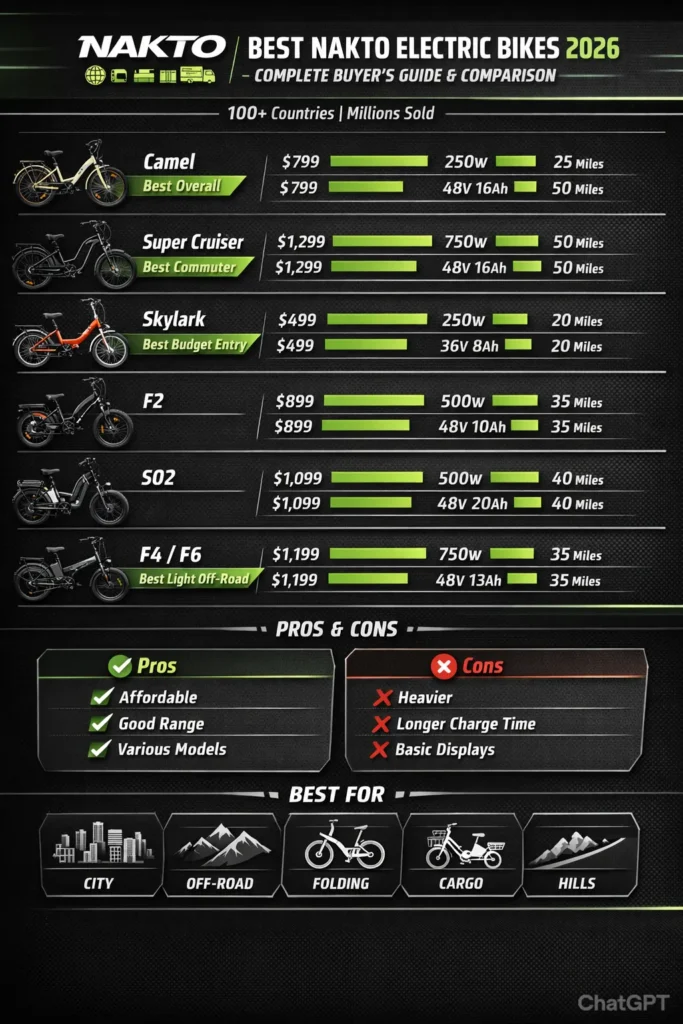
| Model | Motor | Battery | Range | Best For | Weight | Price Level |
| Camel | 250–350W | 36V 10Ah | 25–35 mi | City | ~28 kg | Budget |
| Super Cruiser | 350–500W | 48V 10Ah | 30–45 mi | All-terrain | ~32 kg | Mid |
| Skylark | 250W | 36V 10Ah | 20–30 mi | Folding | ~25 kg | Budget |
| F2 | 350W | 36V | 25–35 mi | Cruiser | ~29 kg | Budget |
| S02 | 350W | 48V | 30–40 mi | Cargo | ~30 kg | Mid |
| F4/F6 | 500W | 48V | 35–45 mi | Hills | ~31 kg | Mid |
Nakto Electric Bike Pros and Cons
Pros
- Competitive pricing
- Straightforward assembly
- Beginner-oriented controls
- Sufficient commuting range
- Easy servicing
Cons
- Heavy frames
- Entry-level components
- Inconsistent customer support
- Minimal smart features
- Moderate durability
Nakto Electric Bike Reliability
Reliability is a key purchase factor.
Positive Observations
- Functional for 1–3 years
- Easy to repair
- Fewer electronic complications
Reported Issue
- Battery wear after 18–24 months
- Occasional controller failures
- Slow customer service response
Overall Assessment
Reliable for moderate commuting use, not designed for heavy-duty daily abuse.
Nakto Battery Life & Mileage
Battery performance determines ownership satisfaction.
Expected Range
20–45 miles per charge
Average real-world: 25–35 miles
Charging Duration
4–6 hours
Variables Affecting Range
- Rider weight
- Terrain elevation
- Tire inflation
- Weather conditions
- Throttle frequency
Battery Longevit
- 500–800 charge cycles
- 2–3 years lifespan
Cold temperatures reduce performance efficiency.
Maintenance, Parts & Long-Term Costs
Nakto electric bicycles use conventional components.
Common Replacements
- Brake pads
- Tires
- Controller units
- Battery packs
Estimated Annual Expense
€100–€300 depending on usage intensity.
Replacement parts may require ordering from:
- Manufacturer
- Third-party suppliers
Nakto vs Competitors
Let’s compare Nakto with competitors like:
- Rad Power Bikes (RadRunner series)
- Fiido
- Ancheer
| Feature | Nakto | RadRunner | Fiido | Ancheer |
| Price | Low | Mid | Mid | Low |
| Motor | 250–500W | 750W (US) | 250–500W | 250–500W |
| Build | Basic | Robust | Good | Basic |
| Tech | Minimal | Advanced | Moderate | Basic |
| Reliability | Moderate | High | Good | Moderate |
Verdict
Choose Nakto for affordability.
RadRunner is a premium utility.
Choose Fiido for compact innovation.
Ancheer for an ultra-budget entry.
Who Should Buy a Nakto Electric Bike?
Ideal For
- First-time buyers
- Students
- Budget commuters
- Riders under 25 km daily
Not Ideal For
- Steep mountain terrain
- Heavy cargo hauling
- Long-distance touring
- Riders seeking premium tech
FAQs
A: for budget-conscious riders who want simple electric mobility.
A:20–45 miles, depending on model.
A: Up to 20 mph (32 km/h).
A: Moderate hills — yes.
Steep hills — choose 500W models.
A:2–3 years with proper care.
Final Verdict
Best Overall: Nakto F4/F6
Balanced torque and endurance.
Commuter: Nakto Camel
Practical and economical.
Best for Light Off-Road: Nakto Super Cruiser
Stable fat-tire traction.
Budget Entry: Nakto Skylark
Compact and urban-friendly.
