
Electric Bike Motor Guide 2026
The Electric bike motor is the true powerhouse of every modern e‑bike.
RED, the battery store electrical energy, and the motor determine how that energy is used in real life. It decides whether your ride feels smooth or jerky, powerful or weak, efficient or wasteful.
- Urban commuting
- Food delivery services
- Long‑range touring
- Cargo transportation
- Trail riding and mountain exploration
Most buyers focus only on battery size or top speed, while completely overlooking the electric bike motor.
This mistake often results in:
- Weak uphill performance
- Sluggish acceleration
- Reduced riding comfort
- Shorter real‑world range
- Higher long‑term maintenance costs
By the end of this guide, you will confidently understand:
- All electric bike motor types
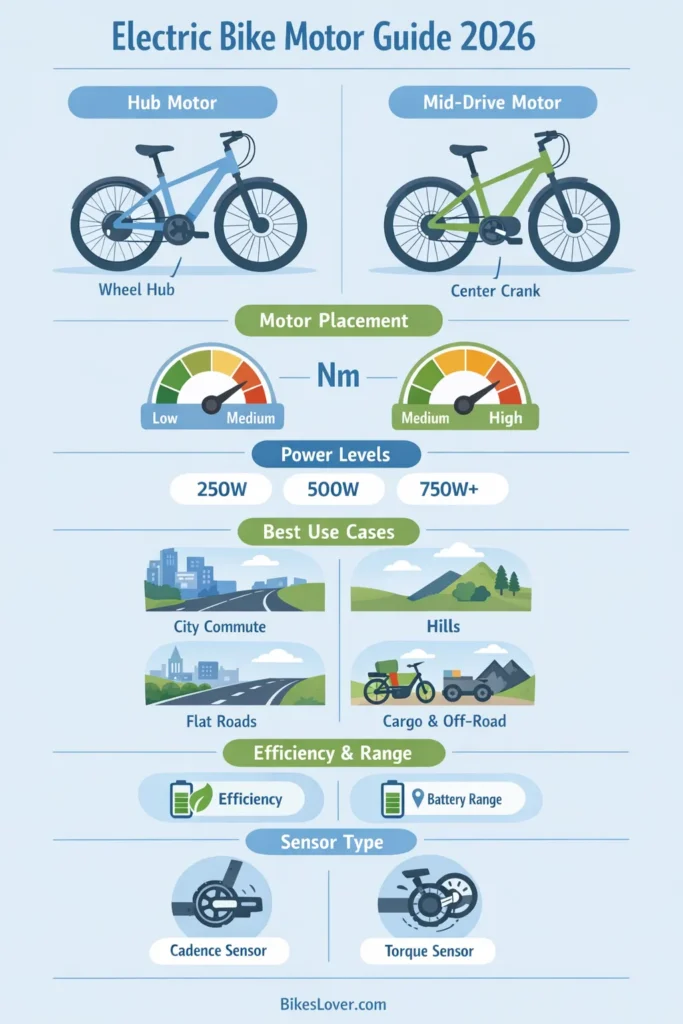
- Hub motor vs mid‑drive motor differences
- Torque vs power explained practically
- Which motor suits your riding style
- How to avoid expensive buying errors
What Is an Electric Bike Motor?
The motor amplifies your pedaling effort.
Unlike motorcycles or scooters, most e‑bike motors are designed to assist human input, notes replace it entirely. This is why electric bicycles still feel like bicycles, just significantly easier and faster to ride.
Core Functions of an E‑Bike Motor
A modern e‑bike motor performs multiple essential roles:
- Supports pedal assistance
- Multiplies rider input
- Enhances acceleration
- Assists climbing inclines
- Maintains steady cruising speed
- Reduces rider fatigue
The motor does not work alone. It functions as part of an integrated ecosystem that includes:
- Battery: Stores electrical energy
- Controller: Regulates power delivery
- Sensors: Detect pedaling motion or force
Together, these components define your e‑bike’s riding character.
Why Electric Bike Motor Choice Matters More Than Ever
Same frame.
Saemes battery capacity.
Same wheel sizes.
Motor selection influences:
- Acceleration smoothness
- Hill‑climbing capability
- Energy efficiency
- Weight distribution
- Ride stability
- Service frequency
- Long‑term reliability
Types of Electric Bike Motors
- Hub Motors
- Mid‑Drive Motors
Hub Motors
It may be installed in:
- Front wheel hub
- Rear wheel hub
Front Hub Motor
Advantages:
- Simple installation
- Cost‑effective
- Popular for conversion kits
Disadvantages:
- Reduced traction on wet surfaces
- Heavier steering feel
Rear Hub Motor
Advantages:
- Improved traction
- More natural push sensation
- Better weight Balance
Disadvantages:
- Slightly more complex maintenance
Hub Motor Subtypes
| Hub Motor Type | Description | Best Use |
| Direct Drive | Gearless, large diameter | High speed, durability |
| Geared Hub | Internal planetary gears | Better torque, lightweight |
Pros of Hub Motors
- Affordable pricing
- Minimal maintenance
- Quiet operation
- Simple mechanical structure
- Ideal for flat terrain
Cons of Hub Motors
- Lower torque output
- Weaker hill climbing
- Wheel‑heavy feel
- Reduced efficiency on steep slopes
Mid‑Drive Motors
How Mid‑Drive Motors Work
- Optimal’s RPM is maintained
- Efficiency increases
Advantages of Mid‑Drive Motors
- High torque output
- Superior hill climbing
- Improved battery efficiency
- Centralized weight balance
- Excellent off‑road performance
Disadvantages of Mid‑Drive Motors
- Higher purchase cost
- Increased drivetrain wear
- More complex servicing
Mid‑drive systems dominate:
- Premium European e‑bikes
- Cargo bicycles
- Trekking e‑bikes
- Electric mountain Bikes
Other Electric Bike Motor Types
Friction Drive Motors
- Roller presses directly against the tire
- Very inefficient
- Poor wet‑weather performance
All‑in‑One Motor Wheels
- Motor and controller integrated
- Common in DIY conversion kits
Electric Bike Motor Power vs Torque Explained
Power (Watts)
- Maximum assisted speed
- Acceleration on flat terrain
Common ratings:
- 250W – European legal limit
- 350W–500W – global standard
- 750W+ – off‑road or private property
Torque
Torque determines:
- Hill climbing strength
- Load carrying ability
- Initial acceleration
| Torque Range | Real‑World Performance |
| 30–50 Nm | Light urban riding |
| 60–80 Nm | Moderate hills |
| 85–120 Nm | Steep terrain & cargo |
Brushless vs Brushed Electric Bike Motors
Brushless Motors
- Industry standard
- High efficiency
- Long lifespan
- Quiet operation
- Minimal maintenance
Brushed Motors
- Outdated technology
- Higher friction
- Shorter lifespan
Cadence Sensor
- Detects pedal rotation
- Delivers on/off assistance
- Lower cost
- Common on entry‑level Bikes
Torque Sensor
- Measures actual pedal force
- Smooth proportional assistance
- Natural riding feel
Electric Bike Motor Efficiency & Battery Range
Efficient motors:
- Waste less energy as heat
- Deliver smoother assistance
- Extend battery lifespan
Best Electric Bike Motor for Different Riders
| Rider Type | Recommended Motor |
| City commuter | Rear hub motor |
| Office travel | 250W hub or mid‑drive |
| Hilly terrain | Mid‑drive (80+ Nm) |
| Cargo bike | Mid‑drive (100+ Nm) |
| Off‑road MTB | Mid‑drive with torque sensor |
| Budget rider | Geared hub motor |
Global Legal Motor Limits
| Region | Legal Limit |
| Europe / UK | 250W – 25 km/h |
| USA | 750W – 20–28 mph |
| Canada | 500W |
| Australia | 250W |
| Pakistan / India | Varies by province |
Maintenance & Motor Longevity Tips
To maximize motor lifespan:
- Avoid pressure washing
- Keep electrical connectors clean
- Update firmware regularly
- Maintain drivetrain properly
- Use correct gear ratios
Pros and Cons of Electric Bike Motors
Pros
- Reduced physical strain
- Faster commuting
- Eco‑friendly transport
- Low operating cost
- Increased accessibility
Cons
- Higher upfront investment
- Additional bike weight
- Legal restrictions
- Battery dependence
FAQs
A1: Mid‑drive motors with 80–120 Nm torque.
A2: Torque and efficiency matter more.
A3: Usually, most systems are frame‑specific.
A4: Efficient motors significantly extend range.
Q5: especially direct‑drive hub motors.
A6: Bosch, Shimano, Yamaha, Brose, and Bafang.
A7: They are water‑resistant, not fully waterproof.
Final
- Hub motors offer simplicity and affordability
- Mid‑drive motors deliver performance and efficiency
- Torque matters more than wattage
- Sensor quality transforms Ride feel
For flat city environments, a quality hub motor is sufficient. For hills, cargo, and long‑term value, mid‑drive systems remain the superior investment
