
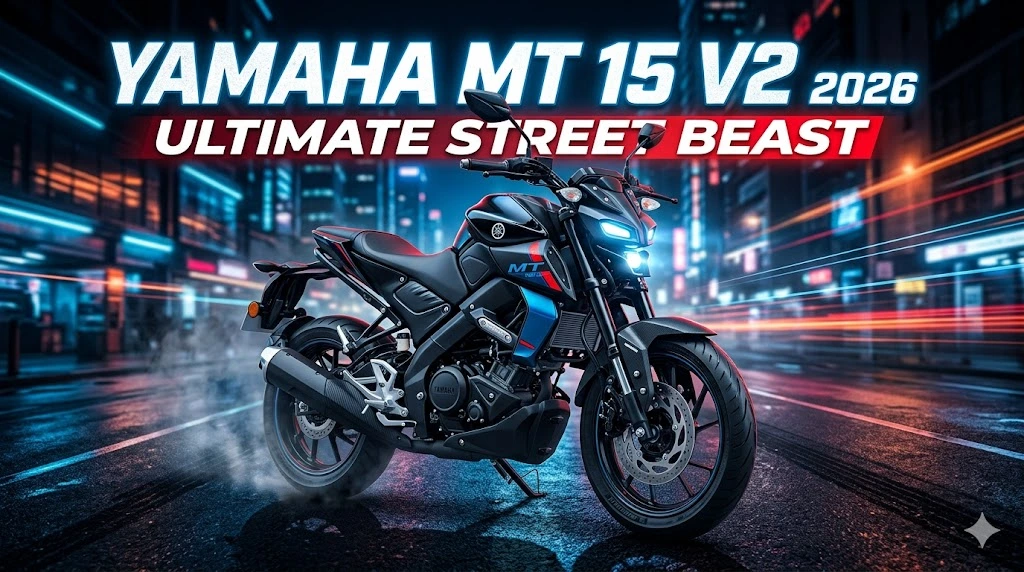
Yamaha MT-15 V2: The Ultimate Streetfighter Guide (2026)
The Yamaha MT-15 V2, also known as the MT-15 Version 2.0, continues to dominate the entry-level streetfighter segment in India and holds strong appeal in select international markets. It masterfully blends the aggressive “Dark Side of Japan” design philosophy from Yamaha’s larger MT series with a refined 155cc VVA engine, upgraded chassis dynamics, and practical modern features.
Whether you’re a young enthusiast seeking weekend thrills, a college student needing a stylish daily commuter, or someone upgrading from a 125-150cc bike, the MT-15 V2 delivers an engaging riding experience without breaking the bank on fuel or maintenance. In 2026, it remains competitive thanks to its lightweight build, agile handling, and efficiency that many naked bikes in the 150-160cc class struggle to match.
This comprehensive guide on BikesLover.com covers everything: updated 2026 pricing, detailed specs, real-world insights, riding impressions, rival comparisons, ownership costs, and a balanced verdict to help you decide if it’s the right bike for you.
Brand Background and the MT Series Philosophy
Yamaha Motor Company, a Japanese powerhouse founded in 1955 (with roots in musical instruments dating back further), has built a reputation for innovative engineering, reliability, and performance-oriented motorcycles. The MT series embodies the “Master of Torque” ethos, focusing on strong low-to-mid-range pull, agile handling, and distinctive streetfighter styling rather than pure top-end speed.
The MT-15, launched globally around 2018-2019 (with India-specific production starting soon after), draws heavily from the YZF-R15 platform but strips away the fairing for an upright, naked-bike posture. The V2 update (introduced earlier and refined ongoing) brought key chassis upgrades like USD forks and an aluminum swingarm, making it more competitive against rivals like the KTM 160 Duke.
Country of Origin: Designed in Japan, manufactured primarily in India for the Indian market (with exports and production in Thailand, Indonesia, Malaysia, etc., for other regions). Global variations exist in specs, emissions compliance, and features.
Engine, Performance, and Riding Experience
At the core sits a 155cc liquid-cooled, single-cylinder, SOHC, 4-valve engine with Yamaha’s Variable Valve Actuation (VVA) technology. It produces approximately 18.4 PS (13.5 kW) at 10,000 rpm and 14.1 Nm at 7,500 rpm. Bore x stroke is 58.0 mm × 58.7 mm with an 11.6:1 compression ratio.
VVA switches cam profiles around 7,400 rpm, delivering strong low-end tractability for city crawling and a thrilling top-end surge. Power delivery feels linear and refined, with vibes well-controlled until high revs.
Transmission: 6-speed gearbox with Assist & Slipper Clutch for smooth, effortless shifts and reduced rear-wheel hop during aggressive downshifts.
Real-World Performance:
- 0-60 kmph: Around 4.9-5.5 seconds.
- 0-100 kmph: Approximately 14-15 seconds (observed in tests).
- Top Speed: 122-130 kmph (claimed/observed, depending on conditions).
City Riding: Excellent low-speed manners; it pulls cleanly in higher gears and excels in traffic with light clutch action.
Highway: Stable up to 100-110 kmph cruising. Shorter gearing keeps it engaging but can feel revvy on long runs.
Handling: The DeltaBox frame, 37mm USD forks, aluminum swingarm, and optimized geometry transform it. At just 141 kg kerb weight, it’s flickable, planted in corners, and offers great front-end feedback. Wheelbase is around 1,325-1,335 mm.
Braking: Dual discs (front 282mm, rear 220mm) with dual-channel ABS. Strong, progressive bite with good modulation. Traction Control (TCS) in select/DLX variants enhances safety on wet or slippery roads.
Ride Quality: Firm and sporty. It handles most urban imperfections well, but the rear monoshock can feel stiff over potholes or with a pillion.
Mileage and Efficiency
One of the MT-15 V2’s biggest strengths is its fuel efficiency, thanks to the refined engine and lightweight design.
Claimed ARAI: Up to 56.87 kmpl.
Real-World:
- City (mixed/aggressive): 45-50 kmpl.
- Highway (steady 70-90 kmph): 50-57 kmpl.
Fuel Tank: 10 liters → Real-world range of 400-500+ km is achievable, making it ideal for long commutes or weekend getaways with fewer fuel stops.
Owners consistently praise lower running costs compared to thirstier competitors like certain KTM models.
Design, Styling, Build Quality, and Ergonomics
The MT-15 V2 screams streetfighter aggression with sharp lines, a muscular fuel tank, a bi-functional LED projector headlamp with DRLs, and a compact tail section. It draws clear inspiration from bigger siblings like the MT-09 and MT-10.
2026 Colors: Metallic Black, Cyan Storm/Silver Cyan, Ice Fluo/Ice Storm Vermillion, Racing Blue, Vivid Violet Metallic, and special editions (e.g., MotoGP-inspired).
Build Quality: Premium Yamaha fit and finish overall. Exposed DeltaBox frame adds visual appeal. Some plastics and switchgear receive minor criticism for feeling average at this price point.
Ergonomics:
- Seat Height: 810 mm – accessible for most riders (average Indian/European heights).
- Rider Position: Upright yet sporty with wide handlebars for good leverage.
- Taller Riders (>5’10”): May find it slightly cramped on long rides.
- Pillion: Compact seat; suitable for short hops, not ideal for heavy or long-distance passengers.
- Storage: Limited under-seat space.
Dimensions: Compact and nimble, perfect for urban environments.
Suspension, Brakes, Wheels & Tyres, Frame & Chassis
- Front Suspension: 37mm USD (inverted) telescopic forks.
- Rear Suspension: Linked monoshock with aluminum swingarm.
- Frame: High-rigidity Deltabox.
- Brakes: Dual discs + dual-channel ABS (most variants).
- Wheels: 17-inch alloys.
- Tyres: Front 100/80-17 (tubeless), Rear 140/70R-17 radial tubeless – excellent grip for the class.
Electronics, Features & Technology
- Instrument Cluster: Digital/LCD (negative display; TFT in some DLX updates) with Bluetooth Y-Connect app connectivity (call/SMS alerts, last parked location, maintenance reminders, trip data, battery voltage).
- Lighting: Full LED setup with projector headlamp.
- Safety: Dual-channel ABS, Traction Control (select variants), side-stand cut-off, slipper clutch.
- Convenience: USB charging in some variants, hazard lights.
- Misses: No built-in turn-by-turn navigation (app-dependent); switchgear could be more premium.
Y-Connect App: Practical for daily use but not the most feature-rich in the segment.
Variants, Colors & Pricing (2026, India Focus)
Variants:
- Standard: Base model.
- Deluxe (DLX): Adds premium features like enhanced Y-Connect/TFT elements.
Ex-Showroom Prices (Delhi approx.):
- Standard: ₹1.59L – ₹1.64L
- Deluxe: ₹1.68L – ₹1.73L (or slightly higher depending on exact trim).
On-Road Prices: Typically ₹1.75L – ₹2.05L+ (varies by city due to RTO, insurance). Check local dealers for offers, exchange, or financing. Prices are more competitive post any GST adjustments.
Global Notes: Available in markets like Malaysia, Thailand, Europe (pricing varies significantly, e.g., around €2,000+ equivalent in some regions). Specs may differ for emissions or local regulations.
Maintenance, Servicing, Reliability & Ownership Experience
Yamaha’s widespread service network ensures easy access. Service intervals are reasonable, with costs typically ₹1,000-1,500 per service. Long-term owners report excellent reliability over 3+ years with minimal issues when serviced regularly. Strong resale value is a major plus.
Spare Parts: Readily available and affordable compared to some European brands.
Ownership Tips: Regular chain maintenance, timely oil changes, and gentle riding in traffic maximize longevity and efficiency.
Pros & Cons
Pros:
- Thrilling, refined VVA engine with excellent mid-range and top-end.
- Class-leading agility, handling, and lightweight feel.
- Strong real-world fuel efficiency and low running costs.
- Head-turning aggressive design and premium LED lighting.
- Modern safety features (ABS, TCS in variants) and Bluetooth connectivity.
- Reliable daily commuter with strong weekend fun factor.
- Good power-to-weight ratio and build quality.
Cons:
- Firm suspension, especially rear on poor roads or with pillion.
- Cramped for taller riders or regular two-up use.
- Some plastics/switchgear feel average for the price.
- Revvy gearing can make highway cruising busier.
- Limited storage and pillion comfort.
- Base variants may lack some premium features.
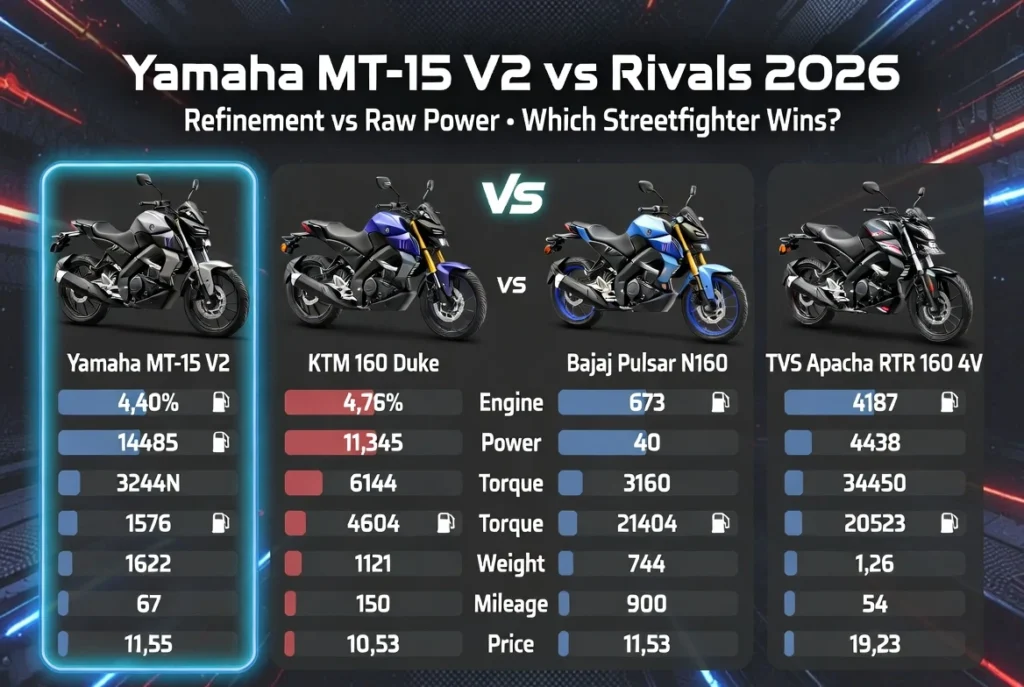
Yamaha MT-15 V2 vs Rivals Comparison (2026)
The 150-160cc naked/streetfighter segment is hotly contested. Here’s how the MT-15 V2 stacks up:
| Parameter | Yamaha MT-15 V2 | KTM 160 Duke | Bajaj Pulsar N160 | TVS Apache RTR 160 4V |
| Engine | 155cc, Liquid, VVA | 164cc, Liquid | 164.9cc, Oil/Air | 159.7cc, Oil-cooled |
| Power/Torque | 18.4 PS / 14.1 Nm | ~18.7 PS / 15.5 Nm | ~16-17 PS | 17.5 PS / 14.8 Nm |
| Weight (kerb) | 141 kg | ~150+ kg | ~152 kg | ~145 kg |
| Mileage (real-world) | 45-55+ kmpl | 35-40 kmpl | 40-45 kmpl | 40-45 kmpl |
| Suspension | USD + Alu swingarm | WP (better travel) | Conventional/upsided | Conventional |
| Features | Y-Connect, TCS (sel.) | TFT, more aggressive | Good value features | Feature-rich (Bluetooth, etc.) |
| Price (ex-showroom approx.) | ₹1.59-1.73L | ₹1.74L+ | Lower | Competitive |
| Best For | Refinement + Handling | Raw power + suspension | Value + Torque | Features + Value |
Verdict on Rivals: The MT-15 wins on refinement, efficiency, and nimble handling. The Duke feels rawer and more powerful but thirstier. Pulsar and Apache offer better value but lag in premium feel and engine smoothness.
vs Yamaha R15 V4: MT-15 is more comfortable and street-oriented; R15 is track-focused with fairings.
Best Use Cases and Who Should Buy It?
Ideal For:
- Solo riders or light pillion for city commutes and spirited weekend rides.
- Beginners to intermediate enthusiasts wanting style, performance, and efficiency.
- Riders prioritizing handling finesse, reliability, and low ownership costs.
- Urban environments in India, Southeast Asia, or similar markets.
Skip If: You need plush comfort for long tours, heavy pillion use, maximum low-end torque for loaded highways, or a budget-focused commuter (consider Pulsar/Apache).
Test Ride Recommendation: Always essential—many buyers fall in love with the handling and looks.
FAQs
A: Varies by city; expect ₹1.75L – ₹2.1L including RTO and insurance. Check local Yamaha dealers.
A: Its lightweight nature, accessible seat height, and tractable engine make it beginner-friendly, though its sporty nature rewards skill.
A: TCS in higher variants; dual-channel ABS is standard on most 2026 models.
A: 45-55 kmpl depending on riding style—excellent for the performance delivered.
A: Good for medium distances solo; vibrations and a firm ride may fatigue on very long hauls.
Final Expert Verdict
The Yamaha MT-15 V2 remains a standout choice in 2026 for riders seeking big-bike thrills in a compact, efficient, and affordable package. Its updates—USD forks, aluminum swingarm, refined features, and strong efficiency—keep it sharp against tough competition. It perfectly balances excitement, practicality, and reliability.
Score: 4.5/5 for the Right rider. If you value refinement, handling, and style over raw power or plush comfort, test ride one today—you won’t be disappointed.
Call to Action: Visit your nearest Yamaha dealership for a demo ride. Compare on-road quotes in your city and explore current offers. Share your MT-15 experiences in the comments below!
