
How to Measure Bike Wheel Size: The Definitive 2026 Guide
Finding the right How to measure bike wheel size for your bike shouldn’t feel like solving a high-level calculus equation. Whether you are a seasoned road cyclist in Belgium, a trailblazer in the Pacific Northwest, or an e-bike commuter in London, knowing your exact wheel dimensions is the foundation of bike maintenance. If you buy the wrong tire or rim, you aren’t just out of pocket—you’re stuck in the garage instead of out on the road.
At BikesLover.com, we see thousands of riders get tripped up by the “Inflation Oversight” or the confusing overlap between “29-inch” and “700c” wheels. In this comprehensive 2026 guide, we are stripping away the jargon. We will teach you how to identify your size in seconds using the sidewall method, how to calculate diameter manually without the “hub hump” error, and why the ISO/ETRTO system is the only “gold standard” you should trust when hitting the checkout button.
The “Quick Win”: Read the Sidewall First
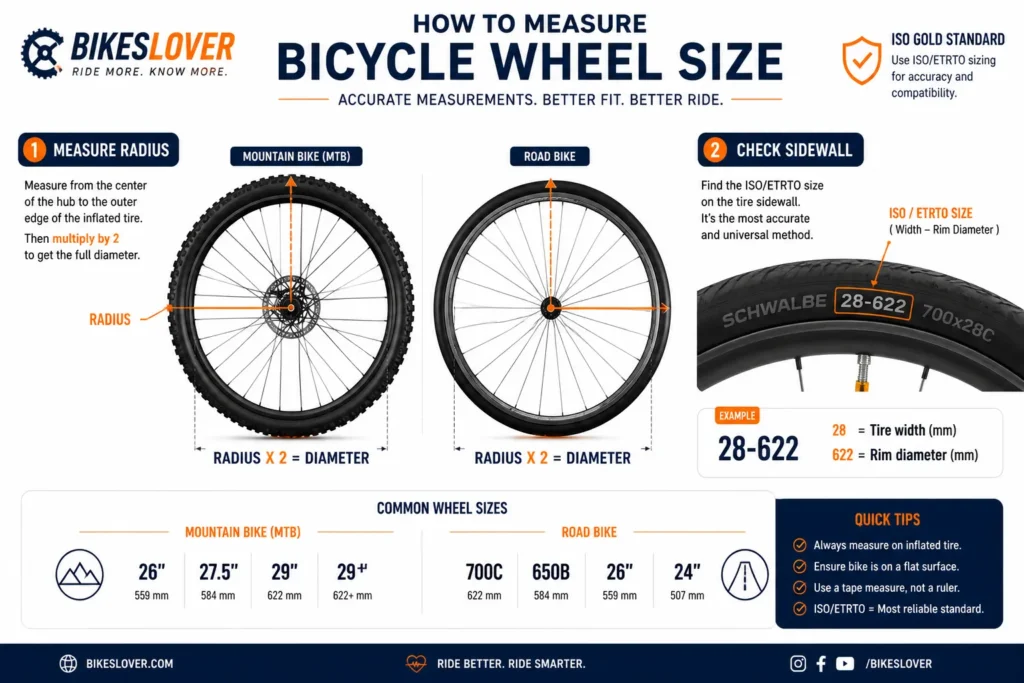
Before you start hunting for a tape measure, look at the tire currently mounted on your rim. Manufacturers emboss the size directly into the rubber sidewall.
- Metric (Road/Gravel): You’ll see something like 700 x 25c. The 700 is the approximate outer diameter in millimeters, and 25 is the width.
- Standard/Imperial (MTB/Cruiser): You’ll see 29 x 2.1 or 26 x 2.0. The first number is the diameter in inches; the second is the width.
- The ISO Code: Look for a sequence like 28-622. This is your “source of truth.” The 622 is the actual diameter of the rim bead seat in millimeters.
Pro Tip: If your tires are old and the markings have rubbed off, don’t guess. Follow the manual measurement steps below.
Three Methods to Measure Bike Wheel Size
Not all measurements are created equal. Depending on whether you are replacing a tire or buying a brand-new carbon rim, you’ll need a different level of precision.
Method A: The Sidewall Method (Fastest)
This is for the rider who needs a new inner tube or a direct tire replacement.
- Rotate the wheel until you find the raised lettering.
- Note the ISO (ETRTO) number first (e.g., 622 for 29-inch/700c).
- Match this number exactly when purchasing. Even if the width (the second number) varies slightly, the diameter must match.
Method B: Manual Diameter Calculation (The Tape Measure Way)
Use this if the sidewall is unreadable.
- Step 1: Inflate the Tire. A flat tire can sag, losing up to 12mm (0.5 inches) of height. For an accurate reading, pump the tire to its recommended PSI.
- Step 2: Measure the Radius. Do not try to measure across the whole wheel. The hub (the center part) sticks out and will force your tape measure into a diagonal, adding “fake” length. Instead, measure from the exact center of the axle to the outer edge of the tire.
- Step 3: The Math. Multiply your radius by 2.
- Example: A radius of 13.5 inches = a 27-inch wheel.
Method C: The ISO/ETRTO Method (For Rim Replacements)
If you are buying a rim without a tire, you need the Bead Seat Diameter (BSD).
- Measure from the internal “shelf” where the tire’s wire bead sits.
- Do not measure to the very top edge of the rim flange.
- Most modern adult bikes will measure 622mm (700c/29er) or 584mm (650b/27.5″).
Bike Wheel Size Conversion Chart (2026 Master List)
This table covers the most common global standards found across Europe, North America, and Asia.
| Traditional Name | ISO / ETRTO (BSD) | Common Bike Category | Typical Tire Widths |
| 12 – 16 Inch | 203 – 305 mm | Kids’ Bikes / Balance Bikes | 1.75″ – 2.25″ |
| 20 Inch | 406 mm | BMX, Folding Bikes, Cargo E-bikes | 1.5″ – 4.0″ |
| 24 Inch | 507 mm | Youth MTBs, Specialized Cruisers | 1.9″ – 2.4″ |
| 26 Inch | 559 mm | Classic MTBs, Beach Cruisers | 1.5″ – 2.3″ |
| 27.5″ / 650b | 584 mm | Modern Trail, Enduro, Gravel | 42mm – 2.8.” |
| 700c / 29er | 622 mm | Road, Hybrid, Modern MTBs | 23mm – 3.0.” |
| 27 x 1-1/4″ | 630 mm | Vintage Road Bikes (Pre-1980s) | 28mm – 32mm |
Export to Sheets
How to Measure Rim Width
Measuring the diameter is only half the battle. If you put a wide “fat tire” on a narrow rim, the tire will “burp” air or roll off the rim during a turn.
Internal vs. External Width
- Internal Width: This is the distance between the inside of the rim walls. This determines which tire widths are safe to use.
- External Width: This is the total thickness of the rim. This is vital for riders with rim brakes to ensure the calipers can actually open wide enough to clear the wheel.
The Rule of Thumb: Your tire should generally be 1.5× to 2.2× the width of your internal rim width.
700c vs. 29-Inch: Clearing the Confusion
This is the most common question we receive at BikesLover. The Truth: A 700c rim and a 29-inch rim have the same ISO diameter of 622mm.
The difference is purely volume and terminology.
- 700c is a French term used for Road and Gravel bikes. These rims are usually narrower.
- 29-inch is a marketing term for Mountain Bikes. These rims are wider to support high-volume, knobby tires.
Can you swap them? Yes, as long as the rim width allows it. You can put a 700x32c gravel tire on a 29er mountain bike rim, which is a popular “hack” for riders who want to use their MTB for commuting on pavement.
Modern Nuances: E-Bikes and Fat Tires
In 2026, the rise of powerful E-bikes has changed the sizing game.
- Heavy Duty Rims: E-bikes often use reinforced rims. Even if the diameter is 20 inches (common on folding e-bikes), the rim width might be double that of a standard BMX bike.
- Fat Tires: Many e-bikes use 4-inch wide tires. When measuring these, ensure you are measuring to the edge of the tread, as the “ballooning” effect of a fat tire can change the effective rolling diameter significantly.
Pros & Cons of Common Wheel Sizes
29-Inch / 700c
- Pros: Incredible “roll-over” ability on obstacles; holds momentum well; highest top speed.
- Cons: Heavier; slower to accelerate; can feel “sluggish” on tight, technical switchbacks.
27.5-Inch / 650b
- Pros: The “Goldilocks” size. Snappier handling than a 29er but smoother than a 26-inch. Great for smaller riders.
- Cons: Doesn’t hold speed as well as a 29er on flat sections.
26-Inch
- Pros: Extremely strong and rigid; lightweight; parts are available in the remotest parts of the world.
- Cons: Feels “bumpy” on rough terrain; slowly being phased out by major manufacturers for high-end bikes.
Common Pitfalls to Avoid
- The Hub Hump: We repeat: do not run your tape measure over the center of the hub. It will add roughly 5mm to 10mm to your measurement, leading you to buy a size that doesn’t exist.
- Fractional vs. Decimal: In the bike world, 28 x 1 1/2 is NOT the same as 28 x 1.50. This is a legacy quirk. Always check the ISO/ETRTO number (e.g., 635mm vs 622mm) to be certain.
- Brake Compatibility: If you are switching wheel sizes (e.g., putting 650 B wheels on a 700c frame), your rim brakes will no longer align with the braking surface. This swap is generally only possible on bikes with disc brakes.
Final Expert Verdict
Measuring your bike wheel size is a skill every rider should master. While the “Sidewall Method” is your best friend for quick replacements, understanding the ISO 622mm vs 584mm standards will save you from the headache of returning parts.
Summary Checklist for Your Replacement:
- [ ] Find the ISO/ETRTO number on the sidewall.
- [ ] If missing, measure Radius x 2 (Inflated tire).
- [ ] Check Internal Rim Width for tire compatibility.
- [ ] Confirm Valve Type (Presta/Thin or Schrader/Wide).
FAQs
A: The bead seat diameter (BSD) is different (584mm vs 559mm). The tire will be too large and will not seat on the rim, posing a massive safety risk.
A: Historically, French sizing used A, B, and C to denote different tire widths on the same outer diameter. Today, “c” is just a legacy term. All modern 700c wheels are 622mm ISO.
A: A wider, “taller” tire increases the total outer diameter. This is why some 27.5-inch bikes with “Plus” tires have the same total height as a standard 29-inch wheel.
A: Use a digital caliper to measure the distance between the two inner edges of the rim walls. This is the “Internal Width.”
A: This is likely the “Inflation Oversight.” If your tire is flat or low-pressure, the rubber compresses. Pump it to max PSI and measure again from the axle center to the outer edge.
