
Best Bike Lock
Choosing the Best bike lock in 2026 is no longer just about buying the thickest U-lock on the shelf. The real decision depends on where you park, what kind of bike you ride, and how much security you need for daily life in your city. A lock that works brilliantly for a quiet suburban café may be the wrong choice for a busy urban street, a campus rack, or a high-value e-bike.
This guide breaks the subject into practical steps so you can choose the right lock type, the right size, and the right security level without wasting money. It also shows how thieves actually attack bikes, which lock styles offer the best balance of security and convenience, and how to lock a bike correctly so your investment actually does its job. If you want one article that covers commuters, e-bikes, budget riders, and street parking, this is it.
Why most cyclists buy the wrong lock
Most cyclists shop for a lock by price alone, weight alone, or brand reputation alone, and that usually leads to false confidence. A cheap cable lock looks convenient, but it offers very limited protection and can be defeated extremely quickly compared with better lock types. Even some solid locks become less effective if they are too short, too awkward to use, or simply left on the bike less often because they are inconvenient.
The bigger lesson is that a lock is part security tool and part habit tool. If the lock is a hassle to carry or use, people skip it, and that is often when theft happens. The best bike lock is the one you will actually use every single time, in the way it was designed to be used.
How bike theft happens
Bike theft is usually a speed game, not a genius game. In the real world, thieves rely on opportunistic tools such as bolt cutters and portable angle grinders because those tools are fast, cheap, and effective against many common locks. That is why high-security products increasingly focus on resisting grinder attacks rather than just beating hand tools.
Cable locks remain weak as primary locks, while stronger U-locks, chains, and premium grinder-resistant designs offer much better deterrence. The practical takeaway is simple: if your bike is valuable or you ride in a city, your lock should be chosen against real-world theft methods, not just marketing claims.
Step-by-step buying guide
Choose your security level
The first question is not “Which brand is best?” It is “How much risk does my bike face?” Sold Secure-style ratings help riders compare locks by security level, with Bronze at the low end and Diamond at the high end. For daily city use, Gold is usually the minimum sensible target, while Diamond is the better choice for expensive bikes and e-bikes in high-theft areas.
A lower-risk rider who locks up briefly in a visible, supervised place may be fine with a lighter lock. A commuter who leaves a bike outside an office or transit station needs something stronger and more theft-resistant. If insurance is involved, check the required rating before buying, because many policies expect Gold or higher.
Choose the right lock type.
There is no single perfect lock type for every rider. U-locks are usually the best all-round option because they balance security, cost, and portability well. Chain locks are more flexible around odd-shaped poles and thick e-bike frames, but they tend to be heavier and bulkier.
Folding locks sit in the middle: they are easier to carry than many chains and more flexible than a rigid U-lock, but their joints can be a weak point compared with the strongest U-locks and chains. Cable locks are best treated as secondary locks for accessories or wheels, not as the main defense for a valuable bike.
Choose the right size
A lock can be very secure and still be the wrong choice if it does not fit the object you need to lock. Standard U-locks fit many racks and bikes, but mini U-locks can be too restrictive if you are locking to poles, barriers, or irregular street furniture. If you ride in places without proper bike racks, you may need a longer chain or a folding lock for flexibility.
Weight matters too, especially if you carry your lock every day. The best lock is the one that gives you enough reach and enough resistance without becoming so inconvenient that you leave it at home. For commuters, that balance is often more important than a small difference in raw security rating.
Lock type comparison
| Lock type | Main strength | Main weakness | Best use case |
| U-lock | Strong security, good value, widely available | Limited reach around thick or awkward objects | City commuters and everyday riders |
| Chain lock | Flexible around poles, rails, and unusual anchor points | Heavier and bulkier to carry | E-bikes and street parking |
| Folding lock | Compact and easier to transport than many chains | Joints can be a security compromise | Commuters who prioritize portability |
| Cable lock | Very light and cheap | Weak as a main lock | Secondary security only |
This comparison shows why top articles often oversimplify the choice. In practice, the right lock type depends on both the theft risk and the kind of objects you lock to every day. A rider parking at a proper rack needs a different tool than someone locking to a pole outside a market or a convenience store.
Best bike lock overall in 2026
The Litelok X1 stands out as the best overall bike lock for many riders in 2026 because it blends strong real-world protection with a manageable weight and more practical portability than the heaviest premium locks. Reviewers highlighted its ceramic-composite anti-grinder design, which slows down attack tools better than conventional steel-only locks. It is especially appealing for city riders and e-bike owners who want serious protection without carrying an oversized lock every day.
Its main downside is price, and it may still be more lock than a low-risk rider needs. It is also less compact than some alternatives, so the best choice depends on whether your priority is convenience, security, or both.
Best high-security option
If you want maximum protection, the Litelok X3 and Hiplok D1000 are among the strongest names in the category, especially for high-value bikes and high-theft environments. These premium locks are designed to withstand grinder attacks for far longer than standard steel locks, which is exactly the type of deterrence modern urban riders need. They are ideal for expensive e-bikes, shared storage areas, and places where thieves have time and privacy.
The trade-off is obvious: more security usually means more cost, and sometimes more weight or less convenience. For many riders, the smartest move is not buying the absolute toughest lock, but buying the toughest lock they can realistically carry and use daily.
Best budget bike lock
Budget shoppers should still aim for respectable protection, not just the lowest sticker price. A budget U-lock, such as the Kryptonite KryptoLok,gives better protection and more versatility than a cable lock while staying more affordable than premium grinder-resistant models. In lighter-risk situations, compact models like the Abus Mini 410 can make sense for quick stops or lower-value bikes.
That said, the budget category is where many people make the worst compromise. If the bike is worth saving, it is usually worth spending more on the lock than people expect. A low-cost lock only makes sense when the bike value, parking risk, and parking time are all low.
Best for street parking
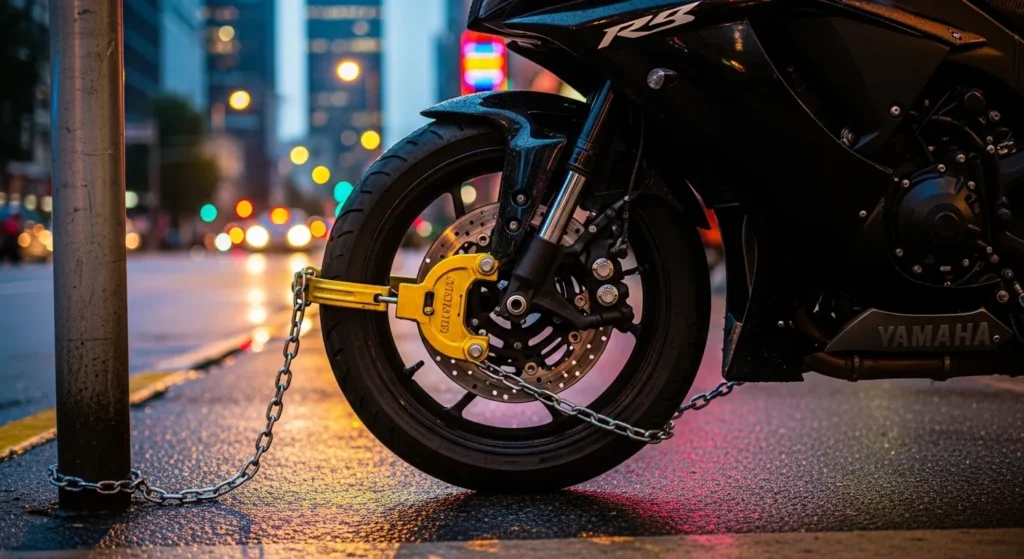
Street parking is different from rack parking because the anchor points are often awkward, temporary, or not ideal for a rigid U-lock. For that reason, chain locks and longer folding locks often work better when you must secure a bike to poles, barriers, or railings. A flexible setup also helps when you need to keep the lock off the ground and reduce leverage points for thieves.
For street parking, the key is not just lock strength but lock placement. You want the lock to secure the frame and rear wheel, sit as high as possible, and avoid large gaps that make prying easier. In informal parking environments, convenience and fit matter as much as raw security ratings.
Best for Pakistan and India
In Pakistan, India, and similar urban environments, riders often face mixed parking conditions: crowded streets, improvised barriers, poles, shared gates, and limited dedicated bike infrastructure. That means the best bike lock is often one that is both secure and versatile enough for non-standard anchor points. A strong U-lock works well when you have a proper rack, but a chain or folding lock can be more practical when you do not.
For these markets, the most useful strategy is usually a Gold-rated or better main lock, plus a lighter secondary lock for wheels or accessories. The local lesson is simple: do not buy by brand alone; buy by security rating, fit, and the kind of objects you actually lock to every day.
How to lock correctly
Step 1: Pick the right anchor
Lock to something fixed, strong, and hard to remove. A proper bike rack is best, but a solid pole or barrier can work if it cannot be lifted or disassembled. Avoid weak fences, loose signposts, and anything that can be cut or unbolted easily.
Step 2: Lock the frame first
Always secure the frame, because that is the part thieves most want to steal and the part most expensive to replace. If your lock allows it, include the rear wheel too, since that prevents a thief from simply removing a wheel and riding off. Locking only the wheel is a common mistake that leaves the bike vulnerable.
Step 3: Keep the lock high
A lock closer to the ground is easier to attack because it gives thieves better leverage and more room to work. Position the shackle or chain as high as practical and minimize inside the lock. Tight placement is better than a loose fit because it makes pry-bar attacks harder.
Step 4: Add a second layer
If the bike or its wheels are valuable, use a second lock for the front wheel, saddle, or accessories. Many cyclists use a primary U-lock plus a cable or chain as a secondary layer. This does not make the bike invincible, but it increases the time and effort needed for theft.
Locking mistakes to avoid
- Locking only the rear wheel, which leaves the frame exposed.
- Using a cable lock as the main lock on a valuable bike.
- Leaving the lock close to the ground, where it is easier to attack.
- Choosing a lock that is too small for your usual parking spots.
- Ignoring the security of the object you are locking to in the first place.
These mistakes are common because they feel small in the moment, but they can erase the value of even a good lock. A strong lock used badly is often weaker than a decent lock used properly. That is why technique matters as much as product choice.
Pros and cons
Pros
- Strong modern locks can significantly slow down angle-grinder theft.
- U-locks, chains, and folding locks give riders different trade-offs for different parking situations.
- Security ratings help buyers compare products more confidently.
- Secondary locks improve practical protection for wheels and accessories.
Cons
- The most secure locks are often heavier and more expensive.
- No bike lock is completely theft-proof.
- Some high-security locks are awkward for informal parking or non-standard anchors.
- Cheap locks can create a false sense of safety.
Best setup for most riders
That layered approach is the most practical answer to modern theft. It balances security, convenience, and carry weight, rather than pretending that one lock can solve every situation.
FAQs
A: The Litelok X1 is widely treated as the best all-round option because it balances security, weight, and usability well.
A: Cable locks are best used as secondary locks, not as the main lock for a valuable bike.
A: A U-lock is usually lighter and easier to carry, while a chain is more flexible around awkward anchor points. The better choice depends on where you park.
A: If you ride in a city or own an expensive bike or e-bike, grinder resistance is now a major advantage.
A: Most commuters do best with a secure U-lock or a practical chain lock that they will actually carry and use every day.
Final verdict
The best Bike lock in 2026 is not just the strongest product on paper; it is the lock that matches your city, your bike, and your daily routine. For most riders, a high-quality U-lock is the smartest starting point, while commuters with e-bikes or expensive bikes should consider premium grinder-resistant models. If you want the safest all-around strategy, choose a solid main lock, add a secondary lock, and use proper locking technique every time.
