
Electric Bike Fast
Introduction
The transportation world has transformed dramatically over the last decade. Traditional bicycles, once limited to manual pedaling and fitness use, have evolved into advanced, intelligent, and high-speed electric mobility machines. In 2026, the concept of the electric bike became a global trend, reshaping commuting, adventure riding, and eco-friendly transport.
Today, riders no longer ask only about distance or comfort. Instead, the most common questions are focused on speed, performance, acceleration, and legality:
- How fast can an electric bike go in real conditions?
- What is the maximum electric bike top speed in 2026?
- Which motor system delivers the fastest acceleration?
- Is a high-speed electric bike legal in my country or region?
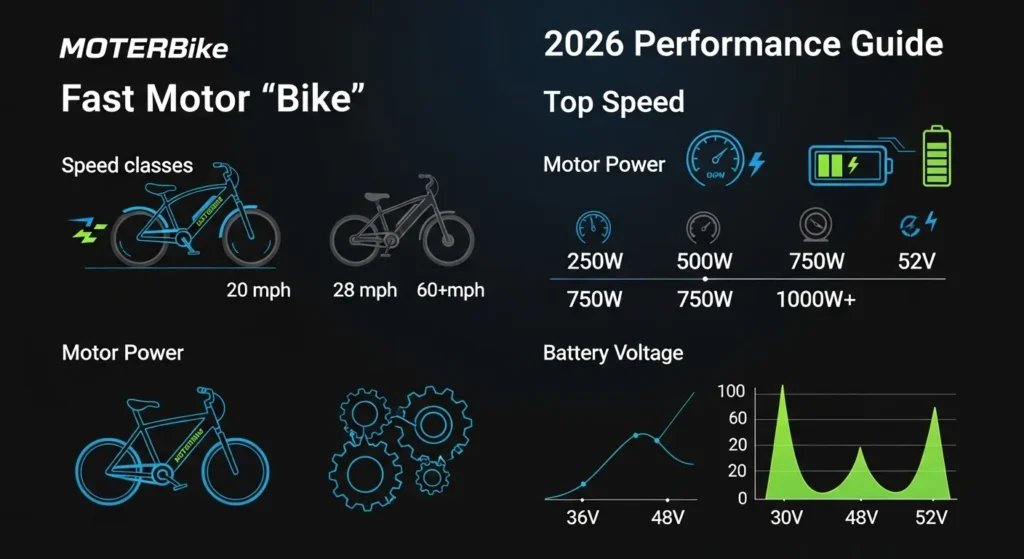
Modern e-bikes now range from slow city commuter models (20 mph) to extreme performance machines exceeding 60 mph in off-road configurations. This wide performance gap makes understanding technical specifications essential before buying.
Leading manufacturers such as Specialized Bicycle Components, Trek Bicycle Corporation, Rad Power Bikes, Bosch eBike Systems, and Aventon Bikes are continuously innovating in motor efficiency, battery technology, and smart controller systems.
This complete guide breaks down everything in simple, human-friendly language so even beginners can understand how fast electric bikes truly work, perform, and behave in real-world conditions.
What Does “Electric Bike Fast” Really Mean?
The phrase electric bike fast is often misunderstood. Many people assume speed only refers to top velocity, but true performance includes multiple engineering and mechanical factors working together.
A genuinely fast electric bicycle is defined by a combination of speed dynamics, torque output, acceleration response, and energy efficiency.
1. Maximum Speed (Top Speed Capability)
This refers to the highest velocity an electric bike can achieve on flat ground under ideal conditions.
2. Acceleration Power
Acceleration determines how quickly the bike reaches speeds like 20 mph or 30 mph. This is often more important in city riding than top speed.
3. Torque Output
Torque represents the rotational force delivered by the motor. Higher torque = stronger hill climbing and faster takeoff.
4. Power Stability
A fast e-bike must maintain consistent performance without sudden drops in speed due to heat or battery drain.
5. Balance, Control & Frame Stability
High-speed riding depends heavily on frame design, suspension quality, and weight distribution.
Speed vs Power vs Torque (Simple Breakdown)
To understand better:
- A 750W electric bike often feels fast in urban conditions due to balanced acceleration
- A 1000W electric bike delivers stronger uphill performance and aggressive acceleration
- A lightweight e-bike frame can outperform heavier models even with lower wattage
Therefore, “fast” does not always mean “high wattage”—it is a combination of engineering factors.
Technology Behind Fast Electric Bikes
Modern high-performance electric bikes rely on intelligent electronic systems that manage power distribution and safety control.
Advanced systems such as Bosch eBike Systems include:
- Smart acceleration mapping
- Battery optimization algorithms
- Thermal heat control systems
- Safety cut-off protection
- Motor efficiency balancing
These innovations make modern electric bikes feel faster, smoother, and more responsive compared to older generations.
How Fast Do Electric Bikes Actually Go in 2026?
Electric bike speed is not universal—it depends heavily on classification laws and motor restrictions.
Class 1 E-Bikes (Pedal Assist Only)
- Maximum speed: 20 mph (32 km/h)
- No throttle system
- Most widely used for commuting
Best suited for beginners and daily urban riders
Class 2 E-Bikes (Throttle + Pedal Assist)
- Maximum speed: 20 mph (32 km/h)
- Includes throttle control
Ideal for effortless riding without continuous pedaling
Class 3 E-Bikes (High-Speed Commuter Bikes)
- Maximum speed: 28 mph (45 km/h)
- Pedal assist only
Popular for fast commuting and long-distance travel
High-Performance Electric Bikes (Off-Road Use)
- Speed range: 40–60+ mph
- Built for racing or off-road terrain
- Not legal for public roads in most countries
These are performance machines requiring advanced riding skills.
Electric Bike Speed Comparison Table (2026)
| Category | Motor Power | Typical Speed | Use Case |
| Entry-Level | 250W–350W | 15–20 mph | Casual commuting |
| Mid-Level | 500W | 20–28 mph | Daily city riding |
| High Performance | 750W | 28–35 mph | Fast commuting & hills |
| Extreme Power | 1000W+ | 35–60+ mph | Off-road & racing |
What Makes an Electric Bike Fast?
Speed performance depends on several technical components working together.
Motor Power (Wattage Impact)
Motor wattage directly influences performance output:
- 250W → Efficient but slower acceleration
- 500W → Balanced performance
- 750W → Strong and responsive acceleration
- 1000W+ → Extreme performance capability
Brands like Aventon Bikes optimize motor tuning to enhance perceived speed even in mid-range systems.
Battery Voltage (Critical Speed Factor)
Battery voltage determines how much energy is delivered to the motor:
- 36V → Basic performance level
- 48V → Strong acceleration and stability
- 52V+ → High-performance output
Higher voltage systems generally provide better acceleration and sustained speed.
Controller System (The Brain of the Bike)
The controller regulates:
- Acceleration curve
- Speed limitation
- Energy distribution
- Heat management
A high-quality controller significantly improves riding smoothness and perceived speed.
Weight & Aerodynamics
Physical design plays a major role:
- Lightweight bikes accelerate faster
- Heavy frames reduce responsiveness
- Aerodynamic posture increases top speed
Even a powerful motor can feel slow if the bike design is inefficient.
Fastest Electric Bikes in 2026
Instead of one “fastest bike,” modern classification divides performance into categories.
Urban Fast E-Bikes
- Speed: 20–28 mph
- Designed for city commuting
- Smooth acceleration and comfort
Performance Mountain E-Bikes
- Speed: 28–40 mph
- High torque for steep hills
- Built with suspension systems
Extreme High-Speed E-Bikes
- Speed: 40–60+ mph
- Racing-grade performance
- Requires advanced riding skills
Not recommended for beginners
Electric Bike Speed Limits by Country
Legal restrictions vary globally and must always be considered before upgrading performance.
🇺🇸 United States
- Class-based system
- 20–28 mph legal limits
🇪🇺 European Union
- Maximum speed: 25 km/h (15.5 mph)
- Strict enforcement laws
🇬🇧 United Kingdom
- Similar to EU regulations
- Pedal-assist requirement
Asia (General Overview)
- Japan: ~24 km/h limit
- Pakistan & India: mixed enforcement
- UAE: restricted usage zones
Always verify local regulations before modifying speed systems.
How to Make an Electric Bike Faster (Safe Methods)
You can improve performance safely without violating laws.
Safe Optimization Techniques
1. Tire Pressure Adjustment
Higher pressure reduces rolling resistance and improves speed efficiency.
2. Reduce Extra Load
Removing unnecessary weight improves acceleration.
3. Upgrade Tires
Low-resistance road tires increase speed performance.
4. Battery Maintenance
A healthy battery ensures stable and consistent output.
5. Riding Posture Optimization
Lower aerodynamic posture reduces wind resistance.
Dangerous Modifications (Avoid)
- Removing speed limiters
- Overvoltage battery systems
- Controller hacking
These modifications can damage equipment and may be illegal.
Electric Bike Fast Buying Guide (Expert Advice)
When selecting a fast electric bike, focus on:
Motor Selection
- 500W → entry fast
- 750W → best balance
- 1000W+ → extreme speed
Battery Choice
- Minimum 48V recommended
- 52V+ for high performance
Terrain Matching
- City → lightweight commuter
- Mountain → torque-focused
- Mixed → hybrid design
Budget Range
- Entry: $800–$1500
- Mid-range: $1500–$3000
- Premium: $3000+
Common Myths About Electric Bike Fast
Myth 1: More watts always mean faster speed
False. Controller efficiency and bike design matter equally.
Myth 2: Battery alone increases speed
BA batteries support energy flow but do not directly define speed.
Myth 3: All e-bikes feel the same
Frame geometry, weight, and tuning make huge differences.
Pros & Cons of Fast Electric Bikes
Advantages
- Faster commuting times
- Easy hill climbing
- Eco-friendly transport
- Reduced physical effort
- Highly enjoyable riding experience
Disadvantages
- Higher cost
- Legal restrictions
- Faster battery consumption
- Maintenance requirements
Real-World Insight – Why Brands Matter
Top manufacturers prioritize performance + safety balance:
- Specialized Bicycle Components → advanced engineering
- Trek Bicycle Corporation → durability and reliability
- Rad Power Bikes → commuter-focused power systems
- Bosch eBike Systems → intelligent motor control
These innovations ensure high-speed riding remains safe and controlled.
FAQs
A: Most legal e-bikes go 20–28 mph, depending on the region.
A: But only modified or off-road models.
A: It can reach 28–35 mph.
A: Motor power, battery voltage, and controller efficiency.
A: If used responsibly with proper safety gear and legal compliance.
Conclusion
The evolution of the electric bike industry in 2026 clearly shows that e-bikes are no longer just simple assistive bicycles—they are now Powerful, intelligent, and highly customizable transportation machines. With advancements in motor efficiency, battery voltage systems, and smart controllers, modern electric bikes can deliver impressive speed while still maintaining control, comfort, and safety.
However, the most important takeaway is that fast does not only mean higher speed numbers. True performance comes from the balance between motor power, battery capacity, torque output, frame design, and riding conditions. A well-engineered 750W e-bike can often outperform a poorly optimized 1000W system in real-world riding.
Another critical factor is legality. Speed limits vary widely across regions such as the United States, Europe, and Asia. Riders must always ensure their e-bike complies with local laws before attempting modifications or upgrades.
