
Introduction
What are the three types of Best bikes? commonly known as e-bikes—are transforming modern transportation in powerful, practical ways. These innovative machines combine traditional cycling with electric propulsion, making travel faster, smoother, and far more efficient than conventional bikes.
In today’s fast-paced world, e-bikes are not just a trend—they are becoming an essential mobility solution. Whether you are commuting to work, delivering goods, exploring nature, or simply enjoying leisure rides, electric bikes offer unmatched convenience.
You can use an e-bike for:
- Daily commuting in busy cities
- Food delivery and gig work
- Fitness training and endurance building
- Mountain and off-road adventures
- Weekend exploration and casual rides
However, one major point of confusion still exists for beginners and even experienced riders:
What are the three types of electric bikes—and which one is ideal for your needs?
Many online guides either provide vague explanations or fail to deliver practical advice. They often list features without helping you make a real decision.
That’s exactly why this comprehensive guide is different.
In this in-depth 2026 guide, you will discover:
- The three main classes of electric bikes (Class 1, 2, and 3)
- Their key differences, advantages, and limitations
- Real-world applications and examples
- Legal frameworks across different regions
- And most importantly: how to choose the right e-bike for your lifestyle
Let’s begin with a quick and clear answer.
Quick Answer: What Are the Three Types of Electric Bikes?
The three primary categories of electric bikes are:
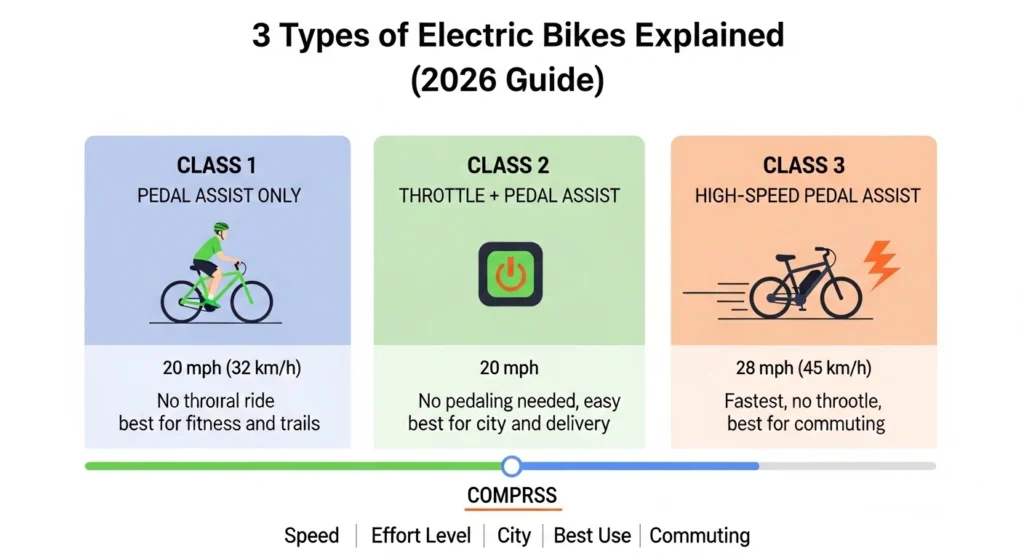
- Class 1: Pedal-assist only, maximum speed 20 mph (32 km/h)
- Class 2: Pedal-assist plus throttle, maximum speed 20 mph
- Class 3: Pedal-assist only, maximum speed 28 mph (45 km/h)
These classifications are determined by:
- The type of motor assistance
- Maximum assisted speed
- Availability of a throttle
Simple breakdown:
- Class 1 = Natural riding experience
- Class 2 = Effortless riding experience
- Class 3 = High-speed performance riding
Why Electric Bikes Are Divided Into 3 Types
Electric bikes are not categorized randomly. The classification system exists for several important reasons that directly impact safety, legality, and usability.
Main Reasons
1. Safety Regulation
Different speeds require different safety standards. A high-speed electric bike cannot safely operate in the same environment as a slow-moving bicycle. These distinctions help prevent accidents and ensure rider protection.
2. Legal Structure
Governments and regulatory authorities use these categories to determine:
- Where are you allowed to ride
- Whether a license is required
- Helmet and safety regulations
- Access to bike lanes or restricted areas
3. Simplified Buying Decisions
For beginners, the classification system makes it much easier to select the right e-bike without technical confusion.
Global Perspective (Important for Buyers)
Understanding regional regulations is crucial before purchasing an electric bike.
- USA & Canada: Full 3-class system widely accepted
- Europe (EU): Mostly limited to Class 1 (25 km/h cap)
- United Kingdom: Throttle use is heavily restricted
- Pakistan & India: Regulations are still evolving, especially for low-speed e-bikes
Important Tip: Always verify your local laws before making a purchase decision.
The 3 Types of Electric Bikes Explained
Class 1 Electric Bikes (Pedal Assist Only)
Key Features
- Pedal-assist system only
- No throttle functionality
- The motor activates only when pedaling
- Maximum assisted speed: 20 mph (32 km/h)
Riding Experience
Class 1 e-bikes deliver a riding sensation that closely resembles a traditional bicycle—but with enhanced power support. The motor amplifies your pedaling effort, making rides smoother and less physically demanding.
You remain actively engaged, but with significantly reduced strain.
Best For
- Beginners entering the e-bike world
- Fitness enthusiasts seeking assisted workouts
- Trail riders and nature explorers
- Environment-conscious commuters
Pros
Natural cycling feel
Widely permitted on bike paths and trails
Longer battery efficiency
Lightweight design compared to other classes
Cons
No throttle assistance
Requires physical effort
Not ideal for fully relaxed riding
Real Example
Across Europe, most legally compliant e-bikes fall under Class 1 regulations, making it the global standard for sustainable mobility.
Expert Tip: If your goal is fitness combined with assistance, Class 1 is the optimal choice.
Class 2 Electric Bikes
Key Features
- A combination of pedal assist and throttle
- Can operate without pedaling
- Maximum speed: 20 mph
Riding Experience
Class 2 e-bikes offer a hybrid riding experience—somewhere between a bicycle and a scooter.
You have the flexibility to:
- Pedal normally for exercise
- Use the throttle for effortless movement
Best For
- Urban commuters
- Delivery riders and couriers
- Elderly users
- Beginners seeking comfort
Pros
No pedaling required when using the throttle
Ideal for stop-and-go traffic
Easy and convenient operation
Comfortable for long rides
Cons
Faster battery consumption
Heavier build
Restricted access in certain areas
Real Example
In major U.S. cities, delivery workers frequently rely on Class 2 e-bikes due to their convenience and efficiency.
Expert Insight: If comfort and ease-of-use are your priorities, Class 2 is the best option.
Class 3 Electric Bikes
Key Features
- Pedal-assist only
- Maximum speed: 28 mph (45 km/h)
- More powerful motor system
Riding Experience
Class 3 e-bikes are engineered for speed and performance. They provide strong motor assistance, allowing riders to cover long distances quickly and efficiently.
Best For
- Professionals commuting daily
- Long-distance riders
- Speed enthusiasts
Pros
Fastest electric bike category
Reduces travel time significantly
Excellent for long-range commuting
Cons
Higher cost
Limited access to bike paths
Requires riding experience
Real Example
In densely populated cities, Class 3 e-bikes are widely used for rapid commuting.
Expert Tip: Choose Class 3 if speed and efficiency are your top priorities.
Class 1 vs Class 2 vs Class 3
| Feature | Class 1 | Class 2 | Class 3 |
| Pedal Assist | Yes | Yes | Yes |
| Throttle | No | Yes | No |
| Max Speed | 20 mph | 20 mph | 28 mph |
| Effort Level | Moderate | Low | Moderate |
| Best Use | Trails | City | Commuting |
| Legal Access | High | Medium | Lower |
| Battery Usage | Efficient | Moderate | Moderate |
Which Type of Electric Bike Should You Choose?
Selecting the right e-bike depends entirely on your lifestyle, needs, and riding goals.
Electric Bike1 if:
- You want exercise and fitness benefits
- You ride on trails or natural paths
- You prefer a traditional cycling experience
Electric Bike2 if:
- You want maximum comfort
- You ride in urban traffic
- You work in delivery services
Class 3 if:
- You prioritize speed
- You commute daily over long distances
- You want to save time
Quick Decision Table
| Your Goal | Best Choice |
| Fitness | Class 1 |
| Comfort | Class 2 |
| Speed | Class 3 |
Legal Differences You Must Know
USA
- Class 1 & 2 → Allowed on most bike paths
- Class 3 → Mostly restricted to roads
🇪🇺 Europe
- Maximum speed: 25 km/h
- Mostly Class 1 compliant
🇵🇰 Pakistan / 🇮🇳 India
- Regulations are developing
- Low-speed e-bikes often require no license
Important: Always confirm local regulations before riding.
Advanced Insights
Throttle Uses More Battery
Class 2 e-bikes consume energy faster due to their reliance on the throttle.
Class 3 Saves Time
Perfect for professionals with tight schedules.
Beginners Should Avoid Class 3
High speed increases the risk for inexperienced riders.
Weight Differences
- Class 1 → Light
- Class 2 → Medium
- Class 3 → Heavy
Terrain Matching
| Terrain | Best Class |
| Mountains | Class 1 |
| City | Class 2 |
| Highways | Class 3 |
Pros & Cons of Electric Bikes (All Types)
Advantages
- Environmentally friendly
- Cost-effective compared to fuel vehicles
- Easy to operate
- Faster than traditional bicycles
Disadvantages
- Higher initial investment
- Battery Maintenance required
- Heavier than standard bikes
- Legal restrictions vary
FAQs
A: Class 1 is the most common worldwide.
A: Throttle bikes are restricted in some areas.
A: Beginners should avoid it.
A: Class 2 is best.
A: Usually no, but it depends on the country.
Conclusion
Choosing the right electric bike doesn’t have to be complicated once you understand the three main classes. Each type is designed for a specific riding style, purpose, and comfort level.
If you’re just starting, Class 1 offers a Natural and balanced riding experience while still giving you helpful motor support. It’s ideal for fitness, trails, and everyday use.
If your priority is convenience and ease, Class 2 gives you the freedom to ride without pedaling, making it perfect for city commuting, delivery work, and relaxed rides.
And if speed and efficiency matter most, Class 3 is built for fast commuting and long-distance travel, helping you save time on every journey.
