
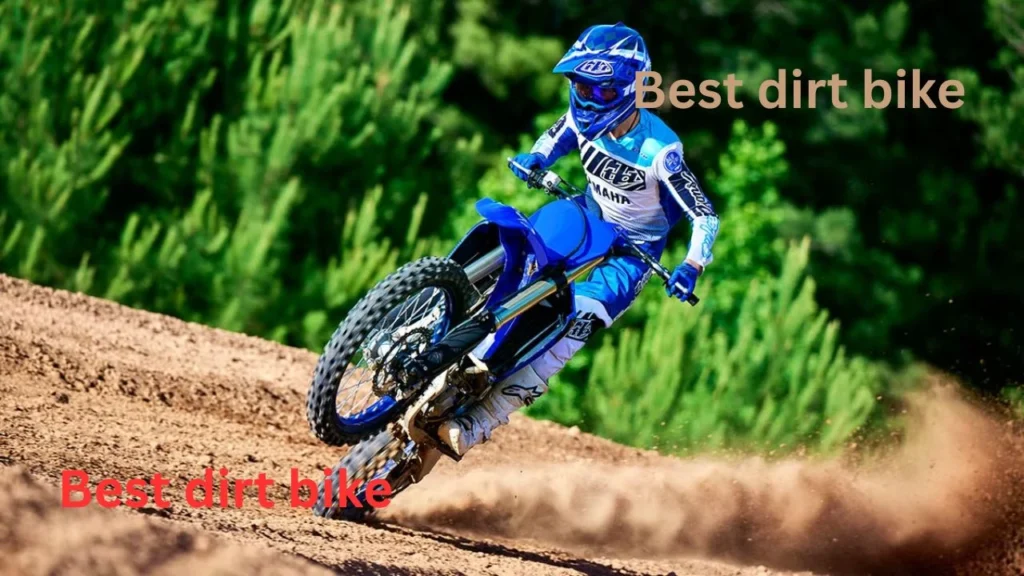
Best Dirt Bike in 2026
The top Best dirt bike in 2026 isn’t won by speed or price tags. Instead, it comes down to choosing an off-road ride that fits how you ride, where you ride, how tall you are, and what you can spend. While one model glides smoothly through French motocross tracks, it could struggle deep in Swedish woods or across Arabian dunes.
From Europe to Asia, then across the Atlantic into the US and down under in Australia, dirt biking keeps gaining ground. Performance matters more every season – so do longer suspension strokes, smarter chassis shapes, engines that last. Yet most web articles stick to bullet points, quick stats, surface details. Few describe what it’s like when power rolls out of a piston, how shifting mass changes cornering behavior, or why certain cc ratings fit new riders best.
What Makes the Best Dirt Bike?
The best dirt bike is the motorcycle that fits your riding purpose. It is not simply about horsepower. It is about control, stability, traction, durability, and rider confidence.
Let’s examine the core factors.
Engine Type: 2-Stroke vs 4-Stroke Dirt Bike
Engine configuration is the most important technical decision when buying an off-road motorcycle.
2-Stroke Dirt Bikes
- Lower overall weight
- Rapid throttle response
- Aggressive power band
- Simpler mechanical structure
- Easier piston rebuild process
- Strong acceleration burst
Every time the crankshaft spins, a 2-stroke engine releases energy. That means faster pickup, snappier throttle feel. Those chasing tough off-road races lean toward these engines – light on feet, sudden in pull. Weight matters less when you’re flying through mud and rocks. Sudden bursts beat a steady push any day out there.
Mechanically speaking, upkeep stays simple even though these need premix fuel along with a bit more regular top-end work.
4-Stroke Dirt Bikes
- Smooth and linear power delivery
- Improved traction on slippery surfaces
- Higher fuel efficiency
- Quieter operation
- Better for long-distance trail riding
Every two turns of the crankshaft, a 4-stroke engine sends power to the wheels. Smoothness comes through in how it pulls, helping riders keep steady command. Usually found on starter off-road bikes, these engines respond gently when you twist the grip. Their consistent nature makes learning less tricky.
Dirt Bike Suspension & Handling Dynamics
Few realize how much bump absorption shapes comfort on rough roads. What matters most sits hidden inside each shock absorber’s response time. Every dip met with delayed resistance shifts weight unpredictably across tires. Smoothness often hides behind milliseconds of valve adjustment deep within fluid chambers.
Modern dirt bikes feature:
- Long-travel telescopic forks
- Adjustable compression and rebound settings
- Rear mono-shock systems
- Lightweight aluminum or chromoly frames
- Balanced chassis geometry
Out back, bikes from KTM roll with tuned damping that handles bumps more smoothly. Yamaha fits theirs with systems reacting faster to surface changes. Honda leans into balance, keeping lean angles steady mid-turn. Suspension on Kawasaki models adjusts on the fly, coping with uneven ground. Suzuki builds in control layers that cut wobble when tipping hard.
Good suspension ensures:
- Better landing control after jumps
- Reduced rider fatigue
- Footing holds firm when the ground turns jagged. Rocks shift under each step, yet traction stays locked. Uneven surfaces meet steady contact without slipping away
- Improved confidence at high speed
Weight Distribution & Seat Height
Seat height determines accessibility.
| Rider Height | Recommended Seat Height |
| Below 165 cm | 850–900 mm |
| 165–180 cm | 900–950 mm |
| Above 180 cm | 950–980 mm |
Lighter bikes improve maneuverability in tight trails and technical sections.
Best Overall Dirt Bike
Technical Overview
- Country of Origin: Austria
- Engine Capacity: 293cc
- Engine Type: 2-stroke
- Cooling System: Liquid-cooled
- Weight: 103 kg
- Seat Height: 960 mm
Why It Dominates
The KTM 300 XC-W is recognized worldwide for extreme enduro performance. Its lightweight frame combined with strong low-end torque makes it ideal for technical terrain.
Core Features
- Electric starter
- WP XPLOR suspension system
- Chromoly steel chassis
- Selectable engine maps
Advantages
Exceptional power-to-weight ratio
Superior torque response
Premium suspension quality
Strong aftermarket support
Disadvantages
Premium pricing
Demanding for beginners
Ideal For: Advanced riders and competitive racers.
Best Trail Dirt Bike
Specifications
- Engine: 250cc 4-stroke
- Fuel Injection System
- Aluminum bilateral beam frame
The WR250F balances performance and dependability.
Strengths
- Smooth torque curve
- Excellent trail agility
- Proven reliability record
Limitations
- Slightly heavier than 2-strokes
- Higher purchase price than entry models
Best Use Case: Forest trails, recreational riding, long-distance enduro.
Best Budget Dirt Bike
Engine & Build
- 249cc 4-stroke
- Air-cooled design
- Trail-oriented geometry
This model remains one of the most recommended entry-level off-road motorcycles.
Strength Points
- Low maintenance complexity
- Affordable purchase cost
- Comfortable ergonomics
Weak Points
- Basic suspension system
- Not suitable for professional racing
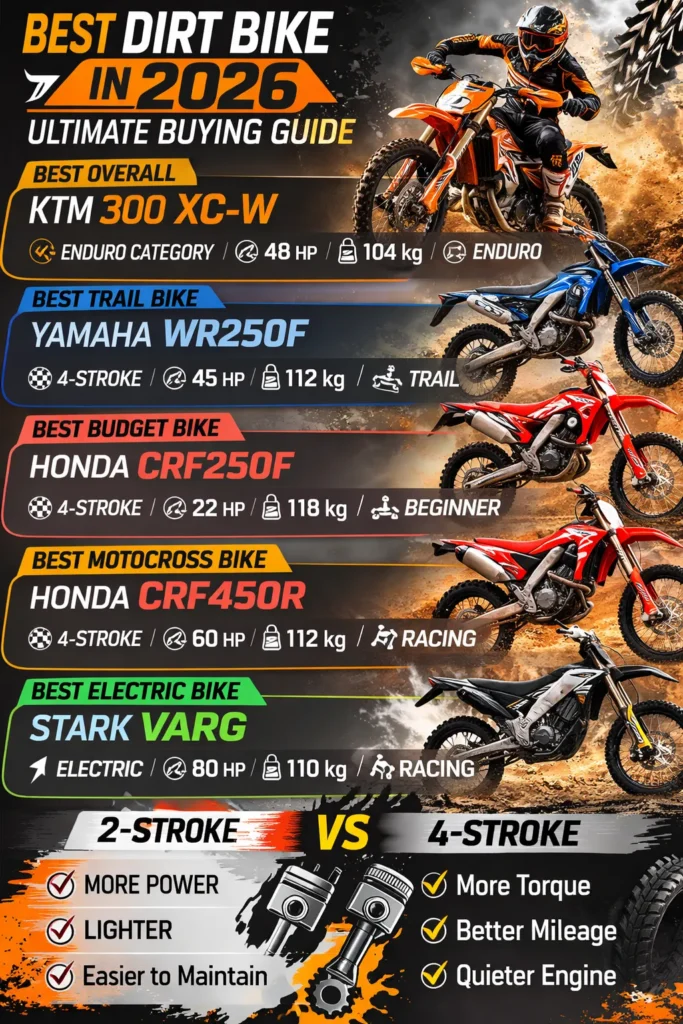
Best Electric Dirt Bike: Stark Varg
Electric off-road motorcycles are expanding rapidly in Europe.
Key Attributes
- 80 HP adjustable electric motor
- Zero emissions
- Instant torque delivery
- No clutch or gearbox
Limitations
- Charging infrastructure dependency
- Premium pricing
Full Comparison Table
| Model | Engine Type | Power Category | Weight | Segment |
| KTM 300 XC-W | 2T 293cc | High Torque | 103 kg | Enduro |
| Yamaha WR250F | 4T 250cc | Balanced | 117 kg | Trail |
| Honda CRF250F | 4T 249cc | Moderate | 114 kg | Beginner |
| Honda CRF450R | 4T 449cc | High HP | 110 kg | MX |
| Stark Varg | Electric | Adjustable | 110 kg | Electric MX |
Best Dirt Bikes by Skill Level
Beginner Riders
- Honda CRF250F
- Yamaha TTR230
Intermediate Riders
- Yamaha WR250F
- KTM 250 XC
Professional Riders
- KTM 300 XC-W
- Honda CRF450R
Best Dirt Bike Brands Comparison
| Brand | Durability | Innovation | Market Position |
| Yamaha | High | Advanced | Strong Global |
| Honda | Very High | Reliable | Dominant |
| KTM | Competitive | Performance Focus | Premium |
| Kawasaki | Solid | Racing-Oriented | Established |
| Suzuki | Consistent | Value-Based | Budget-Friendly |
Dirt Bike Maintenance Checklist
To increase longevity:
- Inspect tire pressure before every ride
- Clean and oil the air filter regularly
- Replace engine oil at recommended intervals
- Check chain tension and lubrication
- Inspect brake pads and discs
- Service suspension components annually
FAQs
A: A 125cc–250cc four-stroke dirt bike is usually best because it offers smooth power and easy control for new riders.
A: 450cc bikes are usually too powerful for beginners and are better suited for experienced riders.
A: Most beginners spend about $3,000–$5,500 depending on the model and condition.
A: Electric dirt bikes are growing quickly because they are quiet, low-maintenance, and eco-friendly.
A: Many beginners start with a used dirt bike to save money while learning
Final Verdict
A few things work for everyone.
For top pulling power plus wild capability, pick the KTM 300 XC-W. Not a suggestion – it just delivers harder than most. Power builds fast. Handling stays sharp even when pushed. This machine thrives on rough work. Throttle response? Instant. Suspension eats up bumps like they’re nothing. It doesn’t beg for attention – it earns it every time out.
Finding your rhythm on rugged paths? The Yamaha WR250F holds steady when the terrain turns unpredictable. Not chasing flash – just consistent response through dust, roots, and long stretches between checkpoints. When rough ground demands a predictable partner, this machine keeps its word without drama.
- If you need affordable beginner access → Honda CRF250F
- If you compete in motocross → Honda CRF450R
Aiming for tomorrow’s electric breakthroughs? Stark Varg fits. When new tech paths emerge, this name sticks close. Not just another option – this one leans into change. Where power evolves, it shows up. Quietly ready. Always wired ahead
