
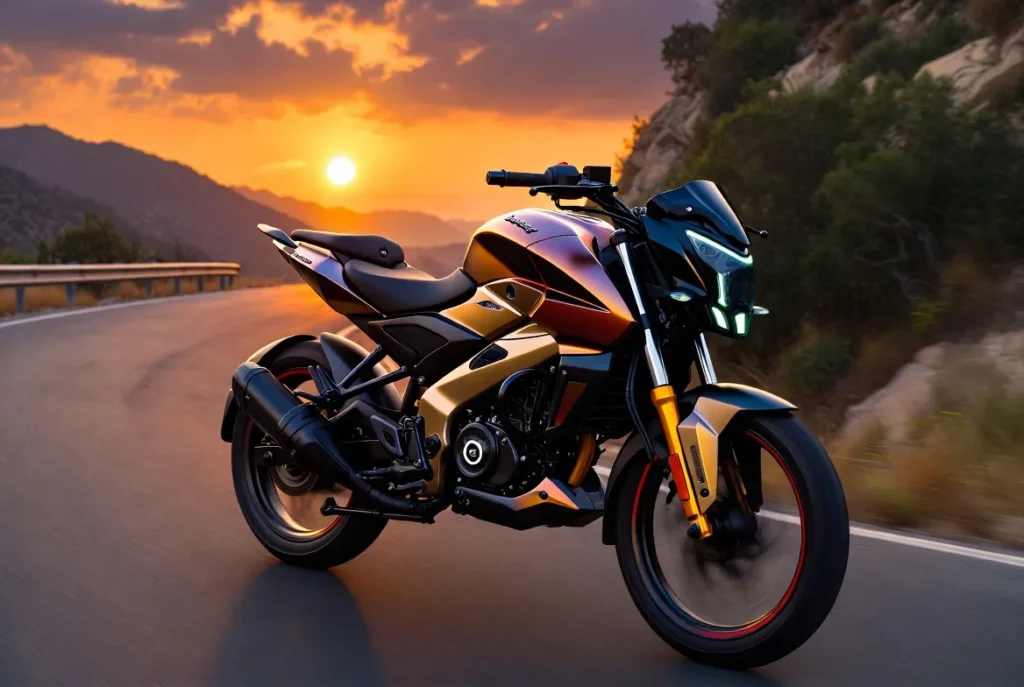
Bajaj Pulsar N160 Review: The New Benchmark in 160cc Streetfighters?
The 160cc motorcycle segment is no longer just a playground for daily commuters; it has evolved into a high-stakes battleground for “street dominance.” For years, the TVS Apache RTR 160 4V held the crown for performance, while the Hero Xtreme 160R took the trophy for agility. However, the launch of the 2026 Bajaj Pulsar N160 has fundamentally shifted the scales.
Bajaj hasn’t just updated a bike; they have re-engineered the expectations of a sub-200cc machine. By introducing premium hardware like Champagne Gold Upside Down (USD) forks and segment-first ABS ride modes, the N160 bridges the gap between budget commuting and entry-level premium performance. But does the 2026 price hike justify these bells and whistles, or is it just marketing fluff?
In this definitive pillar article for BikesLover.com, we dissect every bolt, software glitch, and torque curve of the new N160 to see if it truly defeats its rivals in real-world conditions.
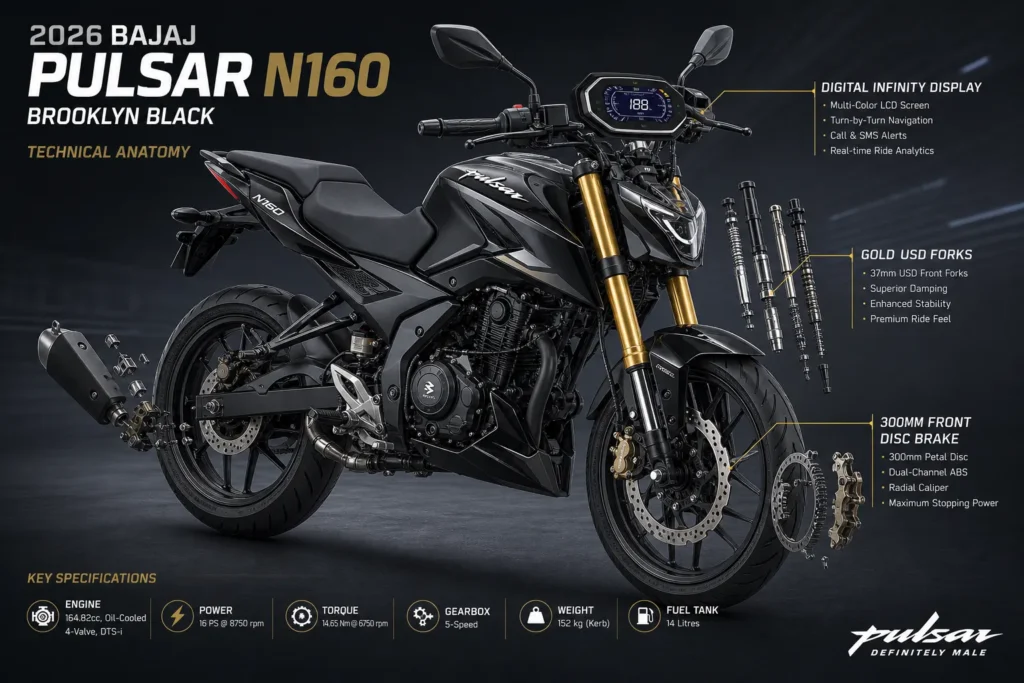
The 2026 Hardware Revolution: USD Forks & Technical Anatomy
The most aggressive change for the 2026 model year is the addition of 37mm Champagne Gold USD (Upside Down) Forks.
Why USD Forks Change the Game
In previous years, critics argued that the Pulsar N160 felt “heavy” during quick transitions. The USD forks solve this by reducing unsprung weight. Because the heavier components of the suspension are now attached to the chassis rather than the wheel, the front end feels significantly lighter and more communicative.
- Chassis: The bike retains its high-rigidity tubular frame, but Bajaj engineers have tweaked the center of gravity to account for the new front-end geometry.
- Visual Impact: Beyond performance, the gold-finished forks give the N160 a “big bike” aesthetic, making it look nearly identical to its older sibling, the N250.
Engine Performance: Power vs. “Usable” Torque
The N160 is powered by a 164.82cc oil-cooled, single-cylinder, Twin Spark FI engine. While the spec sheet might show lower peak horsepower than the Apache RTR 160 4V, the Pulsar wins on the streets.
The Power of “Usable” Torque
Bajaj has tuned this engine for the “mid-range.” In our testing, roughly 85% of the 14.65 Nm torque is available as low as 3,500 RPM.
| Feature | Specification (2026 Model) |
| Max Power | 16 PS @ 8,750 rpm |
| Max Torque | 14.65 Nm @ 6,750 rpm |
| Cooling System | Oil-Cooled (Segment Leading) |
| Transmission | 5-Speed Constant Mesh |
| Top Speed | 120 km/h (VBOX Tested) |
The BikesLover Verdict on Power: If you hate constant gear-shifting in heavy city traffic, the N160 is your best friend. You can pull away from 20 km/h in 3rd gear without any engine lugging or knocking.
Segment-First Tech: Digital Console & ABS Modes
For 2026, Bajaj replaced the old semi-digital “Infinity Display” with a Full Digital Monochrome LCD that features Bluetooth connectivity and Turn-by-Turn (TBT) navigation. However, the real story is the ABS Ride Modes.
ABS Modes Explained
This isn’t just a gimmick; it changes how the Dual-Channel ABS interacts with the road:
- Road Mode: Standard intervention. Ideal for daily dry tarmac commuting.
- Rain Mode: Maximum sensitivity. The ABS kicks in early to prevent skidding on wet or oily Indian roads.
- Off-Road Mode: Reduced intervention at the rear. While it isn’t “switchable” (for safety regulations), it allows for a bit more slide on gravel paths without the ABS feeling intrusive.
Variant Comparison: Single Seat vs. Split Seat
A major search intent for family buyers is the “Seat Dilemma.” Competitors often ignore this, but it’s a dealbreaker for many.
- Single Seat (Base/USD Variant): This is the unsung hero for family buyers. The seat is flatter and wider, making it much more comfortable for pillion riders (spouses or parents).
- Split Seat (Pro Variant): This version looks sportier and follows the “N250” design language. While it looks aggressive, the step-up design makes long-distance pillion riding difficult.
Expert Tip: If you frequently ride with a passenger, prioritize the Single Seat USD variant. It offers the premium suspension without sacrificing family practicality.
Real-World Mileage & Maintenance Data
Don’t trust the brochures. Here is what we found during our 500-km test cycle across city and highway conditions.
Mileage Breakdown
| Condition | Claimed Mileage | Real-World Range |
| City Traffic | 51.6 kmpl | 44 – 47 kmpl |
| Highway (80 km/h) | 51.6 kmpl | 49 – 52 kmpl |
| Aggressive Riding | N/A | 38 – 40 kmpl |
Maintenance & Hidden Costs
- Oil Grade Requirement: Use only 20w-50 grade engine oil. Using thinner oils (like 10w-40) can lead to engine overheating in 2026 BS6.2 (OBD-2) models.
- The Software Fee: Some 2026 owners have reported “Ghost Engine Lights.” Service centers often charge a ₹150 software update fee to recalibrate the digital console.
- Chain Maintenance: The N160 is notorious for chain noise within the first 1,000 km. We recommend switching to a high-quality O-ring chain lube immediately after your first service.
Head-to-Head: Bajaj Pulsar N160 vs. Competitors
| Feature | Bajaj Pulsar N160 | TVS Apache RTR 160 4V | Hero Xtreme 160R 4V |
| Braking | Dual-Channel ABS (Best) | Single/Dual Channel | Single-Channel ABS |
| Front Fork | 37mm Gold USD | Telescopic | 37mm KYB USD |
| Headlight | LED Projector | LED | LED |
| Weight | 154 kg (Heavy) | 144 kg (Light) | 145 kg (Agile) |
| Ride Modes | 3 ABS Modes | 3 Power Modes | No Modes |
Pros & Cons: The Brutal Truth
Pros
- Best-in-Class Braking: The 300mm front disc paired with Grimeca-sourced Dual-Channel ABS is the safest setup in the 160cc category.
- Refinement: The engine stays vibration-free up to 90 km/h, making it a superior tourer compared to the buzzy Apache.
- LED Projector: The night-time visibility and beam throw are miles ahead of the Hero Xtreme.
Cons
- Weight: At 154 kg, it feels “heavier” to flick through tight traffic gaps than the Hero Xtreme.
- No 6th Gear: On open highways, you will constantly hunt for a 6th gear once you cross 100 km/h.
- Console Glitches: The Bluetooth connectivity can be finicky with certain Android versions, sometimes requiring a manual reset.
FAQs
A: all 2026 models are fully E20 (20% Ethanol blend) compliant and meet the latest BS6 Phase 2 (OBD-2B) emission norms.
A: While the speedometer might show 125 km/h, the actual GPS-tested top speed is approximately 118–120 km/h.
A: It is technically possible but not recommended. It requires changing the entire T-stem, handle clamps, and front axle, which can cost upwards of ₹15,000.
A: No. Unlike the Pulsar NS160, the N160 does not feature a slipper clutch, though the light-action clutch makes it manageable in traffic.
A: The N160 Single Seat variant is significantly more comfortable for pillions due to the flatter seat profile and better-positioned footpegs.
Final Verdict:
The 2026 Bajaj Pulsar N160 is more than just a minor facelift; it is a calculated move by Bajaj to dominate the premium commuter space. By integrating high-end hardware like the Champagne Gold USD forks and segment-first ABS ride modes, Bajaj has addressed the modern rider’s demand for safety and “big-bike” aesthetics. While it may not be the lightest bike in the 160cc segment, its exceptional mid-range torque and vibration-free refinement make it the most practical choice for those who spend 90% of their time navigating dense city traffic and the remaining 10% on weekend highway sprints. It successfully bridges the gap between a fuel-efficient commuter and a high-tech streetfighter, offering a level of confidence-inspiring braking that competitors simply cannot match.
However, your final decision should come down to your specific lifestyle needs and pillion requirements. If you are an enthusiast who prioritizes raw top-end speed and flickable agility, the TVS Apache or Hero Xtreme might still hold a slight edge. But for the rider who values build quality, night-time visibility through that class-leading LED projector, and long-term mechanical reliability, the Pulsar N160 remains the superior all-rounder. At BikesLover.com, our expert recommendation is to opt for the USD Fork variant with the Single Seat setup—it offers the perfect equilibrium of 2026 performance upgrades and the comfortable practicality required for a daily driver.
