The Ultimate Guide to Owning a Seattle Electric Bike: Hills, Rain, and Rules
Seattle electric bike has quickly become one of the most exciting cities for electric biking in the United States. With its rolling hills, scenic waterfront routes, and eco-conscious culture, e-bikes offer a practical and enjoyable way to get around the city. Whether you’re commuting through downtown traffic or cruising along the Burke-Gilman Trail, electric bikes make riding easier by providing pedal assistance, helping riders tackle steep inclines and longer distances without exhaustion. As urban mobility evolves, Seattle continues to invest in bike-friendly infrastructure, making it even more appealing for e-bike users.
In recent years, the popularity of electric bikes in Seattle has surged, driven by rising fuel costs, environmental awareness, and advancements in battery and motor technology. From daily commuters to weekend explorers, riders are embracing e-bikes for their convenience, cost-efficiency, and low carbon footprint. Local regulations also support safe usage, with clear guidelines on speed limits and bike lane access. Whether you’re a beginner or an experienced cyclist, Seattle’s vibrant e-bike scene offers something for everyone, blending modern technology with an active, sustainable lifestyle.
Why Seattle is the “Final Boss” of E-Biking
For many cyclists, Seattle represents the ultimate test. The city’s geography is a series of glacial ridges, meaning almost every North-South commute involves a significant elevation gain.
- The Incline Factor: Streets like East Roy St or those in the University District aren’t just “hilly”; they are mechanical stress tests.
- The “Grit” Reality: Seattle rain isn’t just water; it’s a slurry of road salt, oil, and Pacific Northwest silt that acts like sandpaper on a traditional bike chain.
- The Infrastructure Gap: While the Burke-Gilman Trail is a gem, navigating the “missing link” in Ballard or the high-theft zones of Capitol Hill requires a specific set of security habits and equipment.
Mid-Drive vs. Hub Motors: Which Conquers Queen Anne Hill?
The most common mistake new Seattle riders make is buying a high-wattage hub motor bike and expecting it to fly up a 15% grade. On paper, a 750W hub motor looks powerful. However, in the “Final Boss” city, torque and gearing matter more than raw wattage.
The Mechanical Advantage of Mid-Drive
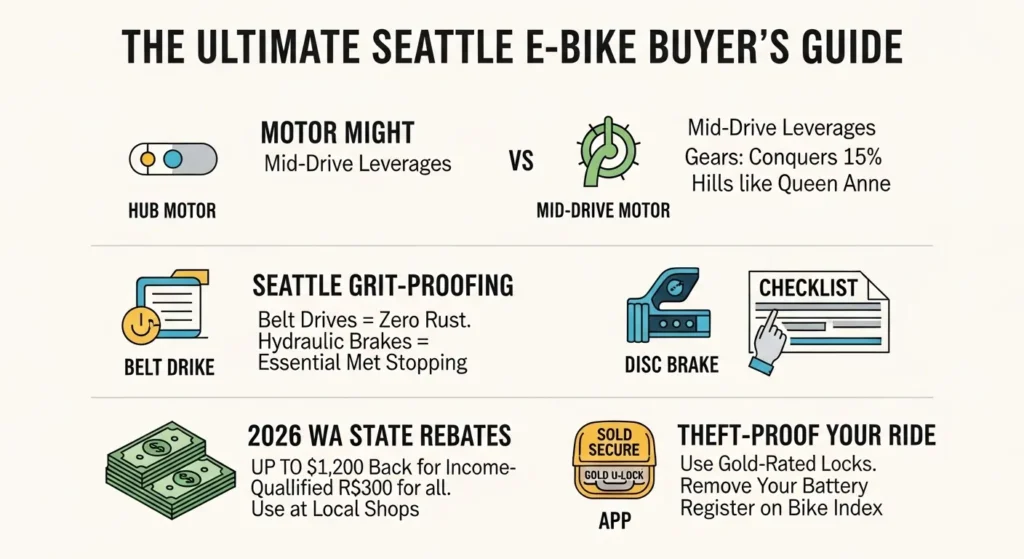
A mid-drive motor (located at the pedals) drives the bike’s actual chain. This means when you shift into a lower gear for a steep hill, you are effectively “downshifting” for the motor too. This leverages the mechanical advantage of the cassette, allowing a 250W Bosch or Shimano mid-drive to outperform a 750W rear-hub motor on a vertical climb.
Hub Motors: The Commuter’s Budget Choice
Rear-hub motors (common on entry-level brands like Rad Power Bikes) are excellent for the flatter stretches of the Elliott Bay Trail. They are cheaper and put less strain on your chain, but they can “bog down” on sustained steep inclines because they cannot leverage the bike’s gears.
Comparison: E-Bike Motors for Seattle Terrain
| Feature | Hub Motor (Rear/Front) | Mid-Drive Motor (Center) | Seattle Recommendation |
| Hill Climbing | Struggles with 10%+ grades | Superior; uses the bike’s gears | Mid-Drive for Queen Anne/Capitol Hill |
| Maintenance | Low (sealed unit) | High (wears chain faster) | Hub for low-cost commuting |
| Weight Distribution | Rear-heavy | Low and Centered | Mid-Drive for better handling |
| Average Torque | 40–60 Nm | 70–95 Nm | Mid-Drive for heavy cargo |
| Price Point | $1,000 – $2,500 | $3,000 – $6,000+ | Hub for budget-conscious |
Seattle E-Bike Laws 2026: Where Can You Actually Ride?
Washington State updated its guidelines under the WE-Bike initiative and refined trail access for 2026. Navigating these rules is essential to avoid fines or conflicts on shared-use paths.
1. The Three-Class System
- Class 1: Pedal-assist only, stops at 20 mph. These have the most freedom and are allowed on almost all paved trails (Burke-Gilman, Sammamish River Trail).
- Class 2: Throttle-actuated, stops at 20 mph. Generally allowed where Class 1 bikes go, but some specific natural-surface trails may restrict them.
- Class 3: Pedal-assist only, stops at 28 mph, and must have a speedometer.
2. The “Sidewalk” Rule
In Seattle, you can legally ride an e-bike on the sidewalk, but you must yield to pedestrians and ride in a “careful and prudent manner.” However, Class 3 e-bikes are generally restricted from sidewalks unless there is no safe alternative or a local ordinance specifically allows it.
3. Trail Access Restrictions
While paved shared-use paths are open to Class 1 and 2, the Washington DNR (Department of Natural Resources) is stricter. On natural surface trails, e-bikes are often restricted to “motorized” trails only, unless specifically marked for e-bike use.
Financial Incentives: The 2026 Washington E-Bike Rebate
The Washington State Department of Transportation (WSDOT) officially relaunched the WE-Bike program on March 30, 2026. This is a massive win for local riders.
- Low-Income Rebate: Residents meeting specific income criteria can receive a point-of-sale voucher for up to $1,200.
- Standard Rebate: Most other residents are eligible for a $300 rebate.
- Selection Process: The program uses a monthly random selection process for applicants, which began on April 13, 2026.
- Applicability: These rebates can be used at participating local bike shops for any of the three classes of e-bikes.
Weather-Proofing Your Ride for the PNW
In Seattle, “rain-resistant” isn’t enough. You need components that can handle 150+ days of moisture.
1. Belt Drives vs. Chains
If your budget allows, look for a Gates Carbon Drive (Belt Drive). Unlike steel chains, belts do not rust, never require grease (which attracts Seattle road grit), and can last up to 20,000 miles. When paired with an Internal Geared Hub (IGH) like a Rohloff or Enviolo, you have a nearly maintenance-free drivetrain.
2. Hydraulic Disc Brakes
Do not buy a mechanical rim-brake bike for Seattle. A 60lb e-bike traveling 20 mph down a wet 12% grade requires the stopping power of hydraulic disc brakes. They provide consistent modulation even when the rotors are soaked.
3. Essential Accessories
- Full-Length Fenders: Essential to keep “road skunk” (that stripe of muddy water) off your back and out of your motor housing.
- Integrated Lighting: Seattle winters are dark by 4:30 PM. Always opt for lights wired directly into your main e-bike battery.
Top-Rated Seattle Electric Bike Shops & Service Centers
Buying online is tempting, but in a city that destroys drivetrains, local support is vital.
- Rad Power Bikes (Ballard): The hometown hero. Their flagship showroom allows for extensive test rides of their entire lineup, from the RadWagon cargo bike to the Radster Trail.
- Gregg’s Cycles (Green Lake/Bellevue): A Seattle institution since 1932. They specialize in high-performance mid-drive systems from Trek and Specialized.
- Dandelion Bikes (Central District): The go-to experts for “car replacement” setups. They specialize in heavy-duty cargo bikes and long-term utility.
- G&O Family Cyclery (Greenwood): Known for their expertise in family hauling and “bakfiets” (box bikes) that are perfect for navigating Phinney Ridge with kids.
Theft Prevention: The Seattle Security Checklist
Bike theft in major US cities, including Seattle, saw an 8–12% increase going into 2026. E-bikes are high-value targets.
- The Double-Lock Method: Use a Sold Secure Gold/Diamond-rated U-lock for the frame and a secondary chain or folding lock for the wheels.
- Remove the Battery: This is the most effective deterrent. An e-bike without a battery is significantly less valuable and harder to flip.
- Bike Index Registration: Register your serial number on Bike Index. Seattle PD and local “good samaritans” regularly use this database to recover stolen property—over $36M in value has been recovered globally through the platform.
- AirTag/GPS Hiding: Hide an AirTag or a dedicated GPS tracker (like Knog Scout) inside the motor housing or under the fork.
Pros & Cons of Owning an E-Bike in Seattle
Pros
- Hill Neutralization: Turns a grueling commute into a light sweat.
- Parking Ease: Skip the $30/day downtown parking fees.
- Rebate Access: Save up to $1,200 via the WE-Bike program.
- Health Benefits: Studies show e-bike riders ride more often and further than traditional cyclists.
Cons
- Theft Risk: High-value targets require expensive locking solutions.
- Maintenance Costs: Drivetrains wear faster due to motor torque and road grit.
- Weight: Hauling a 70lb bike up apartment stairs is a genuine challenge.
FAQs
A: Washington law does not require a driver’s license, vehicle registration, or insurance for compliant Class 1, 2, or 3 e-bikes.
A: While there is no statewide helmet law in Washington, King County and the City of Seattle have local ordinances that require helmet use for all cyclists.
A: Most Metro bus racks can accommodate e-bikes up to 55 lbs, provided the tires aren’t too wide (over 2.3 inches). Always remove the battery before loading to reduce weight and increase safety.
A: A Class 1 or Class 2 e-bike is best. Class 3 bikes are technically restricted from shared-use paths unless they are adjacent to a highway.
A: Applications are handled through the WSDOT WE-Bike portal. You must be a Washington resident at least 16 years old. Selections happen monthly through March 2027.
Final Expert
If you live in Seattle, an electric bike isn’t just a gadget—it’s a mobility revolution. It turns the city’s steepest obstacles into minor inconveniences and bypasses the soul-crushing traffic of I-5 and the Mercer Mess. For the best experience, we recommend prioritizing a mid-Drive motor if your route involves the downtown core or northern ridges, and investing in a belt-drive system to survive the wet winters. With the 2026 rebates now active, there has never been a more affordable time to join the ranks of Seattle’s e-bike commuters.
