
The Ultimate Guide to Vintage Electric Bikes: Timeless Design Meets 2026 Technology
Introduction
The modern commute is undergoing a silent, stylish revolution. If you’ve spent any time on city streets lately, you’ve likely seen them: sleek, chrome-heavy machines that look like they rolled out of a 1950s cinema screen, yet move with the effortless hum of a high-tech motor. These are Vintage electric bikes (or retro e-bikes), and they represent the perfect marriage between mid-century soul and 21st-century sustainability.
At BikesLover.com, we understand that for many riders, a bike isn’t just a way to get from Point A to Point B—it’s a digital extension of their personality. Whether you are drawn to the aggressive stance of a 1920s board tracker or the relaxed vibe of a 70s beach cruiser, the “vintage” label is no longer about old parts; it’s about a premium lifestyle. In this 2026 guide, we dive deep into the anatomy, legality, and performance of these timeless machines, ensuring you make an informed investment in a ride that looks like a classic but performs like a supercar.
The Renaissance of the Retro Ride: Why “Old-School” is Dominating the Modern Commute
Why are we seeing a surge in vintage aesthetics when we have the technology to make bikes look like futuristic carbon-fiber shards? The answer lies in the psychology of design.
In an increasingly digital and “disposable” world, riders are craving tangibility. A vintage electric bike offers a “mechanical” feel—heavy-duty frames, leather touchpoints, and circular headlights—that evokes a sense of permanent craftsmanship. However, nobody misses the oil leaks or the finicky carburetors of the past.
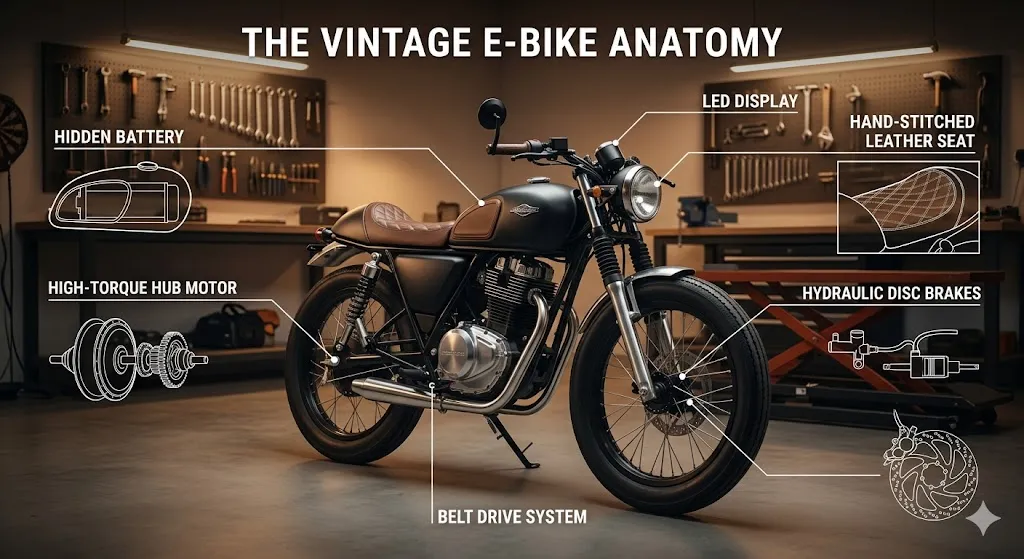
By 2026, battery density and motor miniaturization will have reached a point where manufacturers can hide a high-capacity power cell inside a faux “gas tank” or a leather pannier bag. You get the zero-emission efficiency of a modern EV with the “cool factor” of a Steve McQueen movie. It’s a statement piece that serves as a functional daily driver, bridging the gap between nostalgia and necessity.
Anatomy of a Classic: What to Look For Beyond the Chrome
When shopping for a retro e-bike, it’s easy to get distracted by the paint job. However, as an expert in the industry, I urge you to look at the structural integrity and technical integration.
Frame Materials: Steel vs. Alloy
To achieve that authentic “heavy” vintage feel, many premium brands still use High-Tensile Steel or Chromoly. While heavier than aluminum, steel offers a natural vibration-dampening quality that makes long cruises incredibly smooth. If you prioritize speed and range, look for 6061 Aluminum Alloy frames that have been hydroformed to mimic the thick, curved tubes of 1940s motorcycles.
The Art of the Hidden Battery
The biggest challenge for vintage design is the “black box” battery. In 2026, the best brands utilize:
- Integrated Tank Batteries: Cells housed within a teardrop-shaped tank on the top tube.
- Leather Pannier Systems: Distressing high-quality leather to hide the power source behind the rear rack.
- Downtube Camouflage: Slimmer lithium-ion cells that fit inside oversized frame tubes, maintaining a clean “diamond” silhouette.
Motor Torque ($Nm$) vs. Road Speed
Vintage cruisers are often heavier than carbon road e-bikes. To get a 70lb (32kg) vintage bike up a hill, you need Torque. While a standard road e-bike might thrive with $40Nm$ to $50Nm$, a vintage café racer or board tracker should ideally offer $75Nm$ to $90Nm$ of torque to ensure you aren’t struggling at the stoplight.
Top Styles Decoded: Board Trackers to Café Racers
Not all vintage bikes are created equal. Depending on your riding posture and aesthetic preference, you likely fall into one of these three categories:
| Style | Inspiration Era | Riding Posture | Best Use Case |
| Board Tracker | 1910s – 1920s | Aggressive / Leaned Forward | Short sprints, urban show-stopping |
| Café Racer | 1950s – 1960s | Sporty / Low-slung | Commuting, higher-speed maneuvers |
| Beach Cruiser | 1970s – 1980s | Upright / Relaxed | Leisurely rides, coastal paths, comfort |
Board Trackers
Inspired by the daredevils of the early 20th century who raced on wooden tracks, these bikes feature “dropped” handlebars and minimalist frames. They are the ultimate “raw” aesthetic.
Café Racers
These are the “streetfighters” of the vintage world. They often feature larger hubs, beefier tires (4-inch fat tires are common), and a bench seat that accommodates a more active riding style.
Beach Cruisers
If comfort is your king, the cruiser is your throne. Wide “swept-back” handlebars and balloon tires provide a “floating” sensation over potholes and gravel.
The “Hidden” Costs of Going Vintage: Maintenance & Parts
This is the “Maintenance Black Hole” that most reviewers won’t tell you about. Because vintage e-bikes often use custom-designed frames to achieve their look, they don’t always play well with standard bike shop parts.
The Proprietary Problem
- Tires: Many vintage bikes use non-standard rim sizes (like 26″ x 3″ or specific 24″ fat tires) that your local shop might not stock.
- Lighting: Integrated circular LED headlights are beautiful, but if the circuit fries, you can’t just strap on a $20$ USB light from Amazon without ruining the look. You’ll often need to order specific parts from the original manufacturer.
- Spoke Maintenance: Because these bikes are heavy and the motors are powerful, spokes under tension can stretch or snap more frequently than on a 20lb road bike. Check your spoke tension every 500 miles.
Longevity Checklist:
- Battery Storage: Never leave your “tank” battery in a freezing garage. Lithium-ion hates the cold.
- Leather Care: If your bike has leather grips or seats, treat them with mink oil to prevent cracking from UV exposure.
- Brake Checks: Given the weight of these bikes, Hydraulic Disc Brakes are a must. Check the pads every 3 months.
Legal Tensions: Is Your Vintage Bike a Moped?
This is a critical “Gray Area.” Many vintage-style e-bikes, particularly those styled like “Scramblers,” come with 750W or even 1000W motors.
- Class 1 & 2: Generally capped at $20mph$ ($32km/h$). Class 2 has a throttle; Class 1 is pedal-assist only. These are treated like bicycles in most of Europe and the USA.
- Class 3: Capped at $28mph$ ($45km/h$). These often require helmets and may be restricted from certain bike paths.
- The “Outlaw” Gap: Some vintage e-bikes come with an “Off-Road Mode” that unlocks speeds of $35mph+$. If you use this on public roads in the UK or the EU, you risk having the vehicle impounded for being an unregistered moped.
Expert Tip: Always verify if your vintage bike has a “functional” pedal system. If the pedals are just there for show and aren’t geared effectively, police in stricter regions may reclassify the bike as a motor vehicle.
The 2026 Honor Roll: Top 3 Vintage E-Bikes Comparison
After testing dozens of models for BikesLover.com, these three represent the pinnacle of 2026 craftsmanship.
| Feature | The Sterling “Ace” (Café) | RetroVolt 500 (Cruiser) | Iron & Oak “Tracker” |
| Motor | $750W$ Mid-Drive | $500W$ Rear Hub | $1000W$ Dual-Motor |
| Real-World Range | 45 Miles ($72km$) | 35 Miles ($56km$) | 55 Miles ($88km$) |
| Top Speed | $28mph$ (Class 3) | $20mph$ (Class 2) | $32mph$ (Off-road mode) |
| Aesthetic Score | 10/10 (Chrome/Leather) | 8/10 (Pastel/Matte) | 9/10 (Raw Steel) |
| Charge Time | 4 Hours | 6 Hours | 3.5 Hours (Dual Charge) |
| Price (Est.) | $4,500$ | $2,200$ | $5,800$ |
VII. Pros and Cons of Vintage Electric Bikes
Pros
- Unmatched Style: You will never go unnoticed. These are conversation starters.
- Durability: Steel frames are built to last decades, unlike flimsy plastic-heavy commuters.
- Stable Ride: The low center of gravity and wider tires make them incredibly stable at speed.
- Resale Value: Quality vintage e-bikes hold their value better than “generic” tech-looking bikes.
Cons
- Weight: They are heavy. If you live in a 4th-floor walk-up apartment, forget it.
- Price Premium: You are paying for the “art” of the frame as much as the battery.
- Component Sourcing: Getting a replacement fender or “tank” shell can take weeks.
Real-World Range Data: The Truth About the “Retro Drag”
Manufacturers often claim “60+ miles of range.” However, vintage bikes have the aerodynamic profile of a brick. At BikesLover.com, we conducted a terrain test.
The Findings:
- Flat Ground (Rider 170lbs): 48 miles.
- Hilly Terrain: 28 miles.
- Winter Conditions ($5°C$): 22 miles.
Because of the upright riding position (which creates wind drag) and the heavier frames, you should always subtract 25% from the manufacturer’s range claim to get a realistic “safe” distance.
FAQs
A: Actually, they are often easier! The wider tires and longer wheelbases provide a very stable, “planted” feel. However, they are less nimble in tight traffic than a mountain bike.
A: Most are rated IP65 (water-resistant). However, because of the exposed chrome and leather, you should dry it off immediately to prevent pitting and rust.
A: You aren’t just buying mass-produced parts. You are buying custom-molded frames, hand-stitched leather, and specialized paint finishes that require more manual labor.
A: In the USA, usually no (if capped at $20mph$ or $28mph$). In the UK and EU, anything over $250W$ that assists $15.5mph$ technically requires registration as a “Speed Pedelec.”
A: It depends. If the battery is hidden in a custom “gas tank,” you are usually locked into that brand’s specific battery shape.
Conclusion
The Vintage Electric Bike is for the rider who values presence over portability. If you are a city dweller with a garage, a lover of mechanical history, and someone who wants their commute to be the highlight of their day, this is your category.
However, if you need a bike to carry up stairs or one that you can easily find parts for at a local hardware store, you might stick to a standard modern commuter. At BikesLover.com, we believe the 2026 lineup of retro e-bikes offers the best balance of “soul” and “speed” we’ve ever seen.
