
Introduction
If you are researching a Yamaha electric bike in 2026, comparing Yamaha mid-drive systems with Bosch Performance Line or Shimano STEPS motors, or searching for the best Yamaha e-bike for commuting, gravel exploration, or mountain trail riding, this comprehensive buying guide will help you make a confident and informed decision.
Yamaha is not just another electric bicycle manufacturer. It is one of the original innovators of pedal-assist cycling technology, engineering electric drive systems since 1993. While numerous modern brands have recently entered the e-bike industry, Yamaha brings over three decades of expertise in electric propulsion, drivetrain calibration, and mechanical refinement.
- Complete Yamaha electric bike models (2026 lineup)
- In-depth motor technology breakdown
- Real-world battery performance and riding range
- Yamaha vs Bosch vs Shimano comparison
- Advantages and disadvantages
- Global pricing insights
- Buying advice for commuters and off-road riders
- Maintenance and ownership guidance
- Trusted EEAT-aligned information
Yamaha Electric Bike Brand Overview
A Brief History of Yamaha E-Bikes
Yamaha launched the world’s first production power-assisted bicycle in 1993 in Japan. The system was called PAS (Power Assist System). That groundbreaking innovation became the foundation for many modern pedal-assist mechanisms used across today’s electric bike market.
Unlike newly established startups, Yamaha comes from decades of experience in:
- Motorcycle engineering
- Internal combustion engine manufacturing
- Motorsports research and testing
- Precision transmission systems
- Industrial electric motor production
Because of this deep mechanical heritage, Yamaha emphasizes structural durability, refined torque delivery, and consistent power modulation rather than exaggerated performance numbers.
Many riders describe the Yamaha electric bike riding sensation as “organic,” “intuitive,” and “well-balanced.” Instead of feeling like a machine pushing you forward abruptly, the assistance feels integrated and harmonious.
Country of Origin & Global Presence
- Brand Origin: Japan
- Primary Markets: USA, United Kingdom, Germany, Netherlands, France, Spain, Australia, Japan
- Main Product Focus: Mid-drive electric bicycles
Yamaha does not compete aggressively in ultra-budget categories. Instead, it concentrates on premium mid-range and performance-driven electric bicycles designed for reliability, longevity, and controlled output.
Yamaha Electric Bike Technology Explained
Many manufacturers highlight watt ratings. Yamaha emphasizes ride dynamics.
What Makes Yamaha Mid-Drive Motors Unique?
Most Yamaha electric bikes utilize mid-drive motors positioned centrally near the crankset.
Why Mid-Drive Systems Are Superior to Hub Motors
- Optimal weight distribution
- Enhanced climbing performance
- Natural pedaling sensation
- Improved mechanical efficiency
- Seamless gear integration
- Better traction on technical terrain
Typical Yamaha Motor Specifications
| Feature | Yamaha Mid-Drive System |
| Motor Type | Mid-drive |
| Nominal Power | 250W–500W (region dependent) |
| Peak Output | 500W+ |
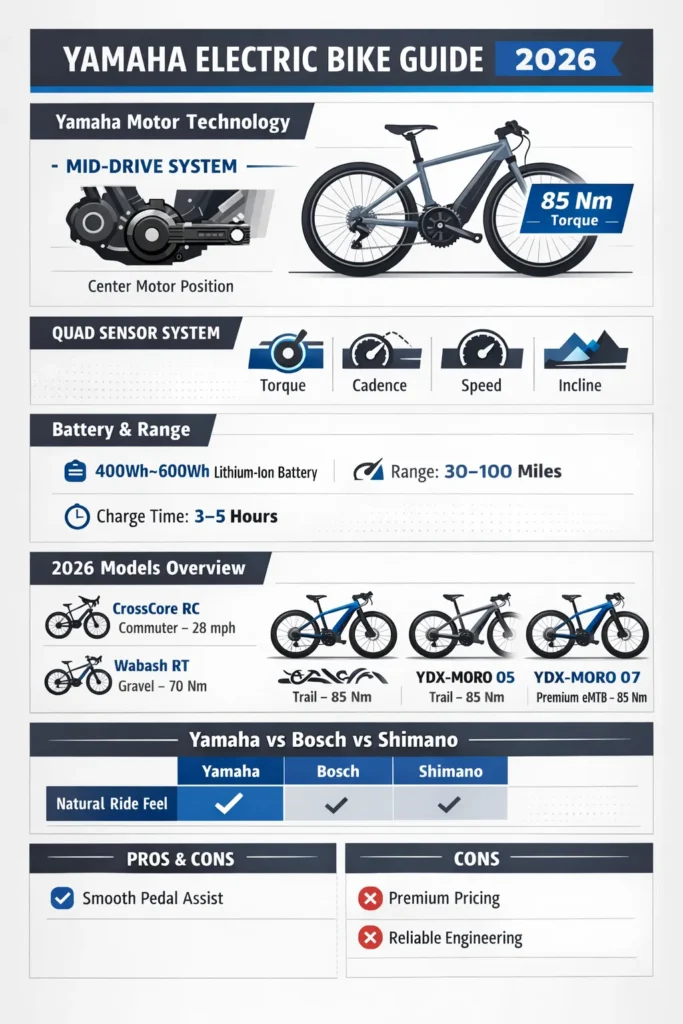
| Torque | Up to 85 Nm |
| Assist Levels | 4–5 modes |
The 85 Newton-meters of torque is particularly significant for hill climbing, cargo hauling, and aggressive off-road ascents.
Rather than overwhelming acceleration, Yamaha prioritizes progressive torque curves. This means the power builds smoothly as you pedal harder.
Yamaha Quad Sensor System – Why It Feels So Refined
Yamaha integrates a Quad Sensor System. This advanced sensing architecture measures four inputs simultaneously:
- Pedal force (torque sensor)
- Crank cadence (rotation speed)
- Bicycle velocity
- Incline angle (tilt detection)
Because of this multi-layered feedback system:
- Power delivery feels seamless
- No sudden surges
- Instant response to pedaling effort
- Enhanced stability on climbs
- Predictable control on descents
This intelligent calibration explains why many cyclists favor Yamaha’s ride quality over competitors.
Zero Cadence Support – Immediate Activation
Yamaha motors activate with minimal pedal input. Riders do not need to apply excessive pressure before assistance engages.
Benefits include:
- Smooth traffic restarts
- Easier hill launches
- Technical trail maneuvering
- Urban stop-and-go riding
For beginners, this feature improves confidence and safety.
Yamaha Electric Bike Battery Life & Range
Battery endurance is one of the most searched aspects of any electric bicycle.
Yamaha Battery Specifications
| Specification | Typical Yamaha Battery |
| Chemistry | Lithium-ion |
| Capacity | 400Wh–600Wh |
| Charging Duration | 3–5 hours |
| Removable | Yes |
All contemporary Yamaha batteries are detachable, allowing convenient indoor charging.
Real-World Range Explained
Actual distance varies based on:
- Rider mass
- Terrain profile
- Assist mode
- Wind resistance
- Tire inflation
- Riding style
Estimated Real-World Range
- Eco Mode: 80–100 miles (130–160 km)
- Standard Mode: 40–70 miles
- High Mode: 30–45 miles
Yamaha prioritizes realistic range projections instead of inflated marketing claims.
Battery Longevity
Typical lifespan:
- 500–800 full Charge cycles
- Approximately 3–5 years with proper care
Battery Preservation Tips
- Avoid frequent 0% discharge
- Store between 30%–70% charge if unused
- Keep away from excessive heat
- Avoid prolonged full 100% storage
Proper battery management significantly extends service life.
Yamaha Electric Bike Models
Yamaha CrossCore RC – Ideal for Urban Commuting
Category: Urban / Fitness
Top Speed: 28 mph (Class 3 USA)
Motor: Yamaha PWSeries
Battery: 500Wh
Why It’s Popular
- Lightweight alloy frame
- Road-oriented geometry
- Efficient torque response
- Comfortable upright positioning
Best suited for:
- Office commuters
- University students
- Daily city riders
Yamaha Wabash RT – Gravel & Adventure Specialist
Category: Gravel / Adventure
Top Speed: 20–28 mph
Torque: 70 Nm
Distinct Features:
- Drop-bar configuration
- Versatile terrain capability
- Endurance-focused design
Ideal for:
- Bikepacking
- Rural exploration
- Long-distance touring
Yamaha YDX-MORO 05 – Electric Mountain Performer
Category: eMTB
Torque: 85 Nm
Suspension: Full suspension
Designed for:
- Trail enthusiasts
- Mountain climbs
- Off-road technical terrain
Yamaha YDX-MORO 07 – Premium Trail Machine
Category: High-performance eMTB
Torque: 85 Nm
Advanced suspension platform
Perfect for:
- Aggressive riders
- Steep descents
- Demanding trails
Electric Yamaha Bike Specs
| Model | Category | Torque | Battery | Top Speed | Best Use |
| CrossCore RC | Commuter | 70 Nm | 500Wh | 28 mph | Urban |
| Wabash RT | Gravel | 70 Nm | 500Wh | 20–28 mph | Mixed terrain |
| YDX-MORO 05 | eMTB | 85 Nm | 500Wh | 20 mph | Trail |
| YDX-MORO 07 | Premium eMTB | 85 Nm | 500Wh | 20 mph | Aggressive off-road |
Yamaha vs Bosch vs Shimano
Search queries often include:
- Yamaha vs Bosch e-bike
- Yamaha vs Shimano motor
- Best mid-drive e-bike system
| Feature | Yamaha | Bosch | Shimano |
| Ride Feel | Natural & balanced | Powerful & advanced | Smooth & consistent |
| Motor Type | Mid-drive | Mid-drive | Mid-drive |
| App Ecosystem | Limited | Advanced | Moderate |
| Torque | Up to 85 Nm | Up to 85 Nm | Up to 85 Nm |
| Dealer Network | Moderate | Extensive | Strong |
Summary
- Yamaha: Best natural Riding sensation
- Bosch: Best smart connectivity
- Shimano: Balanced performance and reliability
If ride smoothness and mechanical refinement matter most, Yamaha is a compelling choice.
Yamaha Electric Bike Pricing
| Model | USA Price | Europe Price |
| CrossCore RC | $2,999–$3,299 | €2,800–€3,200 |
| Wabash RT | $3,199–$3,499 | €3,000–€3,400 |
| YDX-MORO 05 | $4,199 | €3,900–€4,200 |
| YDX-MORO 07 | $4,699 | €4,400–€4,800 |
Compared with entry-level brands, Yamaha occupies the upper mid-tier to premium segment.
Pros & Cons
Advantages
- Exceptionally smooth pedal assist
- Trusted Japanese engineering
- High torque output (85 Nm)
- Reliable battery systems
- Excellent off-road stability
- Balanced weight distribution
- Strong climbing capability
Drawbacks
- Higher price bracket
- Limited smartphone integration
- Dealer coverage varies by region
- Fewer ultra-budget options
Who Should Buy a Yamaha Electric Bike?
Ideal For:
- Daily commuters
- Gravel explorers
- Trail riders
- Long-term reliability seekers
- Riders prioritizing natural pedal feel
Not Ideal For:
- Budget-focused buyers
- Tech-heavy app enthusiasts
- DIY modification hobbyists
Ownership Experience & Maintenance Guide
Yamaha’s mechanical background results in:
- Durable drivetrain assemblies
- Stable motor calibration
- Predictable battery cycles
- Long-term dependability
Maintenance Recommendations
- Service every 1,000–2,000 km
- Lubricate the chain regularly
- Inspect brake pads frequently
- Update firmware when available
- Store battery correctly
Spare parts are more accessible in:
- USA
- UK
- Germany
- Japan
Best Use Cases
| Use Case | Recommended Model |
| Daily commuting | CrossCore RC |
| Gravel touring | Wabash RT |
| Trail riding | YDX-MORO 05 |
| Aggressive off-road | YDX-MORO 07 |
FAQs
A1:If you value ride quality, reliability, and natural pedal assist, Yamaha is worth the investment.
A2:Around 500–800 charge cycles before noticeable degradation.
A3:The CrossCore RC is one of the best Yamaha e-bikes for commuting.
A4:Between 30–100 miles, depending on assist mode.
A5: Most models comply with the EU 25 km/h regulations. Always check local laws.
Final Expert Verdict
The Yamaha electric Bikes lineup in 2026 clearly reflects the company’s engineering heritage and performance-driven DNA. While not positioned as the most affordable brand, Yamaha delivers:
- Precise torque modulation
- Fluid pedal assistance
- Long-lasting structural integrity
- Stable battery performance
- Balanced chassis design
For commuters across Europe, trail riders in North America, and adventure cyclists globally, Yamaha remains a highly dependable and technologically mature choice.
