
Introduction
The MT electric bike is reshaping modern off-road cycling. Across the Alpine mountains, the Scottish Highlands, American trail parks, and Australian backcountry routes, riders are upgrading to electric mountain bikes (e-MTBs) for one clear reason:
Greater power. Extended range. Unlimited exploration.
An electric mountain bike blends advanced engineering with rugged outdoor capability. It allows cyclists to conquer steep gradients, cover longer distances, and reduce physical strain while maintaining the thrill of trail riding.
This complete 2026 pillar guide on BikesLover.com delivers in-depth, structured, SEO-optimized insight covering:
- What an MT electric bike truly is
- How pedal-assist systems function
- Motor architecture and torque dynamics
- Mountain e-bike battery life and real-world range
- Best MT electric bikes comparison
- Buying strategy (step-by-step framework)
- Advantages and disadvantages
- Maintenance and durability expectations
- Global pricing structure
- Legal classifications in Europe & USA
- Professional expert evaluation
Let’s begin with foundational knowledge
What Is an MT Electric Bike?
An MT electric bike (Mountain Electric Bike) is a performance-oriented bicycle designed for uneven terrain, technical trails, gravel paths, and mountainous landscapes. It integrates mechanical cycling components with an intelligent electric propulsion system.
Core structural elements include:
- Reinforced trail-ready frame
- High-traction off-road tires
- Suspension system (front or dual suspension)
- Integrated electric motor
- Rechargeable lithium-ion battery
- Pedal Assist System (PAS)
Unlike throttle-based mobility devices, an electric mountain bike requires pedaling input. The motor amplifies rider effort, creating a seamless hybrid of human and electric propulsion.
In the European Union, most models comply with EN15194 regulations:
- 250W continuous motor output
- Pedal assist up to 25 km/h
In the United States, electric mountain bikes are categorized as:
- Class 1 (Pedal assist up to 20 mph)
- Class 3 (Pedal assist up to 28 mph)
Thus, the MT electric bike remains road-legal and trail-compliant in most jurisdictions when meeting local standards.
Why the MT Electric Bike Is Dominating 2026
Electric mountain biking is not merely a passing innovation. It represents a technological transformation in outdoor recreation.
1. Superior Hill Climbing Capability
Steep inclines become manageable due to high-output torque systems.
Modern electric bike torque and motors typically generate 50–90 Nm. This torque translates to:
- Increased uphill traction
- Reduced rider fatigue
- Consistent power delivery
- Controlled acceleration on gradients
For riders navigating mountainous regions like Switzerland, Austria, or Northern Italy, torque capacity is a decisive factor.
2. Enhanced Distance Capacity
Traditional mountain bikes rely entirely on human endurance. In contrast, a mountain e-bike battery life of 400Wh–750Wh supports:
- 60 km with entry batteries
- Up to 150 km with high-capacity packs
This dramatically expands exploration potential.
3. Accessibility Across Skill Levels
Electric mountain bikes democratize trail access.
They accommodate:
- Entry-level riders
- Senior cyclists
- Mixed-experience riding groups
- Rehabilitation riders
This inclusivity increases participation worldwide.
4. Sustainable Outdoor Mobility
An electric bike off-road system produces:
- Zero direct emissions
- Minimal acoustic disturbance
- Reduced environmental footprint
Compared to fuel-powered vehicles, electric MTBs support eco-conscious recreation.
Key MT e-MTB Specs Explained in Detail
Understanding MT e-MTB specs prevents costly purchasing mistakes.
| Feature | Definition | Functional Impact |
| Motor Power (W) | Continuous output rating | Determines assistance strength |
| Torque (Nm) | Rotational force | Climbing efficiency |
| Battery Capacity (Wh) | Stored energy | Riding range |
| Range | Distance per charge | Trip planning |
| Suspension Type | Shock absorption design | Terrain comfort |
| Frame Material | Structural composition | Weight & rigidity |
| Brake System | Stopping mechanism | Downhill safety |
Let’s analyze each parameter further.
Electric Bike Torque and Motors
What Is Torque?
Torque measures rotational force applied to the drivetrain.
Higher torque ensures:
- Improved climbing performance
- Faster acceleration on inclines
- Greater load-carrying capability
Torque guidelines:
- 40–50 Nm → Recreational trail
- 60–75 Nm → Moderate mountain use
- 80–95 Nm → Aggressive alpine climbs
If you frequently encounter steep terrain, select at least 70 Nm.
Motor Architecture in MT Electric Bikes
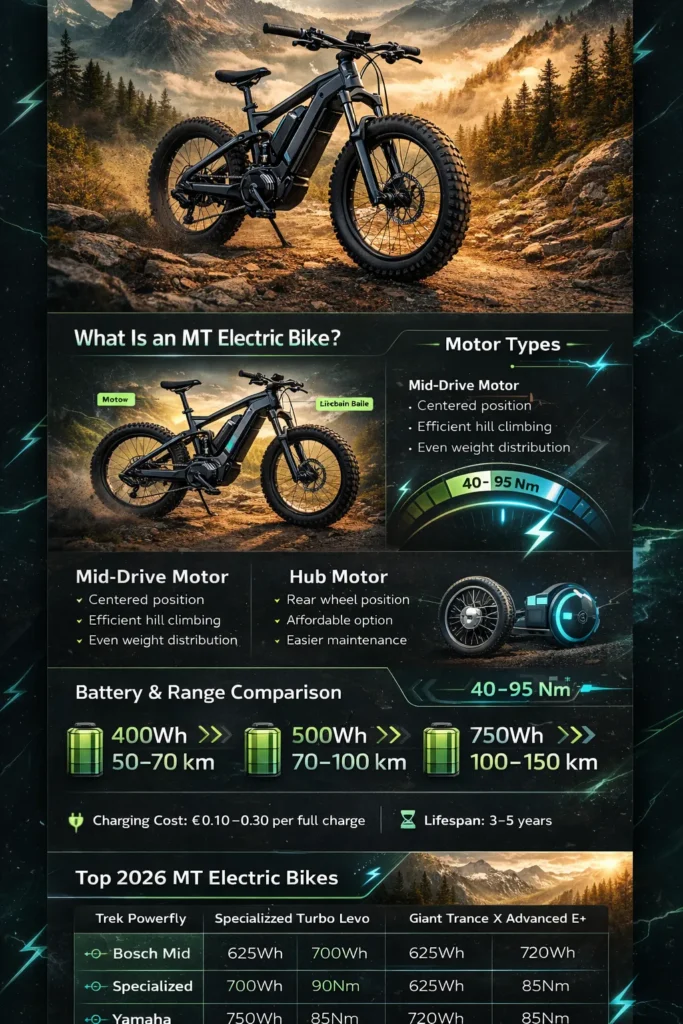
1. Mid-Drive Motor Systems
Mid-drive motors are positioned centrally at the crankset.
Leading global manufacturers include:
- Bosch
- Shimano
- Yamaha
Advantages:
- Balanced weight distribution
- Efficient power transfer
- Superior climbing control
- Natural pedal feel
These systems dominate the premium segment.
2. Hub Motor Systems
Hub motors are installed in the rear wheel.
Advantages:
- Cost-effective
- Mechanically simple
- Minimal drivetrain wear
Limitations:
- Reduced climbing refinement
- Slightly delayed torque delivery
Suitable for casual riders and budget-focused buyers.
Mountain E-Bike Battery Life & Real-World Charging Data
Battery performance depends on:
- Rider mass
- Terrain gradient
- Assist level
- Wind resistance
- Tire inflation
- Ambient temperature
Average Real-World Range
| Battery | Moderate Terrain | Technical Terrain |
| 400Wh | 50–70 km | 40–55 km |
| 500Wh | 70–100 km | 55–80 km |
| 750Wh | 100–150 km | 80–120 km |
Charging cost in Europe averages €0.10–€0.30 per cycle.
Battery durability:
- 700–1000 cycles
- 3–5 years operational lifespan
Top 5 Best MT Electric Bikes in 2026
1. Trek Powerfly
- Bosch Performance Line motor
- 625Wh integrated battery
- 85Nm toque
- Trail-focused aluminum chassis
Ideal for premium trail enthusiasts.
2. Specialized Turbo Levo
- Intelligent motor mapping
- 700Wh battery system
- 90Nm torque
- App-based ride analytics
Designed for advanced riders.
3. Giant Trance X Advanced E+
- Yamaha SyncDrive motor
- Carbon composite frame
- Long-range capability
Excellent for endurance riders.
4. Haibike AllMtn
- Aggressive geometry
- 720Wh battery option
- Downhill-optimized stability
Perfect for technical terrain.
5. Fafrees F28 MT
- Entry-level pricing
- 250W hub motor
- Mixed terrain design
Accessible option for beginners.
Comparative Performance Table
| Model | Motor | Battery | Torque | Target Rider |
| Trek Powerfly | Bosch Mid | 625Wh | 85Nm | Trail enthusiast |
| Turbo Levo | Specialized | 700Wh | 90Nm | Advanced rider |
| Giant Trance X | Yamaha | 625Wh | 85Nm | Endurance explorer |
| Haibike AllMtn | Yamaha | 720Wh | 85Nm | Technical downhill |
| Fafrees F28 MT | Hub | 500Wh | 45Nm | Budget buyer |
MT Electric Bike vs Traditional Mountain Bike
| Feature | MT Electric Bike | Traditional MTB |
| Climbing Efficiency | High | Physically demanding |
| Range Capacity | Extended | Limited |
| Initial Cost | Higher | Lower |
| Weight | Heavier | Lighter |
| Accessibility | Beginner-friendly | Skill dependent |
Electric systems outperform conventional MTBs in steep terrain scenarios.
Pros & Cons of MT Electric Bikes
Pros
Exceptional climbing ability
Extended travel range
Reduced physical fatigue
Environmentally sustainable
Inclusive riding platform
Cons
Elevated purchase cost
Increased weight
Battery replacement expense
Advanced maintenance needs
How to Choose the Best MT Electric Bike
Step 1: Analyze Terrain Conditions
- Cross-country → Hardtail
- Downhill & rocky → Full suspension
- Mixed use → Hybrid e-MTB
Step 2: Select Optimal Torque
70–90 Nm recommended for mountainous Europe.
Step 3: Determine Battery Capacity
500Wh → Moderate rider
625Wh+ → Long alpine journeys
Step 4: Choose Frame Composition
Aluminum → Durable & affordable
Carbon → Lightweight & premium
Step 5: Inspect Braking System
Hydraulic disc brakes are mandatory for trail safety.
Global Pricing Structure
| Segment | Price Range |
| Entry-Level | €900 – €1,800 |
| Mid-Range | €2,000 – €4,000 |
| Premium | €4,500 – €8,000+ |
Regional price variation occurs across Germany, the UK, the USA, the UAE, and Australia.
Maintenance & Long-Term Ownership Insights
Maintenance protocol includes:
- Quarterly brake inspection
- Monthly drivetrain lubrication
- Annual suspension servicing
- Controlled battery storage
Spare parts availability is strong for established manufacturers across Europe and North America.
Best Use Cases for an MT Electric Bike
- Alpine trail riding
- Forest navigation
- Cross-country touring
- Recreational mountain exploration
- Weekend endurance trips
Who Should Buy an MT Electric Bike?
Recommended for:
- Adventure-focused riders
- Cyclists over 40
- Steep urban commuters
- Endurance enthusiasts
- Fitness-oriented explorers
FAQs
A: Are electric mountain bikes good for steep hills
A: Are MT electric bikes legal in Europe
A: Do electric bikes require special maintenance
Final Expert
The MT electric bike represents the future trajectory of mountain cycling. Its integration of torque-rich motors, high-density batteries, and adaptive suspension Technology creates unmatched versatility.
For European and global riders encountering varied terrain, the electric mountain bike delivers enhanced accessibility, performance, and long-term riding satisfaction.
Premium mid-drive systems provide optimal experience, while entry-level models introduce new riders to electric trail mobility.
