
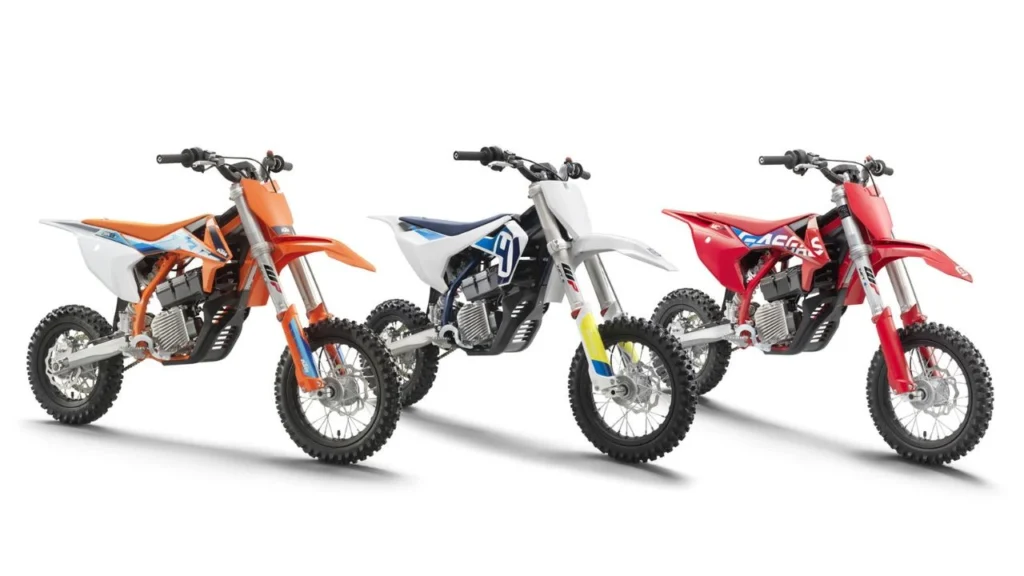
Introduction
This one stands out when it comes to picking a top KTM electric dirt bike – clear layout, packed with info, simple to follow along. What makes it different? Every detail fits together without clutter, built for real use instead of flash.
Out on trails today, electric dirt bikes aren’t just test models anymore. Across Europe, the UK, North America, and Australia, they’re being used more – really put through their paces. Tougher rules around emissions, noise levels, and green regulations have pushed riders to take a closer look at these machines. What once seemed like a sideline option is now part of everyday riding choices.
Yet crucial concerns linger
Is a KTM electric dirt bike truly worth buying in 2026?
Is it really able to stand in for a regular gas-powered motocross bike?
Real talk – how far can you actually go on a single charge?
What’s the charging time needed for the battery?
Comparison with Stark VARG Sur Ron Light Bee and Zero Motorcycles models?
A deep dive into bikes begins here, built just for BikesLover.com. Each key part gets attention – how they perform, what specs say, how batteries work. Ownership expense matters, so that’s covered too. Prices around the world shift, yet details stay clear. Comparisons appear without clutter, showing real differences. Good points show up, bad ones do not hide. What comes next in design sneaks a peek at tomorrow. Everything stays easy to grasp, nothing fancy, just plain talk from start to finish.
If you’re just starting, chasing trails on weekends, or looking at bikes for your child, this guide covers what matters. One way or another, it lines up the details you need.
KTM Electric Dirt Bike Overview & Brand Heritage
Understanding the KTM electric dirt bike starts by looking at who actually builds it.
KTM rolls out of Austria, a bike maker listed as KTM AG, based in the quiet town of Mattighofen. Racing defines its name – worldwide dominance shows up loud in motocross, enduro circuits, the grueling Dakar Rally, and wild off-road contests. While others try to catch up, year after year, these machines own the dirt.
Why KTM Transitioned Toward Electric Off-Road Motorcycles
- KTM’s movement toward electric was influenced by multiple structural factors:
- Increasing European emission regulations
- Strict sound restrictions in forests and urban environments
- Growing demand for beginner-friendly motorcycles
- Significant improvement in lithium-ion battery density
- Expansion of electric motocross competitions
Fresh off years shaping dirt bikes, KTM stepped into electric models already knowing how machines meet the trail. Instead of starting from scratch, its history in motocross laid down real groundwork. With hands-on know-how built on jumps and mud, the shift wasn’t guesswork. Every design choice carried weight from past rides. Not every new name on the block can say that
- Suspension engineering
- Chassis dynamics
- Frame rigidity optimization
- Off-road durability testing
- Professional racing feedback
Every KTM e-dirt bike gains sharper trust thanks to this base. Still, it’s the subtle polish that stands out most across the lineup.
History & Evolution of KTM Electric Dirt Bikes
The Freeride Electric Initiative
In the early 2010s, KTM introduced its Freeride electric prototype. The objective was straightforward yet ambitious:
- Deliver silent off-road mobility
- Maintain KTM’s lightweight agility
- Decrease mechanical complexity
- Smplify riding for beginners
This initiative resulted in the production of the KTM Freeride E-XC, one of the first serious electric off-road motorcycles from an established global manufacturer.
The Freeride platform represented KTM’s early experimentation with battery management systems, electric drivetrains, and regenerative braking concepts.
Expansion Into Youth Electric Motocross
KTM later introduced the KTM SX-E 5, a purpose-built youth electric motocross machine.
This Motorcycle rapidly gained global popularity because:
- It offered adjustable power settings
- It featured a low seat height
- It eliminated clutch and gearbox complexity
- It reduced noise dramatically
Parents appreciated the safety and simplicity. Training schools embraced it for structured development programs. Young riders enjoyed the smooth acceleration and immediate throttle response.
KTM Electric Dirt Bike Models
Let us now examine the primary KTM electric models available or recently produced.
KTM Freeride E-XC – Full-Size Electric Trail & Enduro Bike
Overview
The KTM Freeride E-XC is a full-scale electric off-road motorcycle designed primarily for:
- Technical trail riding
- Light enduro sessions
- Forest terrain
- Short recreational off-road outings
It is not engineered for extreme endurance desert racing. Instead, it focuses on balance, control, precision, and smooth power output.
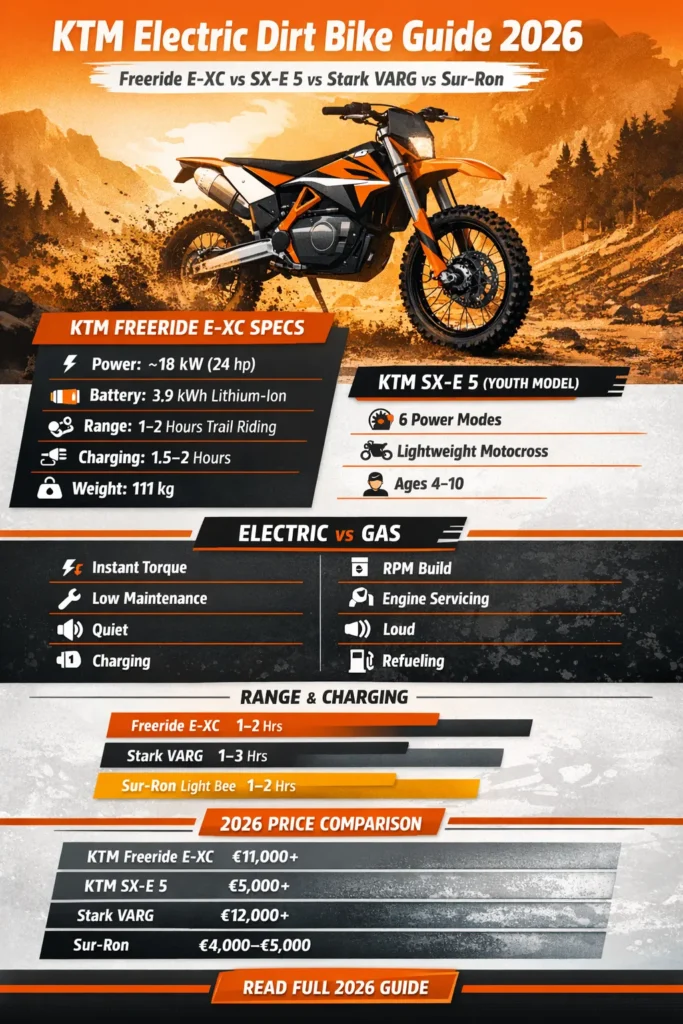
KTM Freeride E-XC Specifications
| Specification | KTM Freeride E-XC |
| Motor Type | Permanent magnet electric motor |
| Peak Output | ~18 kW |
| Battery Capacity | ~3.9 kWh lithium-ion |
| Charging Duration | 1.5–2 hours (fast charger) |
| Weight | ~111 kg |
| Seat Height | ~910 mm |
| Riding Range | 1–2 hours trail use |
Performance Characteristics
When riding a KTM electric dirt bike, the first sensation most riders notice is the instant torque electric bike response.
Electric motors deliver full torque immediately. There is no clutch modulation, no gear shifting delay, and no revving requirement.
The acceleration feels linear, predictable, and refined.
Key Riding Advantages
- Minimal vibration
- Quiet acoustic profile
- Smooth throttle calibration
- Improved low-speed balance
- Easier control in technical sections
Pros & Cons – KTM Freeride E-XC
Advantages
- Reduced mechanical maintenance
- Linear torque delivery
- Quiet operation
- Balanced chassis geometry
- Environmentally sustainable
Disadvantages
- Limited operational range
- Higher acquisition cost
- Charging infrastructure dependency
KTM SX-E 5 – Youth Electric Motocross Motorcycle
The KTM SX-E 5 electric is engineered for children approximately aged 4–10 years.
It integrates race-inspired suspension with electric simplicity.
Feature Summary
- Adjustable ergonomics
- Six power output modes
- Parental control limiter
- WP suspension components
- Lightweight steel frame
- Direct drive system
This motorcycle eliminates traditional clutch systems, reducing complexity for young learners.
Global Pricing Estimate (2026)
| Region | Estimated Price |
| Europe | €5,000 – €5,500 |
| UK | £4,500 – £5,000 |
| USA | $5,000 – $5,500 |
| Australia | AUD 7,000+ |
Prices vary according to taxation, dealer markup, and regional subsidies.
KTM Electric Dirt Bike vs Competitors
A proper electric dirt bike range comparison is essential for informed buying.
We compare:
- KTM Freeride E-XC
- Stark VARG
- Sur-Ron Light Bee
Specification Comparison Table
| Feature | KTM Freeride E-XC | Stark VARG | Sur-Ron Light Bee |
| Power | ~18 kW | 60+ hp equivalent | ~6 kW |
| Battery | ~3.9 kWh | ~6 kWh | ~2–3 kWh |
| Range | 1–2 hours | 1–3 hours | 1–2 hours |
| Weight | ~111 kg | ~118 kg | ~56 kg |
| EU Price | €11,000+ | €12,000+ | €4,000–€5,000 |
Analytical Comparison
Stark VARG
- High horsepower output
- Race-level performance
- Advanced digital tuning
- Premium price positioning
Sur-Ron Light Bee
- Lightweight construction
- Affordable pricing
- Moderate power
- Popular among recreational riders
KTM Freeride E-XC
- Balanced performance-to-weight ratio
- Established brand reliability
- Optimized trail ergonomics
- Mid-tier power classification
KTM Electric Dirt Bike vs Gas Dirt Bike
The debate between KTM electric vs gas dirt bike models continues.
| Parameter | Electric (KTM) | Gas Dirt Bike |
| Maintenance | Minimal | Regular servicing |
| Acoustic Level | Low | High |
| Torque Delivery | Immediate | RPM dependent |
| Refueling | Charging required | Fuel refill |
| Emissions | Zero | CO₂ output |
When Electric Is Superior
- Noise-regulated areas
- Beginner riders
- Urban outskirts
- Technical terrain
When Gas Remains Advantageous
- Extended endurance rides
- Remote expedition routes
- Long-distance rally events
Battery, Charging & Operational Range
Understanding KTM electric dirt bike specs related to battery systems is essential.
KTM E-Dirt Bike Charging Time
- Standard charger: 2–3 hours
- Fast charger: Approximately 1.5 hours
- Home charging compatible
Battery Longevity
Modern lithium-ion batteries typically provide:
- 700–1,000 charge cycles
- 5–8 years of service life
Battery durability depends on:
- Riding intensity
- Climatic conditions
- Charging habits
- Terrain type
Maintenance & Ownership Economics
One major benefit of low-maintenance electric dirt bikes is cost reduction.
Not Required:
- Engine oil replacement
- Spark plug changes
- Valve adjustments
- Clutch servicing
- Fuel system cleaning
Still Required:
- Chain lubrication
- Brake pad inspection
- Suspension service intervals
- Tire replacement
Many riders report 30–50% lower annual maintenance expenditure compared to combustion models.
Ideal Rider Profile
Recommended For:
- European riders facing noise legislation
- Beginner trail enthusiasts
- Youth motocross learners
- Environmentally conscious consumers
- Technical single-track riders
Not Recommended For:
- Desert endurance competitors
- Multi-day adventure explorers
- Riders seeking maximum horsepower output
Global Pricing Overview
| Model | Europe | UK | USA | Australia |
| KTM Freeride E-XC | €11,000–€12,000 | £9,500+ | $11,000+ | AUD 16,000+ |
| KTM SX-E 5 | €5,000+ | £4,500+ | $5,000+ | AUD 7,000+ |
Government incentives for electric vehicles may reduce ownership costs in certain regions.
Electric Motocross Market Growth & Industry Outlook
The global electric motocross market is experiencing strong growth.
Key drivers include:
- Battery density improvements
- Competitive racing adoption
- Environmental policy changes
- Youth rider training programs
- Investment from established manufacturers
Brands investing in electric propulsion systems today are shaping the future of off-road mobility.
FAQs
A: Most models offer 1–2 hours, depending on terrain and riding style.
A: For short trail riding, yes. For long endurance racing, not yet fully.
A: it is one of the safest youth motocross bikes available.
A: Usually 5–8 years with proper care.
A: Some Freeride models are homologated in selected European markets.
Final Expert
Not everyone thinks of quiet bikes when imagining trail rides – KTM’s electric models change that idea fast. These machines move without noise yet deliver tough performance across rough ground. A fresh take on dirt riding shows up where power meets precision unexpectedly. Technology fits into every part, not just tagged onto the edges. What rolls out now proves electric can stand firm beside gas-powered history.
They deliver:
- Immediate torque response
- Quiet operation
- Reduced mechanical complexity
- Beginner-friendly control characteristics
Young riders hitting tight trails might find KTM’s electric bikes fit just right. When tricky ground comes up, these machines keep pace without fuss. Motocross training? They hold their own. Thinking ahead pays off here.
Achieving less peak power than rivals such as the Stark VARG, KTM still builds machines that blend steady operation with proven design choices. Though raw numbers might lag, confidence comes from consistent execution rather than headline-grabbing specs. Engineering decisions favor long-term trust over momentary leaps. Performance stays grounded in what works, not just what impresses on paper.
