
Introduction
The electric Motocross bike has evolved from a niche innovation into a dominant force in off-road performance. What once seemed experimental is now a legitimate rival to traditional petrol-powered dirt bikes. In 2026, across Europe, the United States, Australia, and expanding global markets, riders are transitioning toward electric machines for stronger torque response, reduced upkeep, eco-friendly riding, and near-silent operation.
Yet many enthusiasts still ask critical questions before making the switch:
- Are electric motocross bikes really powerful?
- Can they compete with 450cc gas bikes?
- What is the battery range?
- How much do they cost in 2026?
- Are they worth buying?
This comprehensive 3500+ word pillar guide answers every one of those concerns in clear, practical language. You’ll discover how an electric motocross bike functions, how it compares to petrol models, which are the best electric motocross bikes in 2026, real-world battery performance, pricing analysis, ownership costs, and the long-term future of electric off-road racing.
If you are serious about motocross, trail riding, or enduro competition, this is your complete authority blueprint.
What Is an Electric Motocross Bike?
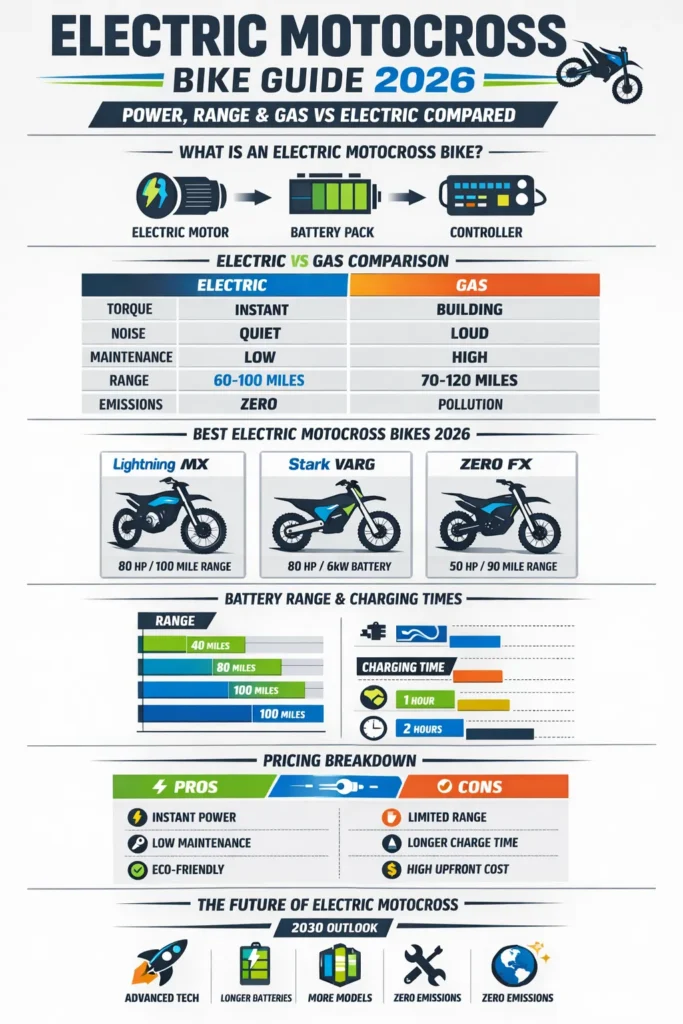
An electric motocross bike is a high-performance off-road motorcycle powered by:
- An advanced electric motor
- A rechargeable lithium-ion battery pack
- A precision electronic controller
Unlike petrol dirt bikes, it does not use:
- Fuel
- Carburetor
- Spark plugs
- Exhaust system
- Engine oil
Instead of combustion, propulsion is generated electronically. When the rider twists the throttle, torque is delivered instantly. Most electric motocross bikes eliminate the clutch and multi-speed gearbox, simplifying the riding experience while maintaining extreme acceleration.
These machines are engineered for:
- Professional motocross tracks
- Off-road trail riding
- Enduro terrain
- Cross-country racing
- Competitive circuits
In 2026, modern electric motocross bikes rival 250cc and even 450cc gas motorcycles in acceleration and low-end torque output.
How an Electric Motocross Bike Works
Understanding the internal structure of an electric motocross bike helps you make an informed purchasing decision.
1. Electric Motor
Most high-performance models use brushless permanent magnet motors. These motors are efficient, durable, and capable of delivering explosive torque.
Key benefits include:
- Immediate torque delivery
- Linear and smooth power curve
- Reduced mechanical components
- Minimal vibration
- No clutch dependency
Unlike internal combustion engines:
- There is no fuel ignition cycle
- There are fewer moving parts
- There is minimal thermal buildup
- There is no gearbox in many configurations
The absence of combustion allows electric bikes to provide seamless acceleration from zero RPM. This responsiveness makes technical sections easier, and hill climbs more controlled.
2. Battery Pack (Understanding kWh)
Battery capacity is measured in kilowatt-hours (kWh), representing total stored energy.
Typical 2026 Battery Capacities:
| Category | Battery Size |
| Entry-Level | 2–3 kWh |
| Mid-Range | 4–6 kWh |
| High-Performance | 6–7+ kWh |
A larger battery provides an extended range but increases overall weight. Manufacturers continuously optimize battery density to balance endurance and agility.
Modern electric motocross bikes use high-grade lithium-ion cells similar to those in electric automobiles. Many brands now implement advanced thermal management systems to prevent overheating and extend lifespan.
3. Controller & Power Modes
The electronic controller acts as the brain of the bike. It regulates:
- Torque mapping
- Throttle sensitivity
- Regenerative braking
- Power modes
- Battery efficiency
Most premium models include:
- Eco Mode
- Standard Mode
- Sport Mode
- Race Mode
- Custom programmable mapping
This adjustability allows riders to tailor performance to terrain, skill level, and competition requirements.
Electric Motocross Bike vs Gas – Complete Comparison 2026
The debate of electric motocross bike vs gas remains the most searched comparison globally. Let’s analyze both objectively.
Performance Comparison
| Feature | Electric Motocross Bike | Gas Motocross Bike |
| Torque Delivery | Instant | Builds with RPM |
| Noise Level | Quiet | Loud |
| Maintenance | Minimal | High |
| Refueling | Recharge | Quick refill |
| Weight | Slightly heavier | Slightly lighter |
| Range | 1–3 hours | 3–5 hours |
| Emissions | Zero | High |
| Skill Requirement | Beginner-friendly | Clutch control needed |
Electric Bike Advantages
- Immediate acceleration
- Reduced servicing expenses
- Environmentally sustainable
- Ideal for noise-restricted regions
- No oil change
- No exhaust system
- Lower mechanical wear
Gas Bike Strengths
- Extended continuous riding time
- Faster refueling
- Established racing infrastructure
- Broader aftermarket support
Verdict: Which Is Better?
Electric wins if:
- You ride near residential areas
- You prefer lower maintenance
- You want beginner-friendly control
- You value sustainability
Gas retains advantages if:
- You require long remote trail endurance
- Charging access is limited
- You compete in petrol-only championships
Best Electric Motocross Bikes 2026 (Top Models)
1. Stark Future VARG
One of the most powerful production electric motocross bikes in 2026.
Specifications:
- Up to 80 HP
- 6.5 kWh battery
- KYB suspension
- Approximately 118 kg
- Fully adjustable digital mapping
It competes directly with 450cc race machines and features advanced mobile app tuning.
Best suited for professional racers and advanced riders.
2. Yamaha Motor Company YZ-EMX Prototype
Yamaha’s electric motocross initiative blends traditional chassis expertise with electric propulsion innovation.
Highlights:
- YZ-based frame geometry
- Balanced handling characteristics
- Lightweight construction
- Swappable battery concept
Ideal for competitive riders loyal to Yamaha engineering.
3. Cake Kalk OR
A Scandinavian-designed electric off-road bike focused on minimalism and sustainability.
Features:
- Lightweight frame
- High torque output
- Clean design philosophy
Best for eco-conscious European trail riders.
4. Sur-Ron Light Bee X
Globally popular entry-level performance electric dirt bike.
Specs:
- ~6 kW motor
- 60V battery
- ~75 km/h top speed
- Lightweight structure
Excellent for beginners and intermediate riders.
5. Segway Powersports X260
Technology-driven electric dirt bike.
Notable Features:
- Smartphone connectivity
- Adjustable ride settings
- Modern suspension geometry
Perfect for tech-oriented riders.
Electric Motocross Bike Pricing 2026
| Category | Price (USD) | Suitable For |
| Entry-Level | $3,000 – $5,000 | Beginners |
| Mid-Range | $6,000 – $9,000 | Intermediate |
| Premium | $10,000 – $13,000+ | Racers |
Prices vary depending on VAT in Europe, import duties, dealer margins, and regional distribution networks.
Battery Range & Charging Explained
Range depends on:
- Rider weight
- Terrain complexity
- Riding aggression
- Power mode
- Ambient temperature
Average Riding Time:
| Usage | Duration |
| Trail Riding | 2–3 hours |
| Aggressive MX | 1–1.5 hours |
Charging Time:
| Charger Type | Time |
| Standard | 3–5 hours |
| Fast Charger | 1.5–2 hours |
Some manufacturers offer removable battery packs for rapid swapping between sessions.
Electric Motocross Bike Maintenance Costs
Electric motorcycles demand less routine servicing.
You do NOT require:
- Oil changes
- Valve adjustment
- Carburetor calibration
- Exhaust repairs
- Spark plug replacements
Maintenance still includes:
- Chain lubrication
- Suspension servicing
- Brake pad replacement
- Bearing inspection
Over 3–5 years, ownership expenses may be 30–50% lower compared to petrol bikes.
Are Electric Motocross Bikes Worth It?
Yes — depending on usage patterns.
Worth it if:
- You ride in urban or suburban areas
- You prefer simplified mechanics
- You want quiet operation
- You prioritize sustainability
Not ideal if:
- You ride long-distance remote terrain
- Charging access is unreliable
- You compete exclusively in gas categories
Charging Infrastructure in Europe & Globally
Europe leads global EV infrastructure expansion.
Leading countries include:
- Germany
- Netherlands
- United Kingdom
- Norway
Most motocross charging occurs at:
- Home garages
- Dedicated track facilities
- Portable generator setups
Who Should Buy an Electric Motocross Bike?
Ideal buyers include:
- Beginners
- Teen riders
- Urban trail enthusiasts
- Eco-conscious athletes
- Riders seeking modern technology
Electric motocross bikes now match traditional 450cc bikes in many performance metrics, including acceleration.
Pros & Cons of Electric Motocross Bikes
Pros
- Immediate torque
- Quiet Riding
- Lower servicing costs
- Eco-friendly operation
- Beginner-friendly control
Cons
- Charging time
- Limited endurance compared to fuel
- Higher initial purchase price
- Battery degradation over time
Future of Electric Motocross
Battery innovation continues rapidly.
Future developments may include:
- Solid-state battery systems
- Ultra-fast charging
- Lightweight composite frames
- Expanded electric racing leagues
- Broader manufacturer adoption
By 2030, electric motocross bikes are expected to dominate urban and regulated environments.
FAQs
A: Usually 3–6 years, depending on charge cycles.
A: High-performance models compete with 450cc bikes.
A: No clutch makes learning easier.
A: Usually $1–$3 per full charge in Europe.
A: It depends on local laws.
Final Expert Verdict
The electric motocross bike is not eliminating gas machines overnight, but it is transforming off-road riding. Performance parity is no longer theoretical — it is practical and measurable.
For modern riders in Europe, the United States, Australia, and growing global markets, electric delivers:
- Instantaneous torque
- Reduced mechanical complexity
- Lower long-term maintenance
- Sustainable performance
If you want intelligent, powerful, future-ready riding in 2026, investing in an electric motocross bike is a strategic and forward-thinking decision.
