
Introduction:
Electric Bike Insurance is not just for riders anymore. By 2026 they will be a way to get around big cities like Amsterdam, London, and Berlin, as well as newer mobility markets such as Lahore. Lots of people, including commuters, university students, delivery professionals, and travelers who care about the environment, now use electric bikes to get where they need to go.
The truth is:
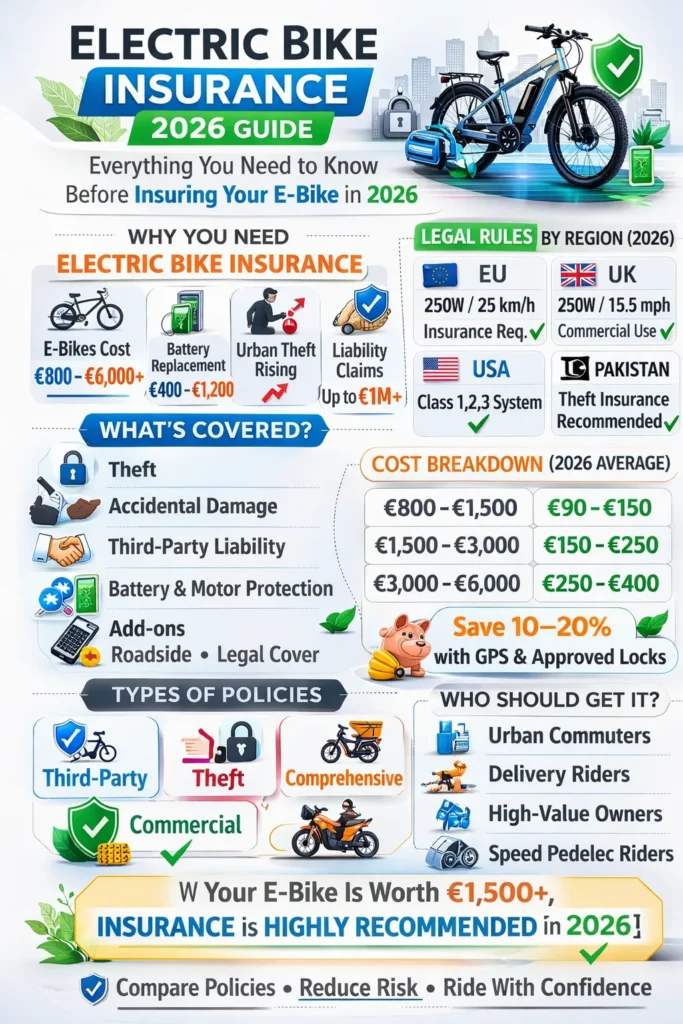
Most e-bikes today cost between 800 euros and 6,000 euros or more. High-end models can easily cost over 7,000 euros. Just the battery can cost between 400 euros and 1,200 euros. Parts like drive motors, digital displays, and hydraulic brakes can make repairs very expensive. At the time, bike theft is going up in big cities, and accidents are getting more complicated.
This is why having insurance for bikes is not just a good idea for many riders. It is a smart way to protect their money.
In this guide, you will learn:
- What electric bike insurance truly means
- Legal requirements in the EU, UK, USA, and Pakistan
- Coverage types explained clearly
- Detailed 2026 cost breakdown
- Advantages and disadvantages
- Side-by-side comparison tables
- Real-world case examples
- Step-by-step buying guide
- Common mistakes to avoid
- Expert verdict for 2026
What Is Electric Bike Insurance?
Electric bike insurance is a specialized protection policy designed specifically for electric bicycles. It provides financial compensation if your e-bike is stolen, damaged, vandalized, or involved in an incident that causes liability.
Unlike standard bicycle policies, electric bike insurance recognizes that e-bikes contain:
- Electric motors
- Lithium-ion battery packs
- Electronic control systems
- Digital displays and sensors
- High-value drivetrain components
These integrated technologies increase both market value and repair complexity. Because of this, standard bicycle insurance policies often provide insufficient coverage.
Electric bike insurance is structured to protect against monetary loss, liability exposure, and unexpected repair bills.
Why Standard Bike Insurance Is Not Enough
Many riders assume:
“My home insurance will cover it.”
Or
“Regular bicycle insurance is sufficient.”
Unfortunately, this assumption is frequently inaccurate.
Problems With Traditional Bicycle Insurance
Standard policies may:
- Exclude electric motors
- Limit battery protection
- Offer lower reimbursement caps
- Refuse coverage for motorized use
- Deny commercial usage claims
Additionally, compensation limits may not reflect the full replacement value of a premium e-bike.
What About Motorcycle Insurance?
Motorcycle insurance is also usually unsuitable. Most pedal-assist e-bikes do not qualify as motorcycles under legal definitions because of limited power output and speed restrictions.
This legal and coverage gap is exactly why electric bike insurance policies were developed.
Do You Legally Need Electric Bike Insurance in 2026?
The requirement depends on:
- Country
- Motor power
- Maximum assisted speed
- Vehicle classification
Let’s examine the main regions.
🇪🇺 European Union – Electric Bike Insurance Rules
The European Union defines most standard e-bikes as EAPCs (Electrically Assisted Pedal Cycles).
Typical criteria:
- Maximum motor power: 250W
- Assistance limit: 25 km/h
- Pedal-assist only (no throttle-only systems)
Under EU transport rules, these standard e-bikes generally do NOT require mandatory insurance.
However, a separate category exists.
Speed Pedelecs (Up to 45 km/h)
Speed pedelecs often:
- Require vehicle registration
- Require insurance coverage
- Require helmets
- Require license plates
In countries such as Germany and Belgium, insurance identification stickers are mandatory for high-speed models.
🇬🇧 United Kingdom – Electric Bike Insurance Laws
In the UK:
- Motor limit: 250W
- Maximum assisted speed: 15.5 mph (25 km/h)
- Pedal-assist only
Standard e-bikes do not legally require insurance.
However:
- Delivery riders typically need commercial coverage
- Speed pedelecs require registration and insurance
Commercial riders face greater liability exposure and should not rely on personal policies.
🇺🇸 United States – 3 Class E-Bike System
The United States uses a three-class system:
| Class | Description | Insurance Required? |
| Class 1 | Pedal assist up to 20 mph | Usually No |
| Class 2 | Throttle + 20 mph | Usually No |
| Class 3 | Pedal assist up to 28 mph | Rarely mandatory |
Insurance requirements vary by state. Riders should consult local Department of Motor Vehicles regulations.
🇵🇰 Pakistan & Emerging Asian Markets
In Pakistan:
- Low-power pedal-assist bikes typically do not require registration
- High-power electric motorcycles may require licensing
- Theft risk is increasing in major cities
In urban centers such as Karachi, theft insurance is strongly recommended due to rising crime statistics.
Why Electric Bike Insurance Is Becoming Essential
Even when not legally required, insurance provides strong financial protection.
Reasons include:
- Rising e-bike price
- Increasing urban theft rates
- Expensive battery replacement
- Growing accident liability claims
- Higher risks for delivery workers
In dense cities like New York City and Paris, theft incidents involving electric bikes have increased significantly in recent years.
Insurance protects not just the bicycle, but your financial stability.
What Does Electric Bike Insurance Cover?
Coverage varies by insurer, but most policies include the following components.
Theft Protection
Covers:
- Theft from Home storage
- Theft from public parking areas
- Forced entry incidents
- In some cases, international theft
Requirements often include:
- Approved high-security lock
- Proof of forced entry
- Police report documentation
Accidental Damage
Covers:
- Crash damage
- Fire damage
- Vandalism
- Natural disasters
If you fall during commuting and damage your motor or frame, comprehensive insurance typically covers repair or replacement costs.
Third-Party Liability
This is one of the most important protections.
Covers:
- Injury to pedestrians
- Damage to vehicles
- Property damage
- Legal defense costs
In Europe, liability limits commonly range from €1 million to €5 million.
Without liability insurance, a serious accident could lead to devastating legal expenses.
Battery & Motor Coverage
This is a defining feature of electric bike insurance.
Lithium-ion battery packs are expensive and sensitive to damage. Premium plans may cover:
- Battery theft
- Electrical faults
- Motor malfunction
- Controller replacement
However, wear and tear is usually excluded.
Add-Ons and Extra Protection
Optional benefits may include:
- Roadside assistance
- Legal expenses coverage
- Personal accident compensation
- Worldwide travel protection
- Accessory coverage
Types of Electric Bike Insurance Policies
| Coverage Type | Theft | Damage | Liability | Battery | Best For |
| Third-Party Only | ❌ | ❌ | ✅ | ❌ | Legal minimum |
| Theft Only | ✅ | ❌ | ❌ | Sometimes | Urban riders |
| Comprehensive | ✅ | ✅ | ✅ | ✅ | High-value e-bikes |
| Commercial | ✅ | ✅ | ✅ | ✅ | Delivery riders |
Comprehensive policies provide the broadest safeguards.
How Much Does Electric Bike Insurance Cost in 2026?
Premiums depend on multiple variables.
Average Annual Premiums (Europe 2026)
| Bike Value | Basic Theft | Comprehensive |
| €800–€1,500 | €30–€80 | €90–€150 |
| €1,500–€3,000 | €70–€150 | €150–€250 |
| €3,000–€6,000 | €120–€250 | €250–€400 |
Cost Determinants
Insurance providers evaluate:
- Bike valuation
- Local crime statistics
- Rider age
- Storage method
- Claim history
- Security devices
- Commercial usage
Urban residents generally pay higher premiums than rural riders.
How to Reduce Your Electric Bike Insurance Premium
You can lower your annual payment by:
- Using certified high-security locks
- Storing your bike indoors
- Installing a GPS tracking device
- Choosing a higher deductible
- Comparing multiple insurers
- Avoiding unnecessary optional coverage
Small adjustments can reduce premiums by 10–20%.
Electric Bike Insurance vs Home Insurance
| Feature | Home Insurance | E-Bike Insurance |
| Theft at home | Usually Yes | Yes |
| Theft outside home | Limited | Yes |
| Crash damage | Rare | Yes |
| Liability cover | Limited | Yes |
| Battery protection | Rare | Yes |
Home insurance often excludes:
- Motorized components
- High-value claims
- Commercial use
Specialized insurance is more comprehensive and tailored.
Pros & Cons of Electric Bike Insurance
Advantages
- Protects high-value investment
- Covers Battery and motor
- Provides liability security
- Covers theft in public areas
- Required for speed pedeles
Disadvantages
- Annual premium cost
- Strict lock requirements
- Policy exclusions
- Claims paperwork
For most riders, benefits outweigh drawbacks.
Top Myths About Electric Bike Insurance
Myth 1: “My home insurance covers everything.”
It often excludes theft outside the home and motorized components.
Myth 2: “Low-speed bikes don’t need insurance.”
Legal requirements differ from financial prudence.
Myth 3: “Cheap bikes don’t need insurance.”
Even €1,000 is a substantial loss for many households.
Choose the Best Electric Bike Insurance
Step 1: Know Your Bike’s True Value
Include:
- Accessories
- Upgrades
- Battery replacement cost
- Installation expenses
Step 2: Assess Your Risk Profile
Ask:
- Do I park in public frequently?
- Is my city high-risk for theft?
- Do I commute daily in traffic?
- Do I use it commercially?
Step 3: Compare Policies Thoroughly
Evaluate:
- Liability limits
- Battery inclusion
- Deductible amount
- Claim settlement time
- Geographic coverage
Step 4: Review Exclusions Carefully
Common exclusions include:
- Unlocked bicycle
- Racing
- Unauthorized modifications
- Wear and tear
Who Should Definitely Get Electric Bike Insurance?
- Owners of bikes worth €1,500+
- Delivery riders
- Urban commuters
- Speed pedelec riders
- International touring cyclists
If your e-bike is essential for daily mobility, insurance is strongly advised.
Real-World Example
Imagine you own a €2,800 trekking e-bike in Berlin.
- Battery cost: €700
- Theft risk: High
- Annual premium: €180
If stolen, insurance reimburses replacement (minus deductible).
Without insurance, you lose €2,800 outright.
Electric Bike Insurance for Delivery Riders
Delivery professionals face:
- Extended riding hours
- Higher accident probability
- Public parking exposure
- Commercial liability
Standard personal insurance often rejects business-related claims. Commercial electric bike insurance is necessary and includes:
- Business liability
- Higher compensation limits
- Work-related injury coverage
Electric Bike Insurance for High-Speed Models
Speed pedelecs (45 km/h) frequently require:
- Registration
- Insurance plate
- Helmet
- License
These models are often legally classified closer to mopeds, making insurance mandatory in many jurisdictions.
FAQs
A:Only for certain high-speed models in some countries.
A:Only if you choose commercial coverage.
A:But proof of purchase is required.
A:Usually, no wear and tear is excluded.
A:Not mandatory, but it often reduces premiums.
Final Verdict
In 2026, electric mobility is accelerating worldwide. E-bikes are more sophisticated, more valuable, and more integrated into daily transportation systems than ever before.
If your electric bicycle exceeds €1,500 in value, insurance is highly recommended.
Rising theft rates, expensive lithium-ion battery systems, and increasing liability risks make electric bike insurance a prudent and forward-thinking investment.
It provides:
- Financial protection
- Legal security
- Long-term peace of mind
- Investment preservation
Serious riders protect their ride.
Electric bike insurance in 2026 is not just about replacing stolen equipment — it is about safeguarding your mobility, your money, and your Future.
