Introduction
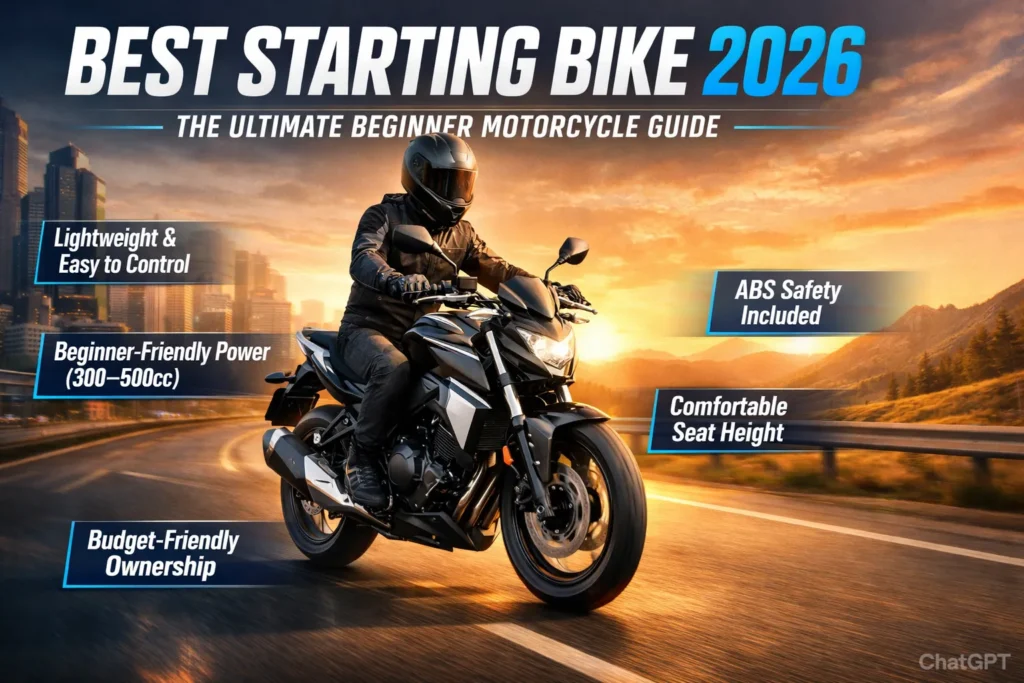
Selecting the best Starting bike is one of the most critical choices you will ever make as a new rider. Your first motorcycle defines your early riding experience, shapes your confidence, builds your technical foundation, and influences how safely you develop long-term skills. Choose wisely, and you accelerate your progress, ride securely, and enjoy every journey. Choose poorly, and you may face intimidation, slow learning, unnecessary expenses, or elevated risk.
At BikesLover.com, we evaluated beginner motorcycle trends across Europe, the United States, Asia, Australia, and emerging markets such as Pakistan. We reviewed licensing structures, insurance premiums, accident statistics, rider surveys, resale value patterns, and ownership costs. This is not a shallow listicle. This is a comprehensive pillar resource designed to help you identify the best starter motorcycle using logic, data, ergonomics, and real-world practicality.
If you are searching for:
- The best starter motorcycle on a budget
- A lightweight motorcycle with a low seat height
- A cruiser, sport, naked, or adventure bike for beginners
- Or simply your first motorcycle purchase
You are in the right place.
Let’s explore every essential factor in depth.
What Makes the Best Starting Bike?
Before naming specific models, we must define what truly qualifies as the best starting bike.
A proper beginner motorcycle should provide:
Predictable power delivery
Light overall mass
Smooth throttle response
Comfortable ergonomics
Affordable running costs
Essential safety features (minimum: ABS)
The primary objective is simple: confidence first, acceleration later.
Many new riders assume “more horsepower equals more excitement.” In reality, excessive output often delays skill development. A motorcycle that feels intimidating reduces learning efficiency. A well-balanced entry-level bike supports progressive improvement.
From a riding dynamics perspective, controllability outweighs performance metrics. Linear torque curves, forgiving clutch engagement, manageable gearing, and balanced chassis geometry contribute far more to rider growth than peak horsepower numbers.
The best starting bike encourages repetition, practice, and skill mastery without punishing minor mistakes.
Ideal Engine Size for Beginners (2026 Guide)
Engine displacement significantly influences beginner suitability.
Below is a simplified segmentation:
125cc–250cc
- Ideal for EU A1 license holders
- Extremely lightweight
- Excellent for dense city environments
- Lower insurance premiums
- Minimal fuel consumption
- Reduced maintenance complexity
These motorcycles are ideal training platforms. However, highway capability can feel limited depending on rider weight and traffic conditions.
300cc–400cc
This category represents the global sweet spot.
- Strong enough for highways
- Still lightweight and forgiving
- Balanced acceleration
- Manageable torque curve
- Excellent skill progression range
For most riders worldwide, this is the optimal beginner segment.
500cc and Above
Suitable only if:
- Power delivery is smooth
- Weight remains manageable
- Throttle mapping is predictable
High-revving 600cc supersport machines are not beginner-friendly. Their abrupt throttle response, aggressive ergonomics, and elevated insurance costs make them unsuitable for new riders.
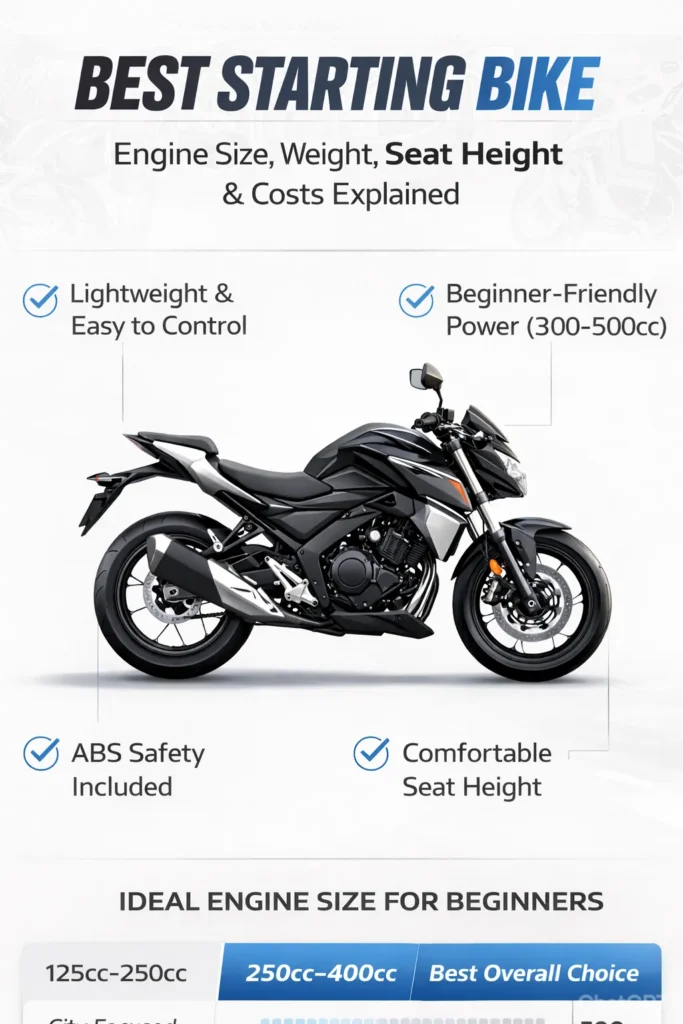
For the majority of beginners globally, 250cc–400cc is the most appropriate starting bike category.
More displacement does not automatically translate into better learning.
Beginner Motorcycle Buying Checklist
Use this evaluation matrix before making a purchase.
| Factor | Why It Matters | Ideal Range |
| Engine Size | Controls power & learning curve | 250cc–400cc |
| Weight | Easier low-speed handling | Under 190 kg |
| Seat Height | Confidence at stops | Under 820 mm |
| ABS | Prevents wheel lock | Dual-channel ABS |
| Insurance | Budget impact | Lower displacement |
| Maintenance | Service simplicity | Single / Parallel Twin |
A motorcycle meeting most of these criteria qualifies as a strong beginner candidate.
Best Starting Bikes for Beginners
Below are globally recognized beginner-friendly motorcycles.
Best Overall Starting Bike: Honda CB300R
The Honda CB300R is frequently considered the safest universal recommendation for new riders.
Key Specifications
- Engine: 286cc liquid-cooled single-cylinder
- Power: ~31 hp
- Weight: ~146–150 kg (wet)
- Seat Height: 801 mm
- ABS: Dual-channel
Why It’s Ideal for Beginners
- Extremely light chassis
- Predictable throttle
- Refined clutch modulation
- Premium fit and finish
- Upright riding posture
Its compact proportions reduce intimidation. Neutral ergonomics promotes balance and control.
Pros
Lightweight
Fuel-efficient
Excellent reliability
Cons
Limited wind protection
Modest two-up comfort
Best For: Urban commuting and skill development.
Best Cruiser Beginner Bike: Honda Rebel 500
Cruiser enthusiasts often prioritize comfort and styling. The Rebel 500 delivers both while remaining beginner-appropriate.
Specifications
- Engine: 471cc parallel twin
- Power: ~46 hp
- Seat Height: 690 mm
- Weight: ~191 kg
Why It Works
- Very low saddle height
- Relaxed riding triangle
- Smooth torque curve
- Manageable acceleration
Despite a larger displacement, its engine tuning is calm and predictable.
Pros
Confidence-inspiring ergonomics
Strong resale value
Linear power delivery
Cons
Heavier than 300cc bikes
Minimal instrumentation
Best For: Riders who prefer cruiser aesthetics and relaxed posture.
Best Sport-Style Starter Bike: Kawasaki Ninja 400
The Ninja 400 remains one of the most recommended entry-level sport motorcycles globally.
Specifications
- Engine: 399cc parallel twin
- Power: ~45 hp
- Seat Height: 785 mm
- Weight: ~168 kg
Why Beginners Appreciate It
- Sporty design
- Smooth mid-range torque
- Predictable acceleration
- Excellent chassis feedback
It feels quick but controllable.
Pros
Balanced handling
Strong aftermarket ecosystem
Engaging yet forgiving
Cons
Slightly aggressive ergonomics
Higher insurance in some regions
Best For: Riders drawn to sport aesthetics without overwhelming power.
Best Balanced Beginner Bike: Yamaha MT-03
The MT-03 provides an excellent compromise between usability and excitement.
Specifications
- Engine: 321cc parallel twin
- Power: ~42 hp
- Seat Height: 780 mm
- Weight: ~168 kg
Strengths
- Upright ergonomics
- Responsive but manageable engine
- Modern styling
- Highway capable
Pros
Beginner-friendly torque curve
Comfortable riding posture
Attractive design
Cons
Entry-level suspension
Mild vibration at high RPM
Best For: Riders seeking long-term versatility.
Best Adventure Beginner Bike: Kawasaki KLX300
For mixed terrain exploration, the KLX300 is an accessible platform.
Specifications
- Engine: 292cc single-cylinder
- Power: ~33 hp
- Seat Height: 894 mm
- Weight: ~137 kg
Advantages
- Lightweight frame
- Off-road capable suspension
- Durable construction
- Simple maintenance
Limitations
Tall seat height
Less highway wind protection
Best For: Dual-sport beginners and trail learners.
Quick Comparison Table – Best Starting Bikes 2026
| Bike | Engine | Power | Seat Height | Weight | Best For |
| Honda CB300R | 286cc | 31 hp | 801 mm | ~146 kg | Overall Beginner |
| Honda Rebel 500 | 471cc | 46 hp | 690 mm | 191 kg | Cruiser |
| Kawasaki Ninja 400 | 399cc | 45 hp | 785 mm | 168 kg | Sport |
| Yamaha MT-03 | 321cc | 42 hp | 780 mm | 168 kg | All-Rounder |
| Kawasaki KLX300 | 292cc | 33 hp | 894 mm | 137 kg | Adventure |
How to Choose Your First Motorcycle
Step 1: Sit on Multiple Bikes
Comfort outweighs specification sheets. Ergonomics determines long-term satisfaction.
Step 2: Prioritize Weight Over Power
Low-speed control is critical. Parking lot maneuvers matter more than top speed.
Step 3: Check Seat Height
Ensure stable footing at stops.
Step 4: Verify Safety Features
ABS is mandatory in 2026.
According to research from:
- Insurance Institute for Highway Safety
- National Highway Traffic Safety Administration
ABS significantly reduces crash risk.
Step 5: Consider Insurance & Maintenance
Parallel twins and single-cylinder engines typically incur lower servicing costs.
Beginner Mistakes to Avoid
Purchasing based purely on aesthetics
Starting with a high-revving 600cc supersport
Ignoring insurance calculations
Neglecting riding gear investment
Your equipment is as important as your motorcycle.
Pros & Cons of Starting Small
Advantages
Accelerated skill progression
Lower operating costs
Greater confidence
Safer learning curve
Disadvantages
May outgrow performance quickly
Limited top-end dominance
However, foundational skill acquisition outweighs temporary performance limitations.
Global Considerations (Europe, USA, Asia & Pakistan)
Europe
- A1 & A2 license tiers
- 125cc–400cc ideal
United States
- No tiered national licensing
- Insurance heavily influences choice
Asia & Pakistan
- Parts availability crucial
- 150cc–300cc economical
- Road infrastructure varies
In Pakistan and similar markets, selecting motorcycles with widespread dealer networks is essential for affordability.
Ownership Cost Breakdown
Fuel
300cc Motorcycles provide excellent efficiency.
Insurance
Lower displacement equals reduced premiums.
Maintenance
Simpler engines mean reduced service expenditure.
Tires & Consumables
Sport bikes may require costlier tire compounds.
Safety First: Why ABS Is Essential
Modern braking systems save lives.
Research from:
- Insurance Institute for Highway Safety
- National Highway Traffic Safety Administration
confirms ABS meaningfully lowers fatal crash probability.
In 2026, a beginner motorcycle without ABS is strongly discouraged.
FAQs
A: 250cc–400cc is ideal for most riders worldwide.
A: Depends on power delivery. The Honda Rebel 500 is beginner-friendly, but a 600cc supersport is not.
A: Used bikes reduce financial risk, but inspect them carefully.
A: ABS significantly improves braking safety.
A: Typically 1–3 years.
Final Expert
The best starting bike is not the fastest, loudest, or most aggressive machine.
It is the motorcycle that:
Builds confidence
Forgives errors
Encourages consistent practice
Matches your ergonomics
Aligns with your riding goals
For most riders worldwide:
300–400cc Motorcycles deliver the optimal balance of performance, safety, affordability, and skill development.
- If you want the safest universal recommendation:
- Honda CB300R or Yamaha MT-03.
- If cruiser style appeals to you:
- Honda Rebel 500.
- If sport performance excites you:
- Kawasaki Ninja 400.
- Choose intelligently. Train consistently. Ride responsibly.
