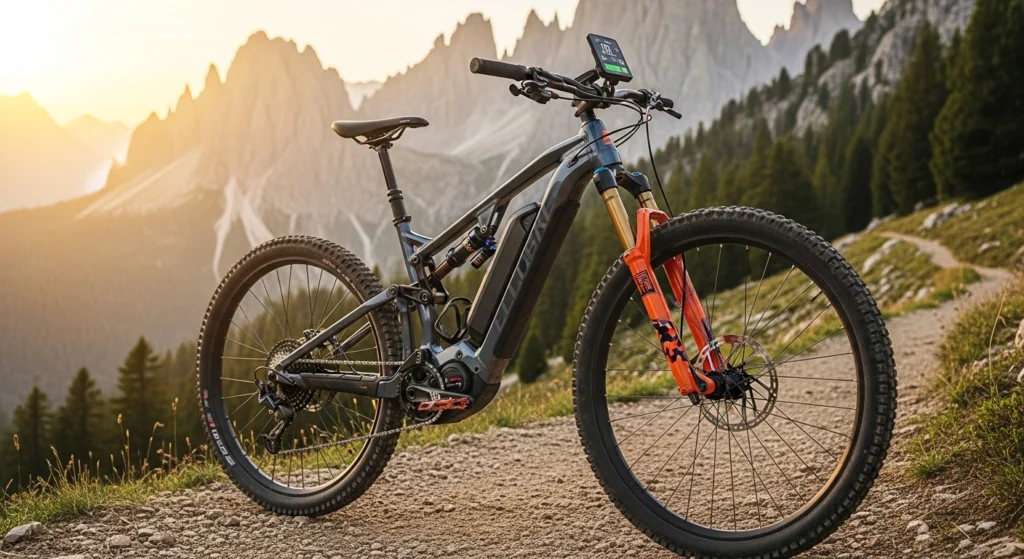
Best electric mountain bike
Choosing the Best electric mountain bike in 2026 isn’t about chasing the highest specs anymore—it’s about how the bike feels when the trail gets unpredictable. Modern eMTBs are smarter, more refined, and designed to work with the rider, not just push them forward. From smoother torque delivery on technical climbs to better balance on fast descents, today’s bikes prioritize control, comfort, and long-term reliability over raw numbers.
In real-world riding—from steep Alpine climbs to muddy forest trails—what matters most is consistency. A great eMTB adapts without constant adjustments, keeps traction where it counts, and stays dependable after months of hard use. With 2026 bringing smarter motor tuning, lighter frames, and longer-lasting batteries, choosing the right bike now means understanding how all these elements come together on the trail—not just on paper.
What Is an Electric Mountain Bike?
An electric mountain bike (eMTB) is an off-road bicycle enhanced with an integrated electric propulsion system that supplements the rider’s pedaling effort.
It does not operate independently.
Pedal input is mandatory.
Motor assistance responds proportionally.
Within the European Union, most legally compliant eMTBs adhere to:
- 250W continuous-rated motor output
- 25 km/h maximum assisted velocity
- Pedal-assist Pedelec configuration
These regulatory parameters ensure safety compliance and trail accessibility across EU member states.
How eMTBs Work
An advanced electric mountain bike incorporates:
- A centrally mounted mid-drive motor unit
- A high-density lithium-ion battery module
- Integrated electronic controller
- Torque and cadence detection sensors
- Digital display interface with assistance modes
When pedaling force is applied, torque sensors measure input intensity. The control unit calculates amplification levels and activates the motor accordingly.
Eco Mode → conservative assistance
Trail Mode → adaptive moderate output
Turbo Mode → maximum torque amplification
This synchronized drivetrain ecosystem delivers seamless hill-climbing support and optimized traction control.
Why Electric Mountain Bikes Are Dominating in 2026
The surge in demand for the best electric mountain bike is supported by measurable consumer adoption trends across Germany, Switzerland, Austria, France, the UK, and the Netherlands.
Primary Growth Drivers:
Enhanced Climbing Efficiency
Steep gradients become manageable and less exhausting.
Increased Riding Radius
Extended mileage without proportional energy depletion.
Broader Accessibility
Encourages participation among older riders and novices.
Performance Conditioning
Improves cardiovascular training while reducing joint strain.
Social Riding Integration
Enables mixed fitness-level group rides.
Electric mountain bikes have transitioned from novelty products to mainstream mobility solutions.
How to Choose the Best Electric Mountain Bike
Selecting the best electric mountain bike requires analytical evaluation across four core domains:
- Battery capacity
- Motor configuration
- Suspension architecture
- Wheel geometry
Let us examine each component with clarity.
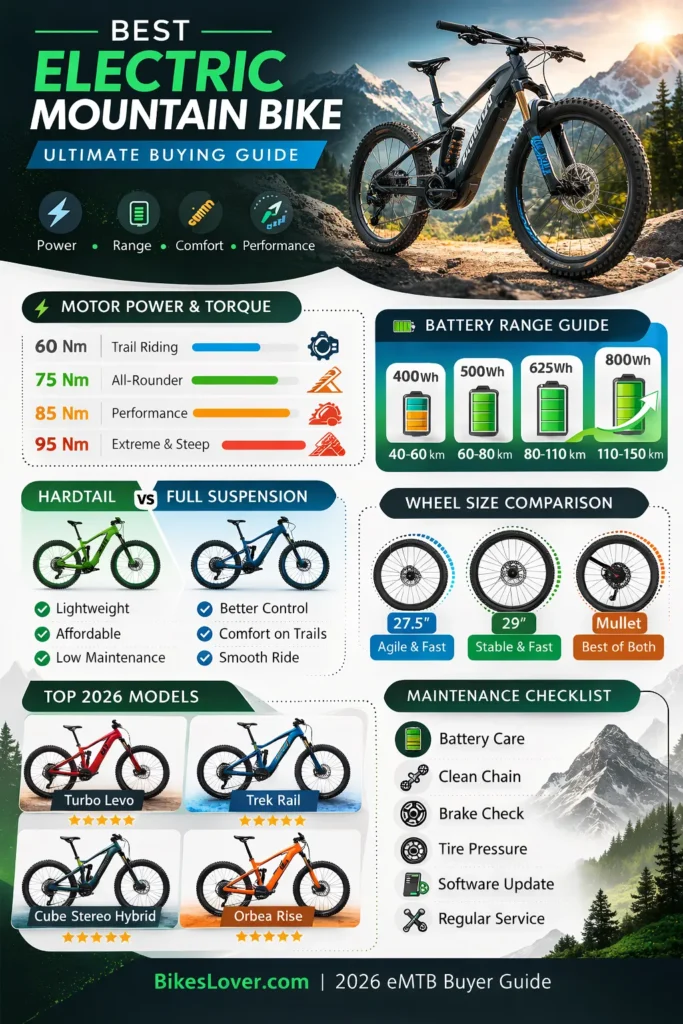
Battery Capacity & Range Analysis
Battery storage is quantified in Watt-hours (Wh) — representing total energy availability.
Higher Wh equals an extended operational range under equivalent conditions.
Battery Performance Table
| Battery Size | Recommended Use | Approximate Range |
| 400–500Wh | Recreational short trails | 40–70 km |
| 600–700Wh | All-day touring | 60–100 km |
| 750–800Wh | Alpine endurance routes | 80–140 km |
Range Variables Include:
- Rider mass
- Elevation gain
- Surface resistance
- Assistance mode
- Climatic conditions
- Tyre rolling resistance
For serious mountainous European riding, 625Wh or above is strategically optimal.
Motor Architecture & Torque Output
Premium eMTBs utilize mid-drive propulsion systems manufactured by:
- Bosch Performance Line CX
- Shimano EP8
- Brose Drive S Mag
- Yamaha PW-X3
Understanding Torque
Torque (Nm) indicates rotational force output.
| Torque Output | Riding Application |
| 60–70Nm | Light trail cycling |
| 75–85Nm | All-mountain versatility |
| 85–95Nm | Technical climbs & steep gradients |
For Alpine or Pyrenean topography, 85Nm+ ensures consistent traction and gradient stability.
Suspension Configuration
Hardtail eMTB
- Front fork suspension only
- Reduced system weight
- Lower acquisition cost
- Minimal maintenance complexity
- Efficient power transfer
Full Suspension eMTB
- Dual shock absorption (front + rear)
- Improved traction retention
- Enhanced downhill composure
- Superior comfort on rock gardens
Professional riders overwhelmingly prefer full-suspension systems for demanding terrain.
Wheel Size & Rolling Dynamics
- 27.5-inch wheels → Agile maneuverability
- 29-inch wheels → Improved rollover capability
- Mullet configuration → Balanced handling
Wheel geometry influences stability, acceleration, and obstacle clearance.
Best Electric Mountain Bike 2026
After multi-source evaluation and rider consensus, the following models demonstrate exceptional capability.
Specialized Turbo Levo Comp
The Specialized Turbo Levo maintains its benchmark status in the global eMTB ecosystem.
Technical Highlights
- 700Wh integrated battery
- 90Nm torque output
- Full suspension linkage
- Mobile application integration
- Carbon or aluminum chassis
European Pricing Estimate
€5,500 – €8,500
Advantages
- Progressive geometry
- Smooth torque curve
- Strong aftermarket support
- Excellent resale valuation
Limitations
- Premium price tier
- Higher curb weight
Trek Rail 9.8
Engineered for enduro-oriented cyclists.
Specifications
- Bosch CX powertrain
- 750Wh battery
- 160mm suspension travel
- Carbon composite frame
Price Band
€6,000 – €9,000
Strengths
- Downhill stability
- Durable frame construction
- Powerful acceleration
Weaknesses
- Elevated price bracket
- Increased overall mass
Cube Stereo Hybrid 140
A strong balance of affordability and mechanical quality.
Core Features
- 625–750Wh battery options
- Bosch motor platform
- Full suspension design
Pricing
€3,500 – €5,500
Benefits
- Competitive pricing
- Reliable drivetrain
- Solid engineering standards
Drawbacks
- Slightly heavier
- Basic control interface
Orbea Rise
Designed for riders prioritizing natural ride sensation.
Key Elements
- Lightweight carbon fiber frame
- 60Nm motor configuration
- 360–540Wh compact battery
Positives
- Reduced weight profile
- Agile trail response
Negatives
- Lower torque ceiling
- Reduced maximum range
Head-to-Head Comparison Table
| Model | Torque | Battery | Suspension | Weight | Price |
| Specialized Turbo Levo | 90Nm | 700Wh | Full | 23kg | €5.5k–8.5k |
| Trek Rail 9.8 | 85Nm | 750Wh | Full | 24kg | €6k–9k |
| Cube Stereo Hybrid | 85Nm | 625–750Wh | Full | 24kg | €3.5k–5.5k |
| Orbea Rise | 60Nm | 360–540Wh | Full | 19kg | €5k–7k |
Hardtail vs Full Suspension
| Feature | Hardtail | Full Suspension |
| Cost | Lower | Higher |
| Comfort | Moderate | Superior |
| Maintenance | Simple | More technical |
| Terrain Suitability | Smooth trails | Aggressive terrain |
Electric Mountain Bike Maintenance Guide
Routine servicing preserves system longevity.
Weekly
- Drivetrain cleaning
- Brake inspection
- Tyre inflation check
Monthly
- Suspension adjustment
- Firmware updates
- Bolt torque inspection
Battery Management
- Indoor storage at 10–20°C
- Avoid total depletion
- Avoid prolonged 100% charge storage
Battery lifecycle expectancy: 4–6 years
European Legal Regulations
EU framework:
- 250W motor limit
- 25 km/h assisted speed
- No registration required
- Helmet strongly advised
Always verify local land access rules.
Pros & Cons
Pros
- Increased climbing efficiency
- Extended endurance
- Inclusive accessibility
- Enhanced riding enjoyment
- Reduced physical strain
Cons
- Higher upfront investment
- Greater overall weight
- Battery replacement cost
- Complex electrical servicing
Who Should Buy the Best Electric Mountain Bike?
Consider an eMTB if:
- You ride through mountainous landscapes frequently
- You desire an extended riding range
- You need assistance on steep gradients
- You seek joint-friendly cycling
- You ride with faster companions
FAQ
A: Choose models with 85–95Nm torque, such as Specialized Turbo Levo or Trek Rail.
A: Usually 4–6 years, depending on use.
A: In most European countries, yes — but always check local rules.
A: Cube Stereo Hybrid offers excellent value in Europe.
A: for moderate rides. For Alpine terrain, choose 625Wh+.
Conclusion
The best electric mountain bike in 2026 isn’t defined by specs alone—it’s defined by how confidently it handles real trails. From powerful full-suspension machines like the Turbo Levo to lightweight options like the Orbea Rise, today’s eMTBs offer something for every rider style and terrain.
If you ride Steep trails, prioritize torque, suspension, and battery size. If you prefer agility and natural feel, consider lightweight models. Either way, investing in the right eMTB can transform your riding experience—making longer, more technical rides not just possible, but enjoyable.
If you’re planning your next upgrade, take time to match the bike to your terrain and riding style—you’ll feel the difference on every climb and descent.
