
Introduction
Best bike lock where you are, whether you are riding a bike in London or touring with an electric bike in Berlin or competing with a carbon fiber road bike in Paris, or just riding a mountain bike in Amsterdam, one thing is for sure about your bike:
Today’s offenders use:
- Industrial bolt cutters
- Hydraulic cutting equipment
- Leverage-based prying tools
- High-torque cordless angle grinders
- Drill attacks and twisting mechanisms
A low-quality lock can be compromised in under 30 seconds.
A premium, high-security lock can dramatically increase resistance time and deter criminals entirely.
Why Choose the Best Bike Lock
Bicycle theft is no longer random. It is organized and data-driven.
Across Europe:
- London reports over 70,000 reported bike thefts annually.
- Amsterdam continues to experience thousands of bicycle disappearances each year.
- Paris and Berlin remain high-risk metropolitan zones.
- E-bike theft rates have surged due to resale profitability.
Electric bicycles are particularly targeted because their market value often ranges between €2,000 and €5,000 — sometimes higher.
Modern criminals
- Prefer cordless grinder attacks
- Identify weak locking practices
- Target thin cables and budget chains
- Scout bikes are parked overnight
- Focus on poorly secured frames
If your lock appears fragile or outdated, your bicycle becomes a preferred target.
Understanding Bike Lock
Before purchasing any lock, you must understand certification standards and independent testing frameworks.
Security ratings determine resistance level under simulated theft conditions.
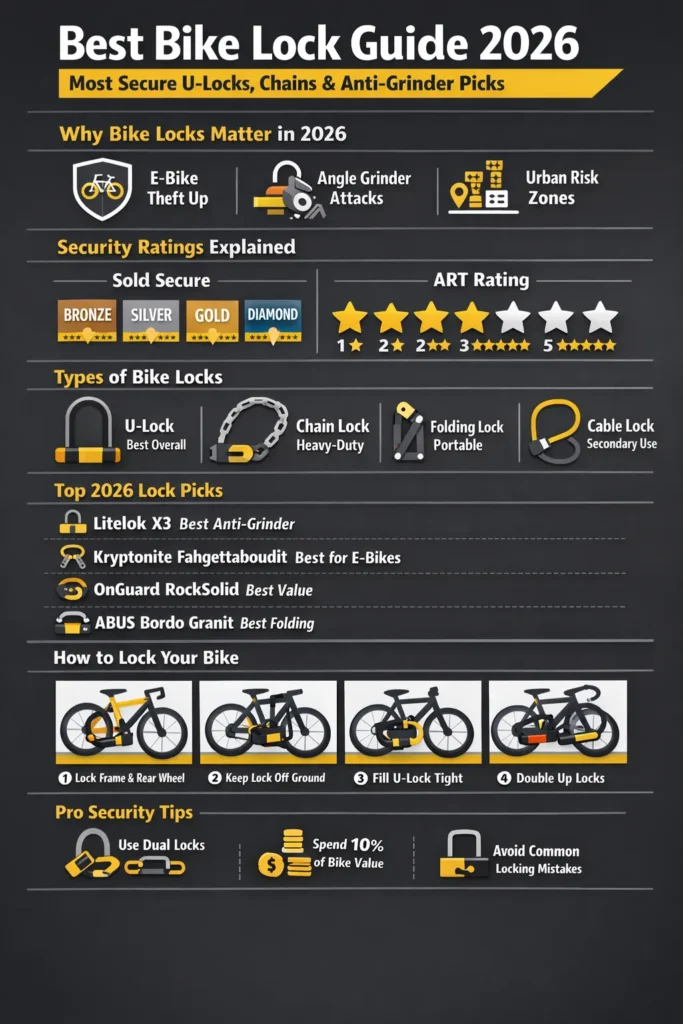
What Is Sold Secure?
Sold Secure is a UK-based independent testing authority that evaluates locks using real-world attack simulations.
They test against:
- Bolt cutters
- Drilling attacks
- Leverage manipulation
- Sustained angle grinder exposure
Sold Secure Rating Levels
| Rating Level | Protection Level | Recommended Use |
| Bronze | Basic deterrence | Low-risk zones |
| Silver | Moderate resistance | Suburban parking |
| Gold | Strong urban protection | Daily city commuters |
| Diamond | Maximum protection | High-theft zones & e-bikes |
Diamond-rated locks are subjected to prolonged grinder exposure and heavy tool stress.
What Is ART Rating?
The ART Foundation is widely recognized across the Netherlands, Germany, and other EU nations.
Many European insurance providers require ART-certified locks.
ART Star System
| ART Stars | Meaning |
| 1–2 Stars | Entry-level security |
| 3 Stars | High security |
| 4 Stars | Very high resistance |
| 5 Stars | Maximum anti-theft protection |
For insurance coverage in many EU regions, ART 3+ is mandatory.
Types of Bike Locks
- Different cyclists require different levels of safeguarding.
- Let’s analyze each lock category with a deeper evaluation.
U-Locks
The U-lock, also known as a D-lock, is considered the gold standard for urban cycling security.
Why U-Locks Are Effective
- Hardened steel shackle construction
- Minimal internal spacing (reduces leverage opportunity)
- High resistance to bolt cutters
- Compact form increases rigidity
- Difficult to twist or pry
Ideal For:
- Urban commuters
- Students
- Road cyclists
- Hybrid bike riders
- Mid-to-high value bicycles
Limitations:
- Restricted flexibility
- Challenging attachment to wide structures
- Heavier than folding locks
For most riders, a Gold or Diamond-rated U-lock represents the optimal balance between portability and protection.
Chain Locks
Chain locks deliver exceptional strength and flexibility.
Advantages:
- Thick hardened steel links (12mm–15mm)
- Ability to wrap around large fixed objects
- Significant visual deterrence
- Suitable for overnight storage
Recommended For:
- E-bikes
- Cargo bicycles
- High-value road bikes
- High-crime districts
Drawbacks:
- Weight (often 3–5 kg)
- Less convenient for daily commuting
If your electric bike exceeds €3,000 in value, a robust chain lock becomes a strategic necessity.
Folding Locks
Folding locks use articulated steel plates connected by rivets.
Benefits:
- Compact folding mechanism
- Easy frame mounting
- Greater flexibility than rigid U-locks
- Ideal for medium-risk scenarios
Best For:
- Café stops
- Office commutes
- Medium-theft cities
Weakness:
- Generally less grinder-resistant than premium D-locks
Cable Locks
Cable locks offer convenience but minimal protection.
Suitable Only As:
- Secondary wheel lock
- Short-term stops in low-risk areas
Not recommended as primary urban protection.
Best Bike Locks
Now we analyze the most secure and reliable bike locks available in 2026.
Best Overall Bike Lock:
The Litelok X3 is engineered specifically for grinder resistance.
Key Attributes:
- Sold Secure Diamond certification
- Barronium composite layered technology
- Advanced anti-cut architecture
- Compact footprint
Ideal For:
- Premium road bikes
- High-end e-bikes
- Major European cities
Advantages:
- Exceptional grinder resistance
- Insurance-compliant
- Compact yet extremely durable
Disadvantages:
- Premium pricing
- Slightly heavier than entry-level U-locks
For maximum anti-angle grinder defense, this lock ranks among the elite.
Best for City Commuters
A cost-effective yet resilient option.
Features:
- Reinforced hardened steel
- Double-bolt locking system
- Gold-rated security
Suitable For:
- Office commuters
- Students
- Mid-range bicycles
Pros:
- Affordable
- Reliable urban deterrent
- Balanced weight
Cons:
- Not fully grinder-proof
Best for E-Bikes
This lock is globally recognized for heavy-duty protection.
Features:
- 14mm six-sided hardened chain links
- Reinforced padlock core
- Sold Secure Gold
Pros:
- Massive deterrent presence
- Extremely tough structure
Cons:
- Heavy mass
Best Folding Lock
- ART-certified
- Compact mounting
- European commuter favorite
Best Budget Lock
- Economical
- Silver-rated
- Suitable for low-risk environments
Quick Comparison Overview
| Lock Model | Type | Security Rating | Weight | Ideal Use |
| Litelok X3 | U-Lock | Diamond | Medium | High-risk cities |
| Kryptonite Fahgettaboudit | Chain | Gold | Heavy | E-bikes |
| OnGuard RockSolid | U-Lock | Gold | Medium | Daily commuting |
| ABUS Bordo Granit | Folding | Gold / ART | Light | Short urban stops |
| Basic Hardened U-Lock | U-Lock | Silver | Light | Budget riders |
How to Choose the Best Bike Lock
Selecting the ideal Lock requires risk analysis, budget planning, and usage patterns.
Assess Theft Risk
Ask:
- Do you park overnight outdoors?
- Is your city classified as high-theft?
- Is your bicycle worth over €1,000?
- Do you own an e-bike?
Higher exposure → Choose Diamond or ART 4–5 certification.
Match Lock to Bike Category
| Bike Type | Recommended Security |
| Commuter | Gold U-lock |
| E-bike | Heavy chain + U-lock |
| Road bike | Lightweight Diamond U-lock |
| Cargo bike | Thick hardened chain |
Apply the 10% Investment Rule
Allocate approximately 10% of your bicycle’s value to security infrastructure.
€500 bike → €50 lock
€2,000 bike → €150–€250 security
€4,000 e-bike → €300+ advanced setup
Preventive investment reduces replacement cost risk.
Implement Dual Lock Strategy
Professional thieves prefer efficiency.
Two locks = increased time + higher noise + greater exposure risk.
Use:
- U-lock for frame anchoring
- Secondary chain or cable for wheels
Complexity discourages theft.
How to Lock Your Bike Properly
Even the most advanced security device fails if used incorrectly.
Correct Locking Process:
- Secure the frame — not only the wheel.
- Lock through the rear triangle when possible.
- Attach to a fixed, immovable structure.
- Keep the lock elevated off the ground.
- Minimize internal lock space to prevent leverage attacks.
Common Errors:
Locking only the front wheel
Using weak signposts
Leaving excessive space inside the U-lock
Placing a lock on the ground
Proper technique increases security effectiveness dramatically.
Bike Theft Trends
Security technology advances — but criminal tactics evolve simultaneously.
Current developments:
- E-bike theft up 30% in the EU
- Increased cordless grinder usage
- Organized theft rings operating across borders
- Insurance companies require higher certifications
If your lock technology is outdated, vulnerability increases.
Maintenance and Longevity Tips
Security hardware requires maintenance.
Best Practices:
- Lubricate the locking cylinder monthly
- Remove debris and moisture
- Avoid prolonged outdoor storage
- Replace compromised units
A corroded lock weakens structural integrity.
Pros & Cons
Benefits:
- Peace of mind
- Insurance compliance
- Strong deterrence
- Long-term financial savings
- Increased resale value protection
Drawbacks:
- Higher upfront cost
- Added weight
- Bulkier profile
However, compared to theft loss, premium protection is rational.
Regional Security Considerations
Different countries prioritize different certifications.
- UK → Sold Secure Diamond
- Netherlands → ART mandatory
- Germany → Heavy-duty chain preference
- USA → U-lock + cable combination
Always confirm local insurance requirements.
FAQs
A1:Sold Secure Gold or Diamond U-lock is ideal for city riding.
A2:Only as secondary locks. They are not safe alone in cities.
A3:Advanced composite locks like Litelok X3 or heavy-duty hardened chains offer the best resistance.
A4:In high-risk areas, dual locking is strongly recommended.
A5:especially if your bike exceeds €1,000 in value.
Final Expert
Selecting the best bike lock in 2026 is not about choosing the most expensive product.
It is about:
- Aligning the protection level with risk exposure
- Safeguarding your investment
- Applying a proper locking strategy
- Meeting insurance standards
- Adapting to evolving theft methods
If you own a high-value e-bike, choose heavy-duty chain protection or advanced anti-grinder Technology. A superior lock protects more than equipment. It protects mobility, independence, and peace of mind. Secure intelligently. Ride with confidence.
