
Introduction
Best bike chain lube, hush noise underfoot, stretch effort further, while sparing your gears from early wear – picking a top-tier lubricant quietly lifts how well your bike works. A smart pick here does more than just slick metal – it shapes every mile.
A bunch of riders spend money on lighter rims, slick rubber, wind-cheating lids, plus digital gear triggers. Yet one part pulls harder than any other – that’s the chain. Wet lube sticks around longer when it rains. On sunny days, dry versions shed dirt better. Wax coatings slip on smooth surfaces, then resist gunk over time. Ceramic mixes add tiny beads that cut friction.
Why Bike Chain Lubricant Matters
Your drivetrain is an integrated mechanical system composed of:
- Chain
- Cassette
- Chainrings
- Derailleurs
Power moves from your legs to the back wheel through linked components. At the core sits the chain. As rotation begins, tiny metal parts – pins, sleeves, and wheels within it – bend and shift without pause.
A few tiny spots of metal touch when there is no oil. That rubbing slows movement way too much.
What Happens Without Proper Lubrication?
If you ignore chain lubrication, you may notice:
- Accelerated chain elongation (often called chain stretch)
- Gear skipping and hesitation
- Grinding noises
- Reduced pedaling efficiency
- Increased wear on cassette teeth
Replacing a chain is relatively affordable. Replacing a cassette and chainrings is significantly more costly.
That is why selecting the best chain lubricant for bikes directly reduces long-term ownership expenses.
Chain Wear Prevention Explained
A high-quality bike chain lube performs four essential functions:
- Minimizes internal friction
- Protects against corrosion and moisture
- Displaces contaminants
- Creates a protective lubrication film
Modern lubricants are engineered using advanced chemistry to optimize viscosity, adhesion, and durability.
When properly applied, the correct lubricant can extend drivetrain lifespan by thousands of kilometers while enhancing pedaling smoothness.
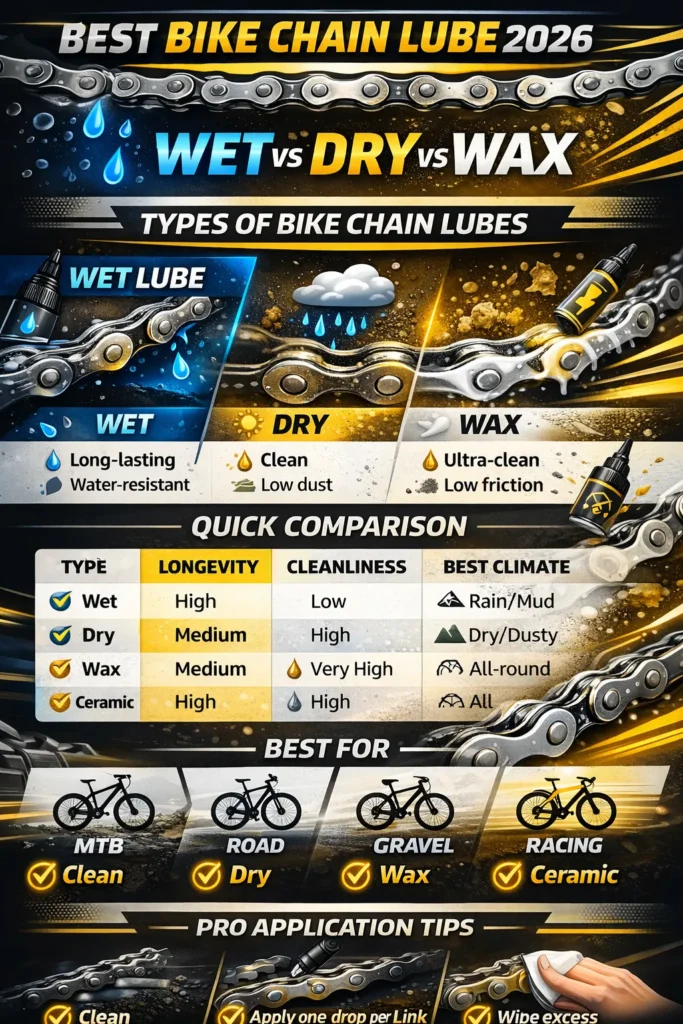
Types of Bike Chain Lubes
Choosing the right lubricant depends on environmental conditions, riding frequency, and terrain type.
Let’s break down each category clearly.
1. Wet Bike Chain Lube
Best For: Rain, mud, damp climates, winter commuting
Wet lubricants are oil-based, viscous, and formulated to resist water wash-off. They form a thicker coating that remains on the chain under heavy moisture exposure.
Advantages:
- Superior rain resistance
- Long-lasting lubrication film
- Excellent rust prevention
Disadvantages:
- Attracts dust and grime
- Requires more frequent cleaning
If you live in the UK, Northern Germany, Belgium, or ride mountain bikes in wet forests, wet lube is usually the most reliable choice.
2. Dry Bike Chain Lube
Best For: Dry roads, warm climates, urban cycling
Dry lubricants are lighter in consistency. They contain a solvent carrier that evaporates, leaving behind a thin dry layer.
Advantages:
- Clean drivetrain appearance
- Reduced dirt accumulation
- Smooth gear transitions
Disadvantages:
- Washes away in heavy rain
- Requires more frequent reapplication
Road cyclists in Mediterranean regions often prefer dry lubricants during summer.
3. Wax-Based Chain Lube
Best For: Performance enthusiasts, meticulous riders
Wax lubricants create a hardened, dry coating around chain components.
Advantages:
- Extremely clean operation
- Quiet drivetrain sound
- Low-friction performance
Disadvantages:
- The chain must be fully degreased before use
- Requires a disciplined maintenance routine
Wax systems are gaining popularity across Europe due to their cleanliness.
4. Ceramic / Advanced Lubes
Best For: Racing, competitive cycling
Ceramic lubricants incorporate microscopic friction-reducing additives.
Advantages:
- Minimal drivetrain resistance
- Enhanced mechanical efficiency
- Performance-focused
Disadvantages:
- Premium cost
- Not necessary for casual riders
These are often used by elite racers and time-trial specialists.
Wet vs Dry vs Wax vs Ceramic
| Type | Best Climate | Durability | Cleanliness | Price Range | Ideal For |
| Wet | Rain/Mud | High | Low | €8–€15 | MTB, winter |
| Dry | Dry/Dusty | Medium | High | €7–€14 | Road, commuting |
| Wax | Mixed | Medium | Very High | €10–€20 | Performance riders |
| Ceramic | All | High | High | €15–€30 | Racing |
Top 6 Best Bike Chain Lube Picks
After reviewing laboratory friction analysis, rider testimonials, and durability testing, these lubricants stand out globally.
1. Muc-Off Bio Wet Lube – Best Overall
A biodegradable, weather-resistant lubricant engineered for demanding conditions.
Features:
- Water-repellent formula
- Eco-conscious composition
- Consistent shifting
Pros:
- Reliable in heavy rain
- Sustainable formulation
- Long service intervals
Cons:
- Can accumulate dust in dry terrain
2. Finish Line Wet Lube – Best for Rain & Winter
Highlights:
- Synthetic oil blend
- Corrosion inhibitors
- Strong adhesion
Pros:
- Excellent winter reliability
- Durable lubrication film
Cons:
- Requires cleaning in dry climates
3. Muc-Off Dry Lube – Best Dry Lube
Pros:
- Clean finish
- Cost-effective
- Ideal for road cycling
Cons:
- Not designed for prolonged rain
4. Squirt Long Lasting Dry Lube
Pros:
- Low contamination
- Quiet mechanical operation
Cons:
- Requires a degreased chain
5. WD-40 Bike All Conditions Lube
Pros:
- Affordable pricing
- Widely available
Cons:
- Average longevity
CeramicSpeed UFO Drip
Pros:
- Extremely low friction
- Used in professional cycling
Cons:
- Premium investment
How to Lube a Bike Chain Properly
Proper technique ensures optimal performance.
Step 1: Clean the Chain
Remove old grease and contaminants using a degreaser.
Step 2: Dry Completely
Moisture weakens lubrication efficiency.
Step 3: Apply One Drop Per Link
Rotate pedals slowly.
Step 4: Allow Penetration Time
Wait 10 minutes before riding.
Step 5: Wipe Excess
Remove outer residue to prevent dirt buildup.
Choosing the Right Lube for Your Riding Style
Road Cycling
Dry or wax-based lubricants are preferred.
Mountain Biking
Wet lubricants provide better protection.
Commuting
All-weather lubes offer convenience.
Gravel Riding
Wax or ceramic reduces dust contamination.
Advanced Drivetrain Maintenance Strategies
- Clean the chain every 200–300 km
- Inspect chain wear monthly
- Replace at 0.5–0.75% elongation
- Avoid mixing lubricant types
- Store indoors during winter
Pros & Cons of Using Proper Bike Chain Lube
Pros
- Extended drivetrain lifespan
- Enhanced shifting precision
- Reduced operational noise
- Improved mechanical efficiency
Cons
- Requires routine maintenance
- Incorrect selection attracts debris
FAQs
A: Without lubrication, friction and wear increase rapidly.
A: Excess lube attracts dirt and creates grinding paste.
A:Dry: 100–200 km
Wet: 200–400 km
Wax: 150–300 km
A: It attracts dirt and damages performance.
A:For racing and efficiency, yes. For commuting, it’s not necessary.
Final Expert
A rainy trail changes everything when picking a lubricant for your chain. Riding hard through mud asks more from the product than smooth paths do. Price matters, sure – but only after weather and how you ride have had their say.
- Downpours across Britain mean slippery grease on tracks
- Dry Europe might mean dry. Or maybe it leans toward wax instead
- Racing → Ceramic
- Daily commuting → All-conditions
Lubricating the chain costs less than replacing the entire drive system.
BikesLover.com exists because real talk about bikes matters. Knowledge lands clearly when it comes straight from experience. Riders everywhere deserve answers that go deep without hype. Truth spreads best through honest details. Clarity wins every time someone picks up a bike.
