
Mountain Bike Size Chart
Selecting the correct Mountain bike size chart is the most essential decision if you want a comfortable, controlled, and enjoyable riding experience. Whether you’re a beginner exploring trails or an advanced rider pushing limits, the size of your bike directly impacts your performance, safety, and overall confidence.
A poorly fitted bike doesn’t just feel awkward—it can lead to serious discomfort and even increase the chances of accidents.
You may experience:
- Reduced pedaling efficiency
- Weak handling and unstable control
- Pain in your back, knees, or wrists
- Increased fatigue on longer rides
- Higher risk of crashes on technical terrain
That’s why this Mountain Bike Size Chart (2026) guide is designed to go beyond basic advice.
Unlike typical guides that rely only on height, this comprehensive resource dives deeper into multiple factors that truly define the perfect fit:
- Rider height
- Inseam measurement
- Frame geometry
- Wheel size
- Riding style and terrain
By the end of this guide, you’ll clearly understand how to choose your ideal MTB size with precision and confidence.
Mountain Bike Size Chart by Height
Height-based sizing is the most common starting point for riders. It provides a general framework to begin your selection process.
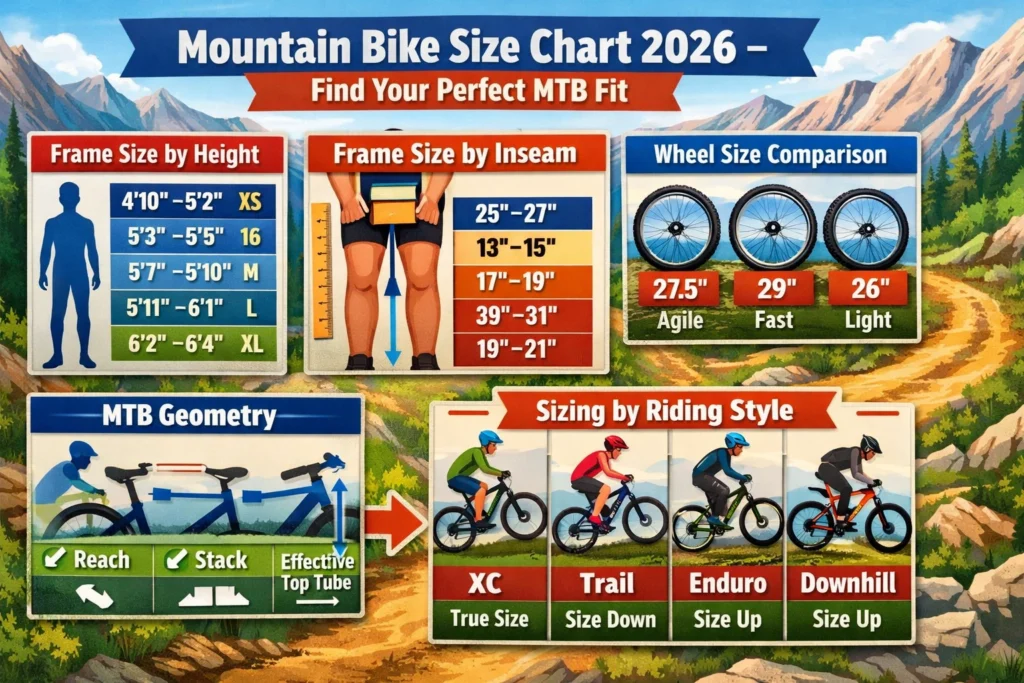
MTB Frame Size by Height
| Rider Height | Frame Size (inches) | Size Label |
| 4’10” – 5’2” | 13–14” | XS |
| 5’3” – 5’6” | 15–16” | S |
| 5’7” – 5’10” | 17–18” | M |
| 5’11” – 6’1” | 19–20” | L |
| 6’2” – 6’4” | 21–22” | XL |
Important Insight: This mountain bike size chart is only a baseline reference.
Most websites stop here—but relying only on height is not enough for achieving an optimal fit.
MTB Size Chart by Inseam
Height alone cannot provide a precise fit because body proportions vary significantly between individuals.
Two riders with identical height may have completely different leg lengths.
This is where inseam measurement becomes crucial.
MTB Size by Inseam
| Inseam Length | Frame Size |
| 25–27” | 13–15” |
| 27–29” | 15–17” |
| 29–31” | 17–19” |
| 31–33” | 19–21” |
Pro Insight: Inseam-based sizing offers a more refined and personalized fit compared to height-only charts used by most competitors.
How to Choose the Right Mountain Bike Size
This section gives you a structured approach to selecting the correct MTB size, helping you outperform most riders in terms of fit and comfort.
Measure Your Height
- Stand upright against a wall
- Remove footwear
- Measure from the floor to the top of your head
Maintain a natural posture without stretching or slouching.
Measure Your Inseam
- Place a book firmly between your legs
- Push it upward to simulate a saddle
- Measure from the floor to the top of the book
This method closely mimics real riding positioning.
MTB Frame Geometry Explained
Modern mountain bikes are no longer sized purely by frame height.
Geometry has become the most influential factor in determining fit.
Reach (Most Important Metric)
Reach refers to the horizontal distance from the bottom bracket to the handlebars.
Why it matters:
- Longer reach = better stability at high speeds
- Shorter reach = improved maneuverability
This is the primary measurement professional riders focus on.
Stack
Stack represents the vertical height from the bottom bracket to the front of the bike.
Effects:
- Higher stack = upright and relaxed riding position
- Lower stack = aggressive and aerodynamic stance
Effective Top Tube (ETT)
The effective top tube measures the distance between the saddle and handlebars.
It influences:
- Rider posture
- Weight distribution
- Overall comfort
Why Geometry Matters More Than Size Labels
Two bikes labeled “Medium” can feel completely different due to geometry variations.
This is where most mountain bike size chart guides fail—they ignore the science behind bike design.
Wheel Size vs Frame Size (27.5” vs 29” vs 26”)
Wheel size significantly affects how a bike performs and fits.
27.5-Inch Wheels
- More responsive and agile
- Easier to handle on tight trails
- Ideal for shorter riders
29-Inch Wheels
- Faster rolling speed
- Better obstacle clearance
- Suitable for taller riders
26-Inch Wheels
- Lightweight and nimble
- Less common today
- Mostly used for specialized riding styles
Wheel Size Comparison
| Feature | 27.5” | 29” |
| Agility | High | Medium |
| Speed | Medium | High |
| Stability | Medium | High |
| Best For | Technical trails | Long-distance rides |
Pro Tip: Smaller riders may find 29-inch wheels harder to control due to increased height.
MTB Sizing by Riding Style
Your riding style plays a major role in determining your ideal bike size.
Cross-Country (XC)
- Focus: Speed and endurance
- Size: True to size
Smaller frames can reduce pedaling efficiency.
Trail Riding
- Focus: Balance and versatility
- Size: Slightly smaller
Provides better control in tight and technical terrain.
Should You Size Up or Size Down?
This is one of the most frequently asked MTB sizing questions.
Size Up If:
- You prefer stability at high speeds
- You ride downhill frequently
- You have longer arms or a torso
Size Down If:
- You ride technical trails
- You prioritize agility and control
- You fall between two sizes
Expert Insight:
If you are unsure, always test both sizes before making a final decision.
Pro Tips for Perfect MTB Fit
Fit Adjustments
- Modify saddle height
- Adjust stem length
- Select proper handlebar widt
Fine-Tuning Comfort
- Set suspension sag correctly
- Adjust saddle position
- Choose appropriate crank length
Buying Tips
- Always test ride when possible
- Check standover clearance
- Plan for future upgrades
MTB Size Selection Process
| Step | Action | Importance |
| 1 | Measure height | Basic |
| 2 | Measure inseam | High |
| 3 | Check charts | Essential |
| 4 | Analyze geometry | Critical |
| 5 | Riding style | Game-changer |
| 6 | Test ride | Final |
Pros & Cons
Pros
- Enhanced comfort and ergonomics
- Better control and handling
- Improved pedaling efficiency
- Reduced injury risk
- Increased riding confidence
Cons
- Requires time and research
- Geometry can be complex
- Variations between brands
FAQ
A: Based on height, inseam, bike geometry, and riding style.
A: It gives a more accurate fit.
A: Size up for stability; size down for agility.
A: No, sizing varies by manufacturer.
A: Only slightly; major size issues can’t be fully fixed.
Final Expert
The modern mountain bike size chart (2026) is no longer just about height—it is a combination of science, biomechanics, and personal preference.
The perfect fit depends on:
- Body measurements
- Frame geometry
- Riding style
- Terrain conditions
