
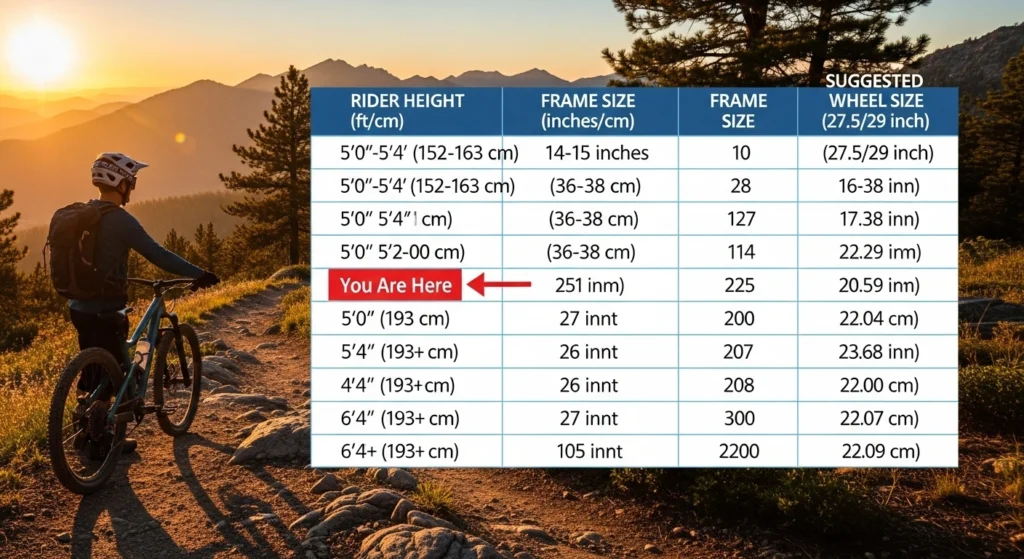
Mountain Bike Frame Size Chart
Selecting the correct Mountain bike frame size chart is one of the most critical decisions any cyclist can make. Whether you are purchasing your very first MTB or upgrading to a modern trail machine, the appropriate size directly influences comfort, handling, efficiency, and overall riding performance.
A poorly sized bicycle can result in:
- Back discomfort and joint strain
- Reduced control and unstable handling
- Inefficient pedaling mechanics
- Increased likelihood of accidents
On the other hand, a properly fitted mountain bike feels intuitive, balanced, and responsive. You can ride longer distances, maintain better control, and enjoy improved confidence on every trail.
Most online resources oversimplify this topic. They rely only on basic height charts, which are no longer sufficient in modern mountain biking. Today’s MTB sizing involves multiple variables, including inseam, reach, stack, and riding preferences.
In this comprehensive 2026 guide, you’ll learn:
- Precise mountain bike frame size charts (height + inseam)
- A step-by-step professional sizing method
- Modern MTB geometry explained in simple terms
- Real-world advice on sizing up vs sizing down
- Wheel size vs frame compatibility insights
- Common sizing errors to avoid
- Expert-level tips for achieving the perfect fit
Let’s break everything down like a true MTB specialist
Mountain Bike Frame Size Chart
This is the most widely used starting reference when choosing a mountain bike frame size.
| Rider Height | Frame Size (inches) | Size Label |
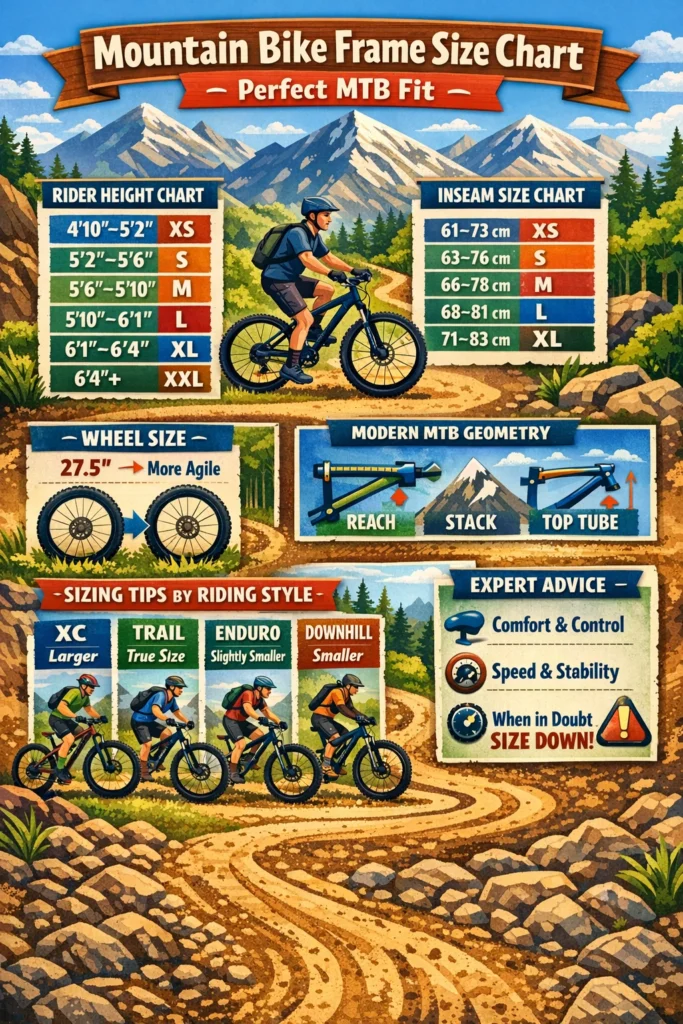
| 4’10”–5’2” | 13–14” | XS |
| 5’2”–5’6” | 15–16” | S |
| 5’6”–5’10” | 17–18” | M |
| 5’10”–6’1” | 19–20” | L |
| 6’1”–6’4” | 21–22” | XL |
| 6’4”+ | 23”+ | XXL |
Key Insight
This chart is broadly adopted across global MTB manufacturers and provides a quick estimation of your suitable bike size.
Limitations of Height-Based Sizing
Height alone is not enough to determine an ideal fit.
Two individuals with identical height can have:
- Different leg proportions
- Varying torso lengths
- Unequal arm reach
That’s why experienced riders always incorporate inseam measurements for improved precision.
MTB Frame Size Chart by Inseam
Your inseam measurement (distance from crotch to ground) provides a more refined and personalized fit.
| Inseam (cm) | Frame Size | Size Label |
| 61–73 cm | XS | Extra Small |
| 63–76 cm | S | Small |
| 66–78 cm | M | Medium |
| 68–81 cm | L | Large |
| 71–83 cm | XL | Extra Large |
Why Inseam Matters
- Ensures proper standover clearance
- Enhances pedaling efficiency
- Minimizes injury risk
- Improves balance and maneuverability
Pro Tip
If your inseam measurement places you between two sizes:
Your riding style should determine your final selection.
How to Choose the Right Mountain Bike Frame Size
Many competitors fail to provide a real methodology. They show charts but lack actionable guidance.
Here is the exact process professionals follow:
Measure Your Height
- Stand upright against a wall
- Remove footwear
- Keep your posture straight
- Measure from the floor to the head
This provides your baseline sizing reference
Measure Your Inseam
- Stand barefoot
- Place a book firmly between your legs
- Raise it gently to simulate a saddle
- Measure from the floor to the top of the book
This gives your true riding dimension
Compare Both Charts
Use both:
- Height chart → Initial estimate
- Inseam chart → Precision adjustment
If both align → ideal match
If they differ → prioritize inseam
MTB Frame Geometry Explained
Modern MTB sizing is no longer based on seat tube length alone.
Understanding geometry is essential.
Reach
Horizontal distance between the bottom bracket and the handlebars
Determines how stretched or compact you feel
- Longer reach = increased stability
- Shorter reach = improved maneuverability
Stack
Vertical height of the front end
Influences the riding posture
- Higher stack = upright and comfortable
- Lower stack = aggressive and aerodynamic
Top Tube Length
Distance between saddle and handlebars
Affects cockpit space
- Longer = extended riding position
- Shorter = compact positioning
Geometry Comparison Table
| Geometry Element | Impact | Best For |
| Reach | Stability & handling | Trail / Enduro |
| Stack | Posture & comfort | Casual riders |
| Top Tube | Fit & stretch | XC riders |
Expert Insight
Modern manufacturers prioritize reach over traditional seat tube measurements.
This is why outdated sizing methods are no longer reliable.
Sizing Up vs Sizing Down – Which is Better?
This is one of the most frequently searched MTB questions.
The answer depends on your riding discipline and terrain preference.
Size Down (Smaller Frame)
Advantages:
- Better control and responsiveness
- Easier handling on technical terrain
- Ideal for beginners
- Increased confidence on trails
Disadvantages:
- Reduced stability at high speeds
- Slightly cramped riding position
Size Up
Advantages:
- Greater stability
- More efficient power transfer
- Better for long-distance rides
- Improved high-speed performance
Disadvantages:
- Less maneuverable
- Harder to control in tight sections
Pro Rule
If you are between two sizes:
Most riders should choose the smaller frame for enhanced control and safety.
Frame Size by Riding Style
Different MTB disciplines require distinct sizing approaches.
| Riding Style | Frame Recommendation |
| Cross Country (XC) | Larger frame |
| Trail Riding | True size |
| Enduro | Slightly smaller |
| Downhill | Smaller |
Global Insight
- European riders → Prefer smaller frames (agility-focused)
- US riders → Prefer larger frames (comfort-focused)
Wheel Size vs Frame Size
Wheel size also influences ride characteristics and compatibility.
27.5-Inch Wheels
- More agile and responsive
- Better cornering ability
- Ideal for shorter riders
- Excellent for technical terrain
29-Inch Wheels (29er)
- Increased stability
- Rolls over obstacles easily
- Suitable for taller riders
- Faster on rough trails
Comparison Table
| Feature | 27.5” | 29” |
| Agility | High | Medium |
| Stability | Medium | High |
| Best For | Short riders | Tall riders |
Common Mountain Bike Sizing Mistakes to Avoid
Even experienced cyclists make these errors.
Relying Only on Height
Always combine height with inseam measurements
Ignoring Reach and Stack
Modern bikes depend heavily on geometry
Choosing a Frame That Is Too Large
Leads to poor handling and increased risk
Quick MTB Size Decision Framework
| Your Situation | Recommended Choice |
| Beginner | Size down |
| Between sizes | Size down |
| Long-distance riding | Size up |
| Technical trails | Size down |
| Racing (XC) | Size up |
Pros & Cons
Advantages
- Enhanced comfort
- Better control
- Improved pedaling efficiency
- Reduced injury risk
- Higher performance levels
Disadvantages
- Requires time and measurement
- Brand variations can be confusing
- May involve trial and adjustment
FAQs
A: Most riders between 5’6”–5’10” typically need a Medium (17–18”), but it’s essential to check your inseam for a more accurate fit.
A: Yes. Inseam measurement gives a safer and more precise fit than overall height.
A: If unsure, size down. Smaller frames give better control and safety, especially for mountain biking.
A: No. Every brand has different frame geometry, so always check the brand-specific sizing chart.
A: Indirectly. Larger wheels generally suit taller riders, which can influence the recommended frame size.
Final Expert
Choosing the correct mountain bike frame size chart is not just about height—it’s a combination of biomechanics, geometry, and riding intent.
To summarize:
Understand your body proportions
Measure both height and inseam accurately
Learn modern MTB geometry (reach, stack, top tube)
Match your bike to your riding style
Consider personal comfort vs performance preference
Golden Rule:
Use height + inseam together
Understand reach and stack
Adjust based on riding style
When in doubt → always size down for better control and safety
