
Introduction
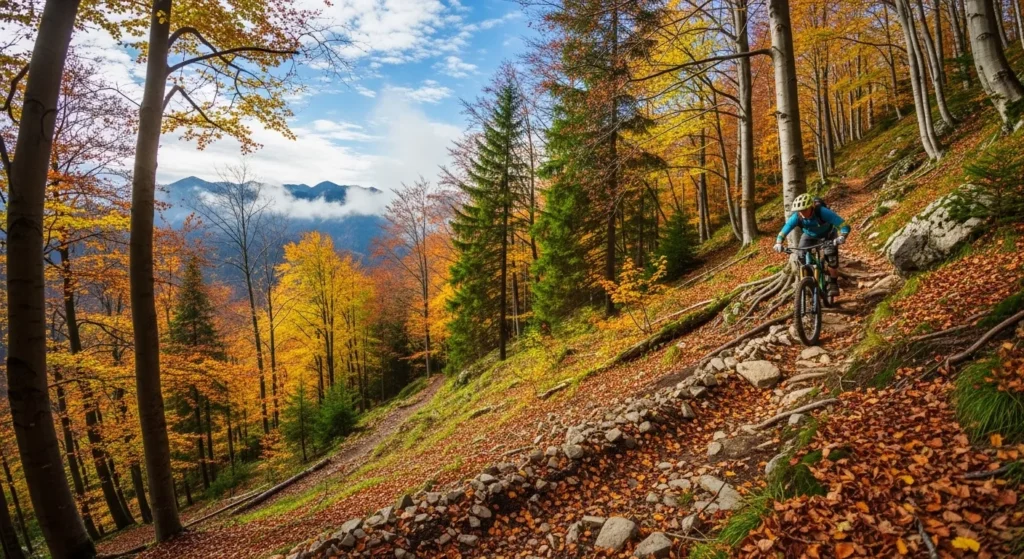
Mountain bike trails and tires bite into soil; the real heartbeat of mountain biking pulses. Speed rips through your bones, sure, yet it is the quiet hum between trees that sticks around after you roll back home. Trails wind like old stories – each turn shaped by weather, rock, time. Freedom shows up when you least expect it, maybe mid-descent, mud flicking past your elbows. Nature does not care if you win, only that you pay attention while rolling through. What keeps folks coming? Not medals. The hush before a jump. A climb, sweating hope into granite. This is where two wheels find meaning.
Not every path through the woods feels the same under tires. One might roll gently beneath trees, wide enough for someone just finding balance on two wheels. Then there’s the kind that drops sharply, littered with boulders and sudden turns meant only for those who’ve spent years mastering control. Jumps appear without warning. The ground falls away fast. Only confidence keeps a rider upright when the trail twists back on itself mid-slope.
What Are Mountain Bike Trails?
Riding mountain bike paths feels different because roots, rocks, and hills shape the way forward. Instead of smooth pavement, wheels meet uneven ground that pushes balance and strength. Bumps and drops appear without warning, changing how fast you move. Elevation climbs slow progress while descents test control. Nature stays in charge here – each turn brings something unpredictable under tires.
- adventure and exploration
- technical riding challenges
- physical endurance
- skill development
- outdoor recreation
Paths appear where feet have walked long enough, yet some take shape through deliberate effort by skilled designers working alongside riders who know the hills. Trails grow quietly under time’s touch, though a few rise from plans drawn with care and hands that dig deep into earth.
Common Surfaces on Mountain Bike Trails
Some trails are smooth, others rough – each changes how your wheels roll. What you’re riding on shapes every pedal stroke and turn.
- Below are the most common surfaces riders experience on mountain biking trails:
- Dirt trails
- Hardpack soil
- Loose gravel
- Roots and rocky sections
- Mud or wet terrain
- San
- Wooden bridges and technical features
- Each terrain requires a slightly different riding technique.
- For example:
- Rocky terrain demands balance and precise bike control
- Loose gravel requires careful braking
Slipping through muck? Grip matters most when spinning pedals without jerks. Rough ground grabs wheels – steady turns keep you moving forward. Loose soil drags under tires unless pressure stays even across each stroke.
Why Mountain Bike Trails Are Important
Foundations shape how we ride, not just dirt routes through trees. What lies beneath every jump, turn, and descent begins long before tires roll.
Well-designed trails allow riders to:
- explore nature and wilderness
- improve technical riding skills
- challenge their limits
- build stamina and endurance
- enjoy outdoor adventures with friends
Few realize how many trails now twist through forests and hills globally. Each path is carved by riders pushing deeper into wild spaces.
Types of Mountain Bike Trails
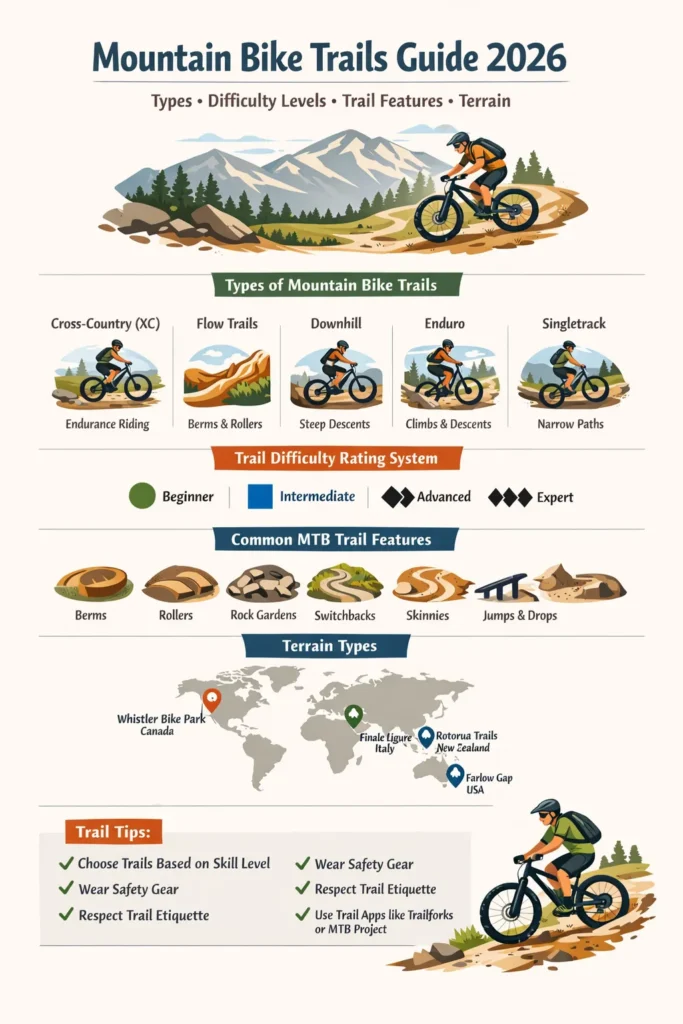
Some paths feel entirely unlike others. One kind pulls you toward speed, another into slow balance moves across rocky ground – each built for how you ride and what you face under tires. Skill shapes them too.
Cross-Country
Cross-country trails are the most widespread and commonly ridden mountain bike trails.
These trails focus on long-distance riding and endurance, rather than extreme technical difficulty.
Key Features
- long trail networks
- moderate climbs and descents
- rolling terrain
- mixed trail surfaces
- natural obstacles
Up a hill, then down – this mix shapes how XC trails boost full-body riding strength. Motion flows one way before reversing, building stamina through change. Not just ascent or descent alone does the work; it’s the shift between that counts. Riding here means muscles adapt fast, never stuck in one rhythm. The constant switch keeps legs learning, heart steady but challenged.
Best Riders for XC Trails
- These trails are ideal for:
- beginner riders
- Fitness-focused cyclists
- long-distance adventure riders
Starting, plenty of first-time mountain bikers stick to cross-country paths – these routes tend to be smoother, simpler to handle. Not much fuss, just steady progress without tricky sections getting in the way.
Flow Trails
A trail built for flow moves you along without snagging on rough patches. Smoothness comes first, so speed feels natural instead of forced. Enjoyment sneaks in when every turn rolls into the next like it was meant to be.
Common Flow Trail Features
- bermed turns
- rollers
- small jumps
- smooth dirt surfaces
Faster movement comes naturally on these paths, linking jumps and berms without stopping. Each section pulls you into the next, like steps in a dance that never halts.
When speed feels right, flow trails answer. Smooth rides live here, linked by rolling shapes that invite motion. Playful bumps and curves connect, guiding those who chase rhythm through the land.
Downhill Trails
Faster descents shape the reason these paths exist. Built only for speed, they twist downward with purpose. Gravity pulls riders through every dip and turn. Each curve meets momentum head-on. Steep drops define their character completely.
Features of Downhill Mountain Bike Paths
- steep slopes
- big jumps
- large drops
- rock gardens
- technical terrain
When speed matters most, steep paths wait. Tough routes suit those who’ve practiced hard – sharp turns demand quick thinking. Rough ground tests balance, while drops reward control. Trails built for experts mix risk with skill. Fast descents attract riders chasing intensity plus precision.
Enduro Trails
Footing through forests, riders tackle climbs like cross-country paths but drop into steep descents that demand control. Trails mix steady uphill stretches with sharp, fast drops requiring nerve and balance.
Downhill races helped spread this way of riding, as athletes tackle one steep run after another.
Typical Enduro Trail Characteristics
- long descents
- rugged terrain
- steep switchbacks
- rock gardens
- technical sections
Finding balance matters most when riding uphill for long stretches. Yet sharp control takes over once the trail points down. Strength builds slowly on climbs, while quick reflexes rule descents.
Singletrack Trails
Riding these paths means you follow one by one, never side by side. A single file flow defines how they work.
Worldwide, folkstend to favor these mountain biking pathsaboveothers.
Singletrack Trail Characteristics
- narrow trail width
- natural landscape
- tight turns
- forest environments.
Footpaths wind between trees, letting cyclists move quietly across wild ground. Nature stays near when wheels follow narrow trails through leafy woods.
Mountain Bike Trail Difficulty Levels
Most mountain biking trail systems use a color-coded rating system to show how challenging a trail is.
This rating system helps riders choose trails that match their experience.
Mountain Bike Trail Rating System
| Rating | Skill Level | Description |
| Green Circle | Beginner | Smooth trail with gentle slopes |
| Blue Square | Intermediate | Moderate climbs and small obstacles |
| Black Diamond | Advanced | Steep terrain and technical features |
| Double Black Diamond | Expert | Extreme terrain and major obstacles |
This system is used in many MTB parks, trail centers, and mountain resorts worldwide.
Beginner Trails
Green trails are designed for new riders.
Features
- smooth dirt surface
- wide trail width
- gentle slopes
- minimal obstacles
These trails help riders practice basic skills like:
- braking
- cornering
- gear shifting
Intermediate Trails
Blue trails introduce more technical challenges.
Features
- moderate climbs
- narrower paths
- roots and small rocks
- tighter corners
These trails help riders develop better bike control and trail awareness
Advanced Trails
Black diamond trails are created for experienced riders.
Features
- steep descents
- rock gardens
- technical obstacles
- lager jumps
Riders must have strong balance, braking skills, and line selection ability.
Expert Trails
These trails represent the highest difficulty level in mountain biking.
Expect
- extremely steep terrain
- massive drops
- technical obstacles
- narrow wooden features
Only expert mountain bikers with advanced skills should ride these trails.
Common Mountain Bike Trail Features
Modern MTB trails include many natural and man-made features that create fun and technical riding challenges.
Berms
Berms are banked corners built into the trail.
They help riders turn smoothly while maintaining speed.
Benefits of Berms
- smoother cornering
- increased speed
- improved trail flow
Rock Gardens
Rock gardens are sections filled with large rocks.
They require riders to:
- Select the correct riding line
- Balance the bike carefully
- control speed
Jumps and Drops
Advanced trails may include:
- dirt jumps
- gap jumps
- drop-offs
These features make trails more exciting but require proper technique and protective gear.
Terrain Types on Mountain Bike Trails
Terrain plays a huge role in how difficult a trail feels.
Even easy trails can become challenging when the terrain is rough.
Common MTB Trail Terrains
| Terrain Type | Characteristics | Difficulty |
| Hardpack | Smooth compact dirt | Easy |
| Loose Gravel | Small loose stones | Moderate |
| Mud | Slippery surface | Challenging |
| Sand | Soft unstable ground | Difficult |
| Rocky Terrain | Large rocks and obstacles | Technical |
Elevation also impacts difficulty.
- Steep climbs require strong pedaling power
- Steep descents demand precise braking control
Best Mountain Bike Trails in the World
Some trails have achieved legendary status among mountain bikers.
These locations attract riders from across the globe.
Farlow Gap – USA
Farlow Gap is famous for being one of the most difficult mountain bike trails in North America.
Highlights
- extremely steep descents
- large rock gardens
- advanced technical sections
This trail is recommended only for expert riders.
Whistler Bike Park
Whistler is considered the most famous mountain bike park in the world.
Features
- massive downhill trail network
- professional jump lines
- trails for all skill levels
Finale Ligure
Finale Ligure is one of Europe’s top enduro mountain biking destinations.
Highlights
- Mediterranean views
- long technical descents
- world-class racing stages
Rotorua Trails
Rotorua offers one of the best flow trail systems in the world.
Features
- volcanic soil trails
- smooth riding surfaces
- scenic forest landscapes
Famous MTB Trail Destinations
| Location | Country | Riding Style |
| Farlow Gap | USA | Extreme technical |
| Whistler Bike Park | Canada | Downhill & flow |
| Finale Ligure | Italy | Enduro |
| Rotorua Trails | New Zealand | Flow & singletrack |
How to Find Mountain Bike Trails Near You
Today, it is easier than ever to discover new mountain biking trails.
Several mobile apps help riders locate MTB trails near me.
Best Apps for Finding MTB Trails
| App | Features |
| Trailforks | Detailed trail maps |
| MTB Project | Community trail database |
| Strava | Popular routes & heatmaps |
These apps provide:
- GPS trail maps
- difficulty ratings
- rider reviews
- photos and route descriptions
Using these tools makes it simple to discover hidden trails anywhere in the world.
How to Choose the Right Mountain Bike Trail
Selecting the correct trail is essential for safety and enjoyment.
Important Factors
- trail difficulty rating
- distance and riding time
- elevation gain
- terrain type
- weather conditions
Beginners should always start with short green trails before moving to harder routes.
Mountain Bike Trail Safety Tips
Mountain biking is fun, but safety should always come first.
Essential Safety Tips
- always wear a certified helmet
- carry basic repair tools
- Check trail conditions before riding
- ride within your skill level
- stay hydrated
Important Gear to Carry
Riders should carry:
- spare tube
- mini pump
- multitool
- water bottle
- small first aid kit
Good preparation makes mountain biking safer and more enjoyable.
Mountain Bike Trail Etiquette
Trail etiquette ensures that trails remain safe and accessible for everyone.
Basic Trail Rules
- yield to hikers
- yield to uphill riders
- Control your speed
- Stay on marked trails
- respect wildlife
Responsible riding protects trail access for future generations.
Pros and Cons
Pros
exciting outdoor adventure
improves physical fitness
builds technical riding skills
connects riders with nature
Many trail types are available
Cons
risk of crashes or injuries
weather affects trail conditions
Some trails require travel
occasional trail closures
Despite these challenges, mountain biking remains one of the most rewarding outdoor sports.
FAQs
A: Green-rated trails are best for beginners because they have smooth terrain, gentle slopes, and minimal obstacles.
A: Double black diamond trails are the most difficult and include steep terrain, large drops, and technical rock sections.
A: A flow trail is designed with berms, rollers, and jumps that allow riders to maintain smooth speed and rhythm.
A: Mountain bike trails can range from 1 mile to over 50 miles, depending on the trail network.
A: MTB trails can be risky if riders attempt trails above their skill level. Wearing protective gear and choosing the correct trail difficulty greatly reduces risk.
Final Verdict
Mountain bike trails are the true heart of mountain biking.
Starting slow on woodland tracks or diving into steep descents – every path shapes how you ride. Trails shift the feel under your wheels, whether gentle or sharp.
Whentrailsshowwhatkindofgroundtheyhave, howtoughtheyare, and whatobstaclesappear, itbecomeseasiertopickonethatfitsyourability. A rider who knows these details can move ahead without guessing. Each path tells a story through its surface, slope, and layout. Matching those traits to experience keeps things smooth. Routes speak louder when you listen closely to their shape and texture.
